
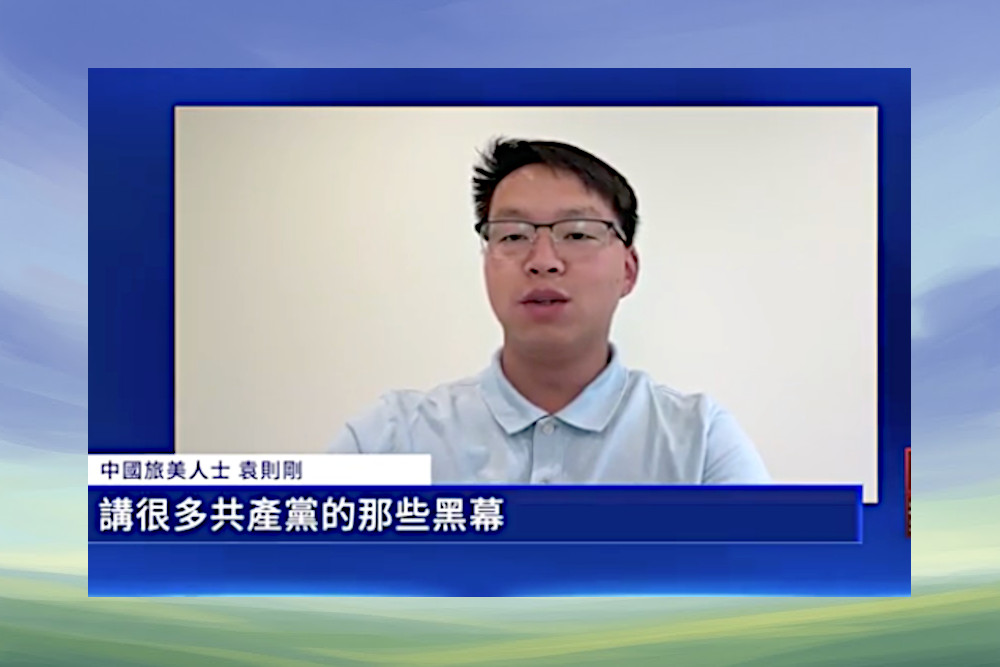
In late March 2023, Yuan Zegang arrived in the United States, marking the end of a grueling, month-and-a-half-long journey that took him on foot through more than a dozen countries. Originally from Guizhou Province, China, Yuan was once a staunch believer in Chinese Communist Party (CCP) propaganda — a so-called “little pink,” a term used to describe young nationalists who fervently defend the regime online. Today, he has become a vocal anti-communist activist on American soil and a member of the China Democracy Party, openly declaring his willingness to “sacrifice himself” for a democratic China.
A youth shaped by propaganda
“I was a little pink from a young age, thoroughly brainwashed by the Communist Party. I loved my country, and I thought that meant loving the Party,” recalled 35-year-old Yuan Zegang in an interview with The Epoch Times. Born into a family of farmers, Yuan Zegang spent many years in China’s construction industry, building high-rise apartments and driving trucks. Despite a difficult life, he took pride in his hard work and deeply believed the CCP’s patriotic messaging.
At the time, he frequently posted extreme nationalist comments on platforms like Douyin (China’s version of TikTok) and Twitter. “I used to curse the United States, Japan, Taiwan, and wealthy Chinese immigrants who had moved overseas. I thought they were traitors,” he said. Yuan Zegang didn’t realize there was a difference between the Party and the nation — he equated patriotism with loyalty to the CCP. He was prepared to defend it at all costs, even if it meant blindly opposing the West.
His views were applauded by friends, family, and the online community. “Everyone encouraged me. They thought that was how a ‘real’ Chinese person should behave,” he said.
Scaling the firewall and seeing the truth
Yuan Zegang’s transformation began in 2016, when, at the age of 26, a coworker introduced him to ways of circumventing China’s internet censorship — a process known as “climbing the wall.” For the first time, he was able to access information from outside the Great Firewall.

“At first, I didn’t believe it. A colleague told me about the dark side of the Communist Party, and I thought it was impossible,” he said. “But I kept watching videos and reading articles, and slowly I started to believe. I realized the Party really was evil.”
Speaking out came with consequences. His friends and family, still immersed in CCP propaganda, began treating him as a traitor. He also came under scrutiny from authorities. “Police called me and told me to stop posting critical comments. In China, your online activity is tied to your real identity, so they can find you easily.”
Yuan Zegang had used his social media accounts to speak out against corruption, poorly built infrastructure, and the government’s disregard for people’s lives. He was repeatedly warned to delete his posts. “Eventually, I started using more indirect language to avoid being censored.”
A painful farewell to China
The turning point came after the death of Yuan’s parents, both of whom had suffered from chronic illnesses. The burden of medical expenses was entirely borne by the family. “We spent everything trying to save them, but the government offered no help. Eventually, they both passed away. I was devastated,” he said. “That’s when I completely lost hope in the regime and decided to leave China for good.”
After reaching the United States in 2023, Yuan Zegang joined the China Democracy Party in February 2024. By July, he had become director of the Los Angeles Regional Committee’s Action Department. “I’ve been actively organizing anti-communist protests, especially outside the Chinese Consulate, and raising awareness in the Chinese-American community,” he said. Yuan Zegang also formally renounced his CCP affiliations.
His activism has had consequences back home. “My brother and his family have been repeatedly harassed by the authorities. Their phones are checked, and they no longer dare to contact me.”
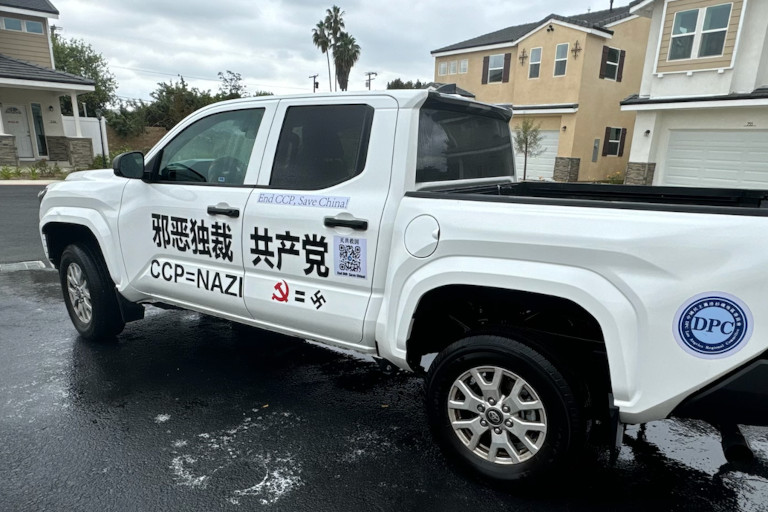
To make his stance even more visible, Yuan Zegang bought a truck on July 1, 2024, and decorated it with bold Chinese and English slogans like “Destroy the Communist Party and Save the Nation” and “Down with the CCP.” He said: “Very few people dare to display slogans like this, but many people — both Westerners and Chinese — have shown support. When I drive around, people give me a thumbs-up almost every day.”
Calling on others to wake up
When asked how he views young nationalists still loyal to the CCP, Yuan Zegang was empathetic. “I understand them completely. They can’t access outside information — just like I couldn’t back then. They’re not bad people. They’re just misled because the truth is blocked.”
But he also offered a warning: “If most young people continue down this path, there’s no future for China.” He believes the Great Firewall and Internet censorship are the biggest obstacles preventing people from waking up to reality.
“I just want to tell them: don’t be as foolish as I was. I was once ready to die for the Party. Now, I’m willing to give my life for democracy.”
Reflecting on the difference between the systems in China and the U.S., Yuan Zegang said plainly: “The United States is a country that puts people first. It cares for the vulnerable. China, on the other hand, is a society where privilege rules. Ordinary people have no freedom of speech and no hope.”
Yuan Zegang’s evolution from a proud little pink to a courageous advocate for democracy is more than a personal journey — it mirrors the inner struggle of a generation caught between lies and truth, still seeking a way forward.
Translated by Patty Zhang
Follow us on X, Facebook, or Pinterest
