
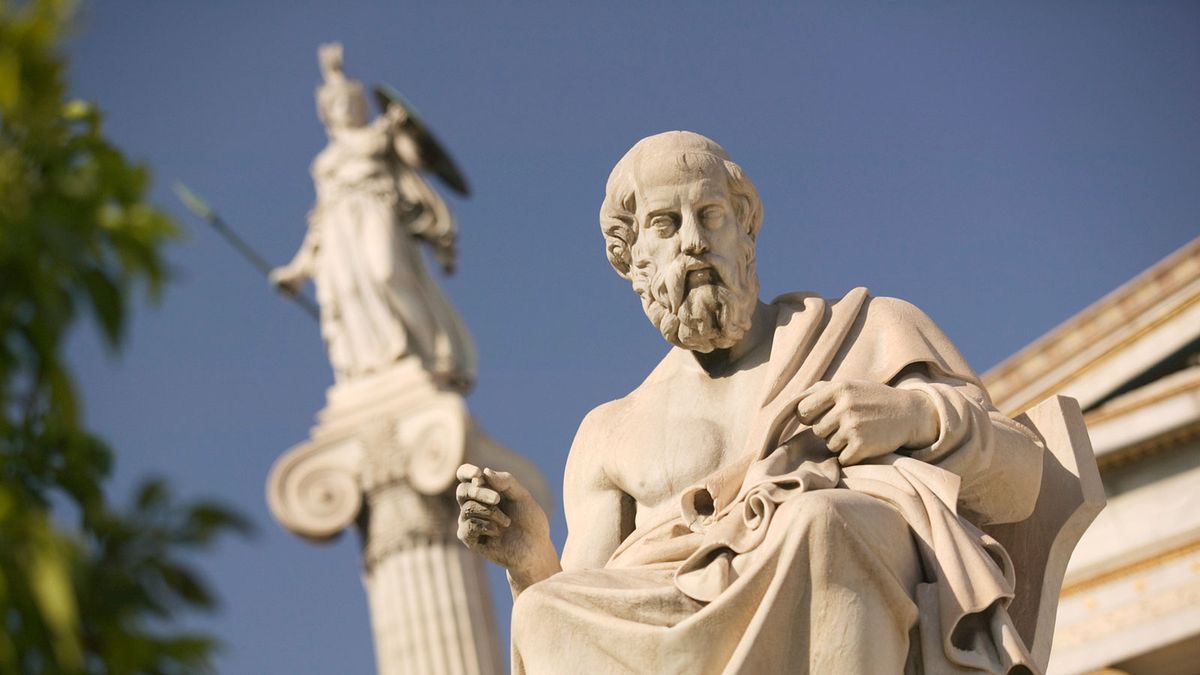
Imagine a young poet in ancient Athens, burning his own manuscripts. At the age of 20, after a single encounter with the Greek philosopher Socrates, a man named Aristoklis abandoned everything he thought he knew about his future. That young poet would become Plato, one of history’s most influential philosophers, whose life and works continue to shape how we think about truth, virtue, and the good life more than 2,400 years later.
We live in a time of extraordinary access to information, yet many people feel a growing hunger for genuine wisdom, the kind that helps us understand ourselves and live with greater purpose. This is precisely what the Greek philosopher Plato (427-347 B. C.) devoted his entire life to exploring. His philosophy was never meant to gather dust in libraries. It was forged through personal loss, years of wandering, and a relentless search for truth that took him across the ancient world.
Whether you are encountering this ancient Greek philosopher for the first time or revisiting his teachings, this biography of Plato goes beyond dates and facts. It explores the remarkable story of his life and works, his greatest philosophical ideas, and seven timeless lessons that remain surprisingly practical today.
The remarkable life of Plato
Plato was born in 427 B. C. in Collytus, a district of Athens, into one of the city’s most distinguished families. His father, Ariston, traced his lineage to the ancient Athenian king Kodros. His mother, Perictione, was a descendant of Solon, the great lawgiver who laid the foundations of Athenian democracy. He had two brothers, Glaucon and Adeimantus, both of whom would later appear as characters in his philosophical dialogues.
Born Aristoklis, he was renamed Plato during his teenage years, reportedly because of his broad forehead and wide-set build. As a child of Athenian nobility, he received an exceptional education. Reading and writing were taught by Dionysius, gymnastics by Ariston the Argeios, and music by Akragantinos Metellos. He studied philosophy, music, poetry, and athletics, developing into a well-rounded young man who initially set his sights on becoming a poet.
He was also influenced by Kratylos, a follower of the philosopher Heraclitus, who introduced him to ideas about the constantly changing nature of reality. But even with all these teachers, Plato’s true education had not yet begun. That would come through a meeting that would alter the course of his entire life.
At the age of 20, Plato encountered the man known simply as the “Man of Athens,” Socrates. In that single meeting, something shifted permanently within him. The young poet who had been composing verses and dreaming of literary fame felt the pull of a deeper calling. According to tradition, Plato destroyed his early poetic works and devoted himself entirely to philosophy.
What was it about Socrates that so profoundly transformed this young aristocrat? Socrates did not lecture. He asked questions. He led his students through dialogue to examine their own assumptions, beliefs, and values. For Plato, this was a revelation. Here was a method not for accumulating facts, but for discovering truth through honest self-examination.
The bond between teacher and student became one of the most significant relationships in the history of human thought. The wisdom of Socrates would become the foundation upon which Plato built his own philosophy. But this deep bond also meant that Plato’s greatest loss was still ahead of him.
Plato and Socrates: A bond beyond death
Plato’s early ambitions were likely political. Growing up in Athens during a turbulent period, he witnessed both oligarchy and the restoration of democracy. He quickly developed an aversion to the violence and corruption that plagued the city’s politics, and he eventually concluded that there was no place for a truly conscientious person in Athenian government.
Then, in 399 B. C., the unthinkable happened. Socrates was sentenced to death, a legal consequence of asking the deep political and philosophical questions that challenged conventional thinking. The man who had taught Plato everything about seeking truth was executed by the very democracy that was supposed to value free thought.
The loss was devastating. Plato, along with other followers of Socrates, fled Athens for the city of Megara. He was roughly 30 years old. The grief of losing his mentor did not break him, however. Instead, it became the catalyst for everything that followed. The young man who had once destroyed his poetry now began writing the philosophical dialogues that would preserve Socrates’ teachings for all time, and expand upon them in ways that would transform Western thought forever.
There is something deeply human in this story. Many of us know what it means to lose a teacher, a mentor, or someone whose guidance shaped who we are. Plato channeled that loss into creation, turning personal sorrow into a gift that has lasted millennia.

Plato’s travels and the search for wisdom
After leaving Athens, Plato spent roughly 12 years traveling across the ancient world, seeking knowledge from every tradition he could find. From Megara, he went to Cyrene in North Africa, where he studied geometry. He then traveled to Egypt, where ancient wisdom traditions offered perspectives far different from the Greek philosophical schools he already knew.
He continued to Italy, where he studied with the Pythagoreans, a community devoted to mathematics, music, and mystical teachings about the harmony of the universe. From Italy, he went to Sicily, where he befriended the Greek politician Dion and was invited by Dionysius the Elder to bring philosophical principles to governance.
This political experiment ended badly. When Plato attempted to convince the tyrant Dionysius about the principles of justice that should guide the exercise of power, Dionysius responded by having Plato sold into slavery. Plato was eventually freed, reportedly ransomed with a collection of silver coins.
These years of wandering were far from wasted. Like seekers throughout history, from Buddhist monks traversing Asia to Confucian scholars traveling across China, Plato understood that wisdom often requires leaving the familiar behind. His travels enriched his philosophy with insights from diverse cultures and deepened his understanding of mathematics, governance, and the nature of the soul.
The Academy: The world’s first university
In 387 B. C., Plato returned to Athens and founded the Academy, a school of philosophy named after the nearby Temple of the hero Akadimos. It was, by many accounts, the first institution of higher learning in the Western world. At the Academy, Plato taught philosophy, mathematics, astronomy, and the art of dialectic, the method of rigorous dialogue that Socrates had pioneered. Students came from across the Greek world to study, debate, and pursue truth together. The Academy was not merely a place to absorb information. It was a community dedicated to the transformation of the whole person through the pursuit of wisdom.
Among those students was a young man named Aristotle, who would study at the Academy for 20 years before becoming one of history’s greatest philosophers in his own right, eventually serving as tutor to Alexander the Great. The Academy continued to operate for nearly 1,000 years, from its founding in 387 B. C. until A.D. 529. Plato himself remained there for the rest of his life. In 347 B. C., at approximately 80 years old, it is believed that Plato died peacefully in his sleep. He was buried at the Academy where he had spent his final decades teaching and writing.
Plato’s greatest works and ideas
Plato wrote approximately 36 philosophical works, nearly all of them in the form of dialogues. Among them, The Apology of Socrates preserves Socrates’ defense at his trial, The Symposium explores the nature of love, and The Republic describes the ideal state governed by wisdom. All of these works, apart from The Apology, take the form of interactive conversations, a literary style that reflected Plato’s belief that truth emerges through dialogue rather than monologue.
‘The Republic’: Wisdom as the foundation of a good society
The Republic is widely considered one of the most influential philosophical texts ever written. In it, Plato imagines a society governed by philosopher-kings, leaders whose authority comes not from wealth or military power, but from wisdom and the pursuit of justice.
At the heart of The Republic is a deceptively simple question: What is justice? Plato’s answer unfolds across the entire work, arguing that justice in a society mirrors justice within the individual soul. A just person, like a just city, is one where reason governs, spirit supports, and desire is properly directed. This vision remains remarkably relevant. In a world that often measures leadership by power and wealth, Plato’s insistence that true authority belongs to those who love wisdom offers a profound challenge to our assumptions.

via Dreamstime)
The Allegory of the Cave: Breaking free from illusion
Perhaps Plato’s most famous teaching is the Allegory of the Cave, found in Book VII of The Republic. Imagine prisoners who have spent their entire lives chained inside a dark cave, facing a blank wall. Behind them, a fire casts flickering shadows of objects onto the wall. For these prisoners, the shadows are the only reality they have ever known.
One prisoner breaks free, turns around, and sees the fire. He stumbles out of the cave into the sunlight, where he discovers the real world for the first time. At first, the brightness is overwhelming. But gradually, his eyes adjust, and he begins to see things as they truly are.
Plato’s message is direct: Most of us spend our lives watching shadows and mistaking them for reality. True education means turning the soul around, away from illusion and toward the light of genuine understanding. This teaching feels especially relevant in an age of constant information, where we are surrounded by images and opinions that may or may not reflect deeper truths.
Interestingly, many Eastern philosophical traditions describe a strikingly similar insight. In Hindu philosophy, the concept of maya suggests that the material world is an illusion, obscuring a deeper reality. In Buddhism, the path to enlightenment involves seeing through the constructed nature of ordinary perception. Plato’s cave and these Eastern traditions, developed independently across vast distances, point toward the same fundamental human challenge: learning to see clearly.
The Theory of Forms: Seeking higher truth
Plato proposed that the physical world we see, touch, and measure is not the deepest level of reality. Behind every imperfect, changing object in the material world exists a perfect, unchanging Form, an ideal template of which physical things are merely shadows or copies.
A beautiful flower eventually wilts, but the Form of Beauty itself is eternal. A just act may be imperfect, but the Form of Justice is absolute. For Plato, the goal of philosophy was to train the mind to perceive these higher realities through reason, moving beyond the senses to grasp the unchanging truths that underlie all existence.
This idea carries a spiritual dimension that resonates deeply with seekers across cultures. The intuition that there is something more real, more beautiful, and more true beyond what our ordinary senses can perceive is a thread that runs through traditions worldwide.
Plato’s teachings on the soul and self-mastery
Central to Plato’s philosophy is his understanding of the human soul. He described the soul as having three parts: reason (our capacity for wisdom and truth), spirit (our sense of courage and honor), and desire (our appetites and physical drives). A well-lived life, according to Plato, is one where these three parts work in harmony, with reason guiding, spirit supporting, and desire properly channeled. When desire or unchecked emotion overthrows reason, the soul falls into disorder, and suffering follows. This is why Plato declared that “for a man to conquer himself is the first and noblest of all victories.”
Plato also taught that the soul is immortal, existing before birth and continuing after death. He believed that learning is not truly the acquisition of new information, but a process of remembering what the soul already knows from its existence in the realm of the Forms.
This emphasis on self-cultivation and inner harmony finds a remarkable parallel in Chinese philosophy. Confucius, who lived roughly a century before Plato, similarly taught that the path to a good life begins with cultivating one’s own character. The Confucian ideal of ren, or benevolence, rooted in self-discipline, echoes Plato’s vision of the soul governed by reason. Meanwhile, Laozi’s teaching of wuwei, effortless action aligned with natural harmony, offers a complementary Eastern perspective on the same fundamental question Plato wrestled with: How should a person live?
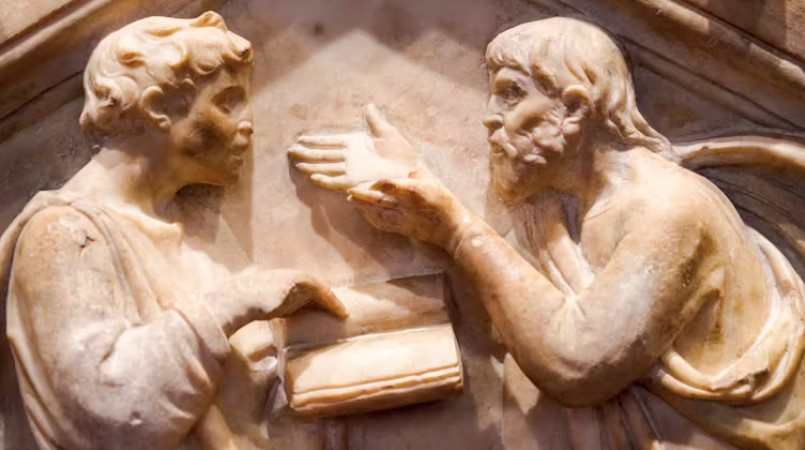
East meets West: Plato, Confucius, and the search for virtue
One of the most fascinating dimensions of ancient philosophy is how thinkers separated by vast distances arrived at strikingly similar conclusions about virtue, wisdom, and the good life.
Plato and Confucius never met. They lived in different centuries, spoke different languages, and built their philosophies within entirely different cultural frameworks. Yet both believed passionately that education is the most powerful force for human transformation. Both insisted that moral character matters more than wealth or social status. Both taught that wisdom, not power, should be the foundation of good leadership. And both devoted their lives to creating institutions of learning, Plato with his Academy and Confucius through his lifelong teaching practice.
As one cross-cultural study published in Humanities and Social Sciences Communications noted, while Western philosophy has emphasized logic and systematic argumentation, and Chinese philosophy has favored intuitive wisdom and harmony with natural patterns, both traditions ultimately aim at the same destination: understanding truth and discovering how to live a meaningful life.
The parallels extend to their students as well. Just as Plato’s greatest student, Aristotle, carried his teacher’s legacy forward into new territories, Confucius’s disciples preserved and expanded his teachings in The Analects, a collection of wisdom that has guided millions across two and a half millennia. These connections remind us that the deepest human questions, Who am I? What is a good life? How should we treat one another?, transcend any single culture or era.
Seven life lessons from Plato that still matter today
Plato’s philosophy was never abstract for its own sake. It was always aimed at helping people live better, more examined, more purposeful lives. Here are seven of his most enduring lessons.
- Know yourself. Plato inherited from Socrates the conviction that self-knowledge is the beginning of all wisdom. “The unexamined life is not worth living,” Socrates declared at his trial, and Plato spent his career showing how honest self-reflection leads to genuine growth.
- Master yourself. “For a man to conquer himself is the first and noblest of all victories.” Before you can lead others or change the world, Plato believed, you must first bring your own desires, fears, and impulses into harmony with reason.
- Seek truth beyond appearances. The Allegory of the Cave teaches us to question our assumptions. The shadows on the wall may feel real, but there is always a deeper reality worth seeking. In an age of information overload, this lesson has never been more relevant.
- Education transforms the whole person. For Plato, learning was not about memorizing facts. It was about awakening the soul to truths it already carries within. True education changes not just what you know, but who you are.
- Balance is the key to a good life. Plato’s vision of the harmonious soul, where reason, spirit, and desire work together rather than against each other, is essentially a philosophy of balance. Excess in any direction leads to disorder.
- Small, consistent effort creates lasting change. Plato did not teach shortcuts. His Academy was a place of lifelong learning and daily practice. Wisdom, like physical fitness, comes not from a single dramatic effort but from steady, patient dedication over time.
- Wisdom requires courage. In the Allegory of the Cave, the freed prisoner does not simply enjoy the sunlight for himself. He returns to the darkness to help free others, even though they may resist and ridicule him. True wisdom, Plato teaches, always calls us to share what we have learned.
Plato’s most inspiring quotes
Plato’s words have echoed across centuries because they speak to experiences every person recognizes. Here are some of his most powerful observations, each one a small window into a larger philosophical vision.
- “You can discover more about a person in an hour of play than in a year of conversation.” Watch how someone behaves when they are relaxed and unguarded, and you will see their true character more clearly than in any formal exchange.
- “Justice means minding one’s own business and not meddling with other men’s concerns.” True justice begins with taking responsibility for your own life and conduct before judging others, an insight that resonates with Confucius’s teachings on character and judgment.
- “We are twice armed if we fight with faith.” Conviction and inner strength multiply our capacity to face challenges. Those who believe in their cause possess a power beyond physical resources.
- “He who commits injustice is ever made more wretched than he who suffers it.” Doing wrong harms the person who does it more deeply than the person who endures it, because injustice corrupts the soul itself.
- “For a man to conquer himself is the first and noblest of all victories.” Self-mastery stands above every external achievement. The greatest battle is always the one within.
- “The measure of a man is what he does with power.” Character reveals itself most clearly in moments of authority and influence, when no one can compel you to act justly except yourself.
The enduring light of Plato’s wisdom
More than 2,400 years after Plato walked the groves of the Academy, his questions remain our questions. How do we tell truth from illusion? How do we live with justice and integrity? How do we cultivate the wisdom to lead ourselves and serve others? What makes this philosopher’s life and works so enduring is that they were never merely theoretical. Plato’s philosophy grew from a real life marked by loss, travel, learning, and devotion to something larger than himself. His teachings invite us not just to think differently, but to live differently, to examine our assumptions, to seek harmony within ourselves, and to approach each day as an opportunity for growth.
In the spirit of Plato’s own words, the power of choice lies in your hands. What aspect of your life might benefit from a little more self-examination?
Follow us on Twitter, Facebook, or Pinterest
