
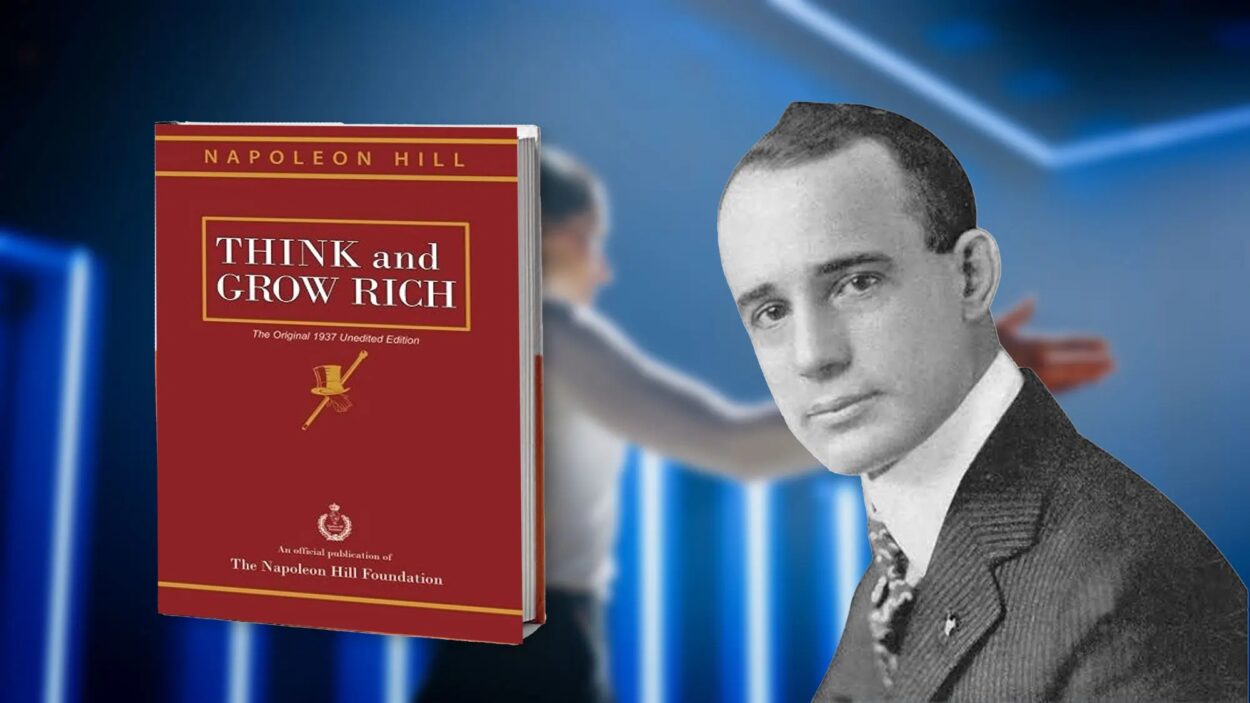
The following is an interview with Andrew Carnegie, known as the “Steel King,” conducted in Pittsburgh in 1908.
Night had fallen, and the streets were silent. A 26-year-old reporter, unknown to Napoleon Hill, clutched his notebook tightly as he slowly stepped into a grand mansion. His heart raced with a mix of excitement and anxiety — for that day, he would be interviewing none other than the famed and highly successful “Steel King,” Andrew Carnegie.
By the fireplace sat an elderly man with white hair, quietly resting on the sofa. The firelight danced across his deeply lined face, lending him an air of mystery. Hill thought this would be just another interview filled with catchy quotes and worldly wisdom. As always, he prepared to dig out some “shining” material from this industrial titan.
To his surprise, however, the interview turned out to be dull and uninspiring. Carnegie seemed distracted, his answers vague and indifferent. Hill grew disappointed and was about to take his leave.
The 20-year pact
At that moment, Carnegie suddenly looked up at him, as if waiting for precisely this point. “Young man,” he said, “I have a task for you — perhaps the craziest proposal you will ever hear.” Hill froze. The air seemed to tighten around them. He locked eyes with Carnegie, bracing for something extraordinary. Carnegie rose and walked closer. “All my life, I’ve pursued success, only to discover there exists no true philosophy of success in this world. Our schools teach everything under the sun, except how to succeed. Would you be willing to travel the world, interview those who stand at the summit, unearth their secrets, and distill them into a practical philosophy that anyone could use?”
Hill’s heart pounded. This sounded like destiny calling — yet it was wildly unrealistic. Carefully, he asked: “What exactly would you expect me to do?” Carnegie replied softly: “Dive deep into their souls — Edison, Bell, Ford, even the President of the United States. Find out the common thread of their success, and write a book that could change the fate of countless lives.”
A thousand questions flooded Hill’s mind: Was this real? A test? A joke? Or perhaps a divine mission? Carnegie went on: “This may take you twenty years or more. I’ll provide letters of introduction, but not a penny in financial support. You must accomplish this on your own. Now, you have thirty seconds — decide if you want to accept or decline.”
Thirty seconds that could rewrite a life
Memories of his own life flashed through Hill’s mind: Born into poverty, he lost his mother at eight, began writing articles to survive at 13, entered law school at 18, only to drop out due to financial constraints, and ended up as a small-time reporter. “This may be the only chance I’ll ever get,” a voice inside him urged. “Seize it!” Taking a deep breath, he declared with solemn resolve: “I accept. And I will see it through to the end.”
Hill did not hesitate when Carnegie asked. Yet he also posed a logical question: “You are a wealthy man asking me to undertake twenty years of monumental work. Why not fund my living expenses, so I could focus entirely on it?” Carnegie gave him a reply worth pondering for a lifetime: “If you help someone by handing them money, you might ruin them. One must develop their capabilities, knowledge, and wisdom through personal struggle to achieve lasting success.”
The birth of the philosophy of success
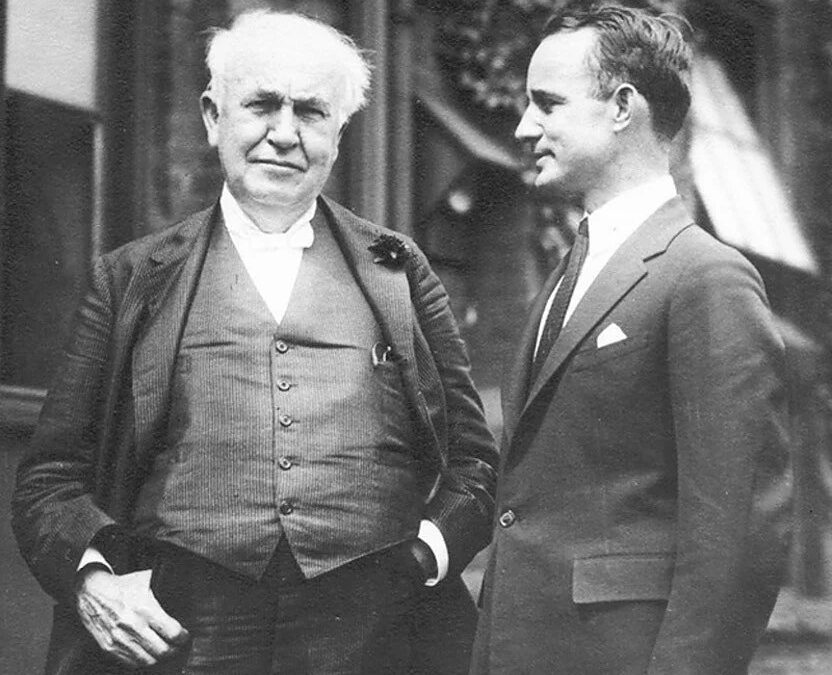
Time flew by. Over the next 20 years, from 1908 to 1928, Napoleon Hill poured himself into this mission. He visited 504 of the world’s most successful individuals — including inventor Thomas Edison, automotive pioneer Henry Ford, oil tycoon John D. Rockefeller, and even seven U.S. presidents. He discovered that the keys to their success all aligned with the principles Carnegie had hinted at.
At last, in 1928, he formally published Think and Grow Rich, capturing the essence of what he had learned. In 1937, he released a revised edition. The book has since sold over 100 million copies worldwide, profoundly shaping the lives of entrepreneurs, leaders, and dreamers across generations. Hill himself became an advisor to President Franklin D. Roosevelt. His philosophy inspired countless people to reach for their full potential, transforming not only their careers, but also the very course of society. In 2020, Forbes magazine listed Think and Grow Rich as one of the most influential business books ever written.
A journey sustained by intuition and a sixth sense
Hill never forgot that pact. Yet through these 20 years, he did not “rise to the top” himself. Instead, he faced one setback after another — founding schools, launching publications, starting businesses, failing repeatedly, even fleeing from gang threats.
By 1927, and over forty years of age, he still had nothing tangible to show for his efforts. But the “book of destiny” was finally complete. There was just one problem: Publishing it required $25,000 — an astronomical sum in those days. Hill had not a cent, nor anyone willing to invest in a so-called “success philosophy” from a man who, by all appearances, had failed. “How can you teach success when you’re struggling yourself?” Reality was harsh, the contrast bitter. Hill fell into deep despair.
One night, he wandered alone into the countryside under a pale, round moon. Lost in emptiness, he suddenly heard a voice whispering in his ear: “Borrow fifty dollars from your brother-in-law. Go to Philadelphia. Trust me — everything will turn around.” He spun around — no one was there. Where had this voice come from? Was it a hallucination, or a guiding force beyond? Hill didn’t know. But he chose to believe. The next day, he gathered his courage and asked his brother-in-law for the money. To his surprise, the man agreed without hesitation.
In Philadelphia, the miracle happened — he found someone willing to back the publication. Within just three months of its release, Think and Grow Rich became a global bestseller and a timeless classic. Hill thus became the leading figure of “success philosophy.” But behind this dramatic turnaround lay even deeper mysteries.
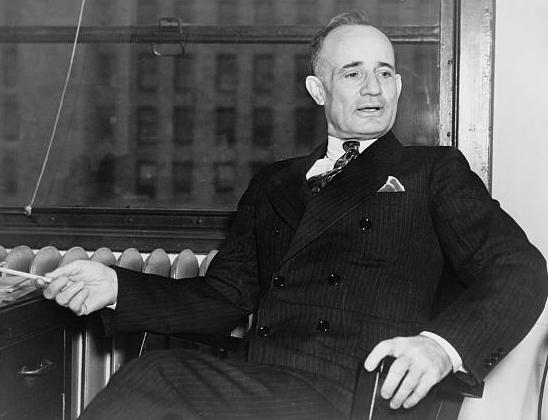
He attributed his success to his sixth sense
Hill openly confessed that the greatest force sustaining him while writing this book was not just the interviews with 500 extraordinary people, but also something he called his “Invisible Counselors.”
He claimed that many of the ideas did not come solely from the minds of men, but flowed from a “higher intelligence” received through intuition. Hill even created a kind of “spiritual cabinet,” starting with Lincoln, Edison, and Napoleon, eventually growing to include 50 figures — even Jesus, Plato, and Confucius. “You may say this was all in my imagination, but to me, they were truly real,” Hill wrote. “Their wisdom came to me through my sixth sense.”
Hill believed the sixth sense was a higher form of creative imagination, a bridge that connected the human mind to the universe — much like a radio receiver picking up broadcasts. He boldly predicted that there may be an undiscovered “intuition receptor” in the brain, the physical mechanism for inspiration and premonition.
Later, this notion found echoes in Dr. J.B. Rhine’s ESP experiments at Duke University. In tests like the “Zener card experiments,” participants could sometimes identify hidden symbols purely by mental focus, with odds of some results being 1 in 298 trillion, far beyond random chance. Hill insisted this was not a supernatural power, but untapped human potential. “Meditate often, reflect deeply — by fifty, perhaps your sixth sense will awaken.” As he put it plainly: “Confucius said: ‘At fifty, I understood Heaven’s mandate.’ I was fifty-four when I completed Think and Grow Rich. Perhaps that was no accident.”
The even more shocking work: A book locked away for 73 years
Yet what truly stunned the world was not Think and Grow Rich, but the book he wrote the following year — one that remained unpublished and hidden for 73 years: Outwitting the Devil.
In 1938, driven by an overwhelming creative surge, Hill penned this daring work. But this time, it was not interviews with great men, nor messages from his spiritual cabinet. It was a direct, chilling dialogue with the Devil himself. This haunting manuscript exposed how fear, doubt, procrastination, and inferiority act as toxic forces that enslave the human mind. Its revelations cut so deeply into the soul that his family deemed it far too subversive to be published. It remained locked away for more than seven decades, finally emerging in 2011.
Translated by Katy Liu and edited by Laura Cozzolino
Follow us on X, Facebook, or Pinterest
