

People often wonder whether life unfolds according to fate or through our choices. For Gao Xiaosong, this question took on unexpected weight because of a prophecy he received as a teenager. While traveling in Qingdao after graduating from high school, he met a fortune teller whose predictions about small matters were surprisingly accurate. Curious and amused, Gao asked him a question he considered harmless: “So when will I die?”
He expected vagueness or humor. Instead, the old man answered with unsettling certainty: “You will die at thirty-five.”
For an 18-year-old, the idea of death felt distant. Gao quickly brushed the comment aside and moved on with life. Yet as the years passed, the fortune teller’s words lingered like an echo he could never fully ignore.
A journey to Wutai Mountain
When Gao reached the age of thirty-four, the prophecy no longer felt abstract. Throughout that year, he carried a quiet sense of unease. As the very last day approached, he realized he could no longer sit and wait for dread to arrive. He decided to drive to Wutai Mountain, a place long regarded as sacred in Chinese Buddhism, hoping the pilgrimage would bring peace of mind.
On the cold November morning he arrived, the foot of the mountain was nearly deserted. He noticed a thin teenage boy crouched by the roadside, shivering in the wind. “What are you doing out here?” Gao asked. The boy replied: “I’m waiting to be a tour guide.” Gao looked around at the empty road and said: “But no tourists are here.” The boy simply answered: “You came, didn’t you?”
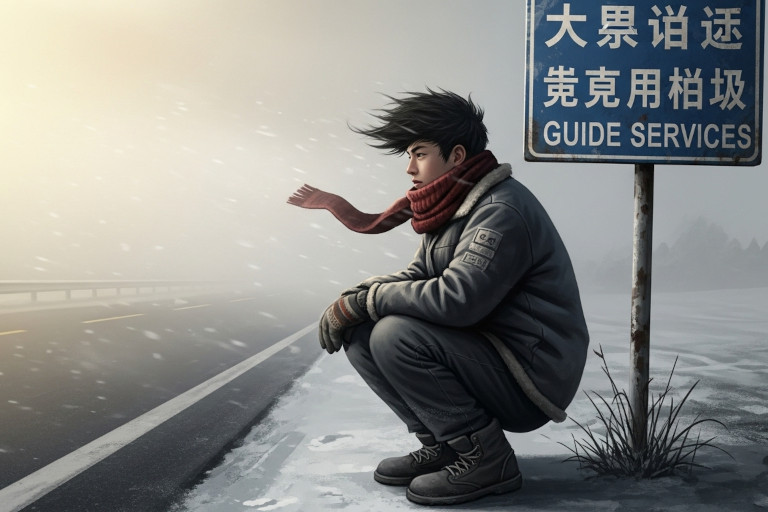
The straightforward reply revealed both the boy’s hope and his difficult situation. Feeling sympathy, Gao asked him to help find a vehicle strong enough to travel the higher mountain paths. The boy soon returned with an old, worn jeep, and the three of them—Gao, the driver, and the boy—headed up the winding road.
The spirit who guards the mountain
Wutai Mountain is known as the dwelling place of Manjushri Bodhisattva (Wenshu Pusa), the embodiment of wisdom. In local folklore, the mountain is also protected by Lord Wu (Wuye), a deity said to be the fifth son of the Dragon King.
According to legend, Manjushri once borrowed a magical Cooling Stone (qingliang shi) from the Dragon King to relieve the intense summer heat that troubled local villagers. The moment the stone arrived, the mountain became cool and comfortable even in the hottest months. This is why Wutai is also called Clear and Cool Mountain (Qingliang Shan).
But the Cooling Stone was the favorite treasure of the Dragon King’s fifth son, Lord Wu. Angered that it had been taken, he followed Manjushri to Wutai and swept his tail across the peaks, flattening their summits. Even today, the mountain’s broad, level platforms are said to come from that strike. Manjushri later subdued the dragon prince, who eventually converted and served as a guardian of the mountain.
Because the legend says Lord Wu loves opera, villagers built a stage outside Wuye Temple (五爺廟) so they could perform for him. Stories later spread that he responds readily to sincere prayers and protects those who come with a respectful heart.
Singing before Lord Wu
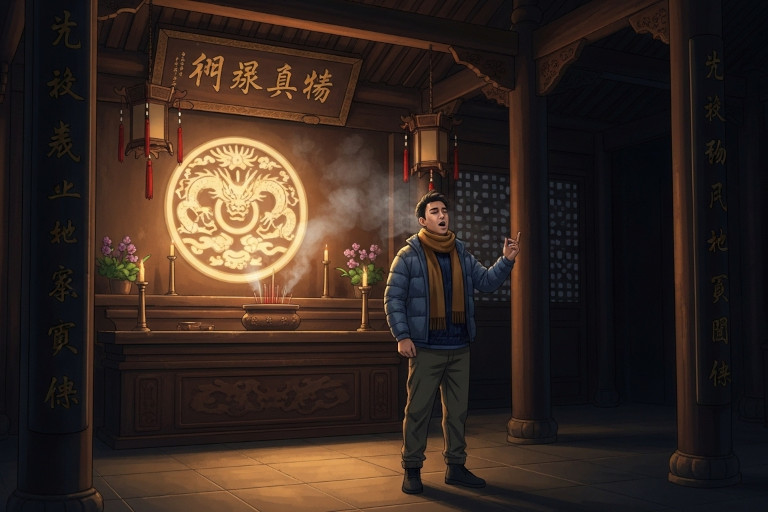
Gao had visited Wutai Mountain before, and Lord Wu’s temple was always meaningful to him. That night, finding the temple quiet and nearly empty, he lit incense and—following local tradition—sang a short passage of Beijing opera as an offering. Whether beautiful or not was beside the point; sincerity mattered more.
Feeling calmer, he asked the driver and the young guide to continue upward. He stopped briefly at each temple along the way. With so many temples scattered across the mountain, it was well past ten o’clock when they reached the last one. The wind had become bitter, and after making a quick bow at the altar, Gao hurried back to the jeep for warmth.
A jeep rolling toward disaster
The driver had stepped out briefly. Gao sat in the passenger seat and reached over to turn the ignition just enough to start the heater. What he didn’t know was that the handbrake was broken. The driver had left the jeep in gear to keep it from sliding on the slope.
The moment Gao turned the key, the jeep lurched forward.
Shocked, he scrambled toward the driver’s seat, his hands fumbling in panic. In the confusion, he pressed the wrong pedal—the accelerator—and the jeep jumped ahead toward the darkness. The cliff edge appeared suddenly in the headlights.
In that instant, one thought flashed through his mind: So the prophecy was right after all.
But before the jeep could pass the final half-meter to the drop, a dark blur moved from behind. The young guide, jolted awake by the sudden motion, threw himself forward and stomped on the brake with all his strength. The jeep shuddered violently, then stopped.

The boy had saved his life.
A second story behind the rescue
After they descended the mountain the next day, Gao gave the boy a generous tip of 3,000 yuan (about US$425). They parted ways, and he assumed he would never see him again. But the boy later came forward with his own account of that morning.
He said he was 15 at the time and had already been practicing under the Xuanyin Taoist sect (玄隱派) for two years. He usually offered informal guiding services near the mountain entrance, but in the freezing month of November, he had stopped going. That morning, however, he woke unusually early, feeling restless.
When he tried to meditate, several birds began pecking loudly at his window. Each time he went outside to chase them away, they returned as soon as he stepped back in. Feeling strangely pushed out of the house, he finally picked up his guide sign and walked to the entrance. He expected the cold to keep everyone away. Yet within half an hour, Gao arrived.
Everything else—from the quiet temples to the near-fatal slide—unfolded exactly as Gao later described.
The quiet power of intention
Whether it was intuition, Taoist training, spiritual guidance, or the protection of Lord Wu pleased by a heartfelt opera song, no one can say. Wutai Mountain has long been seen as a place where thoughts carry weight, and where sincerity brings its own form of protection.
For Gao, a simple act of kindness toward a shivering teenager became the thread that pulled him back from the edge—literally at the moment he needed it most.
Translated by Cecilia
Follow us on X, Facebook, or Pinterest
