
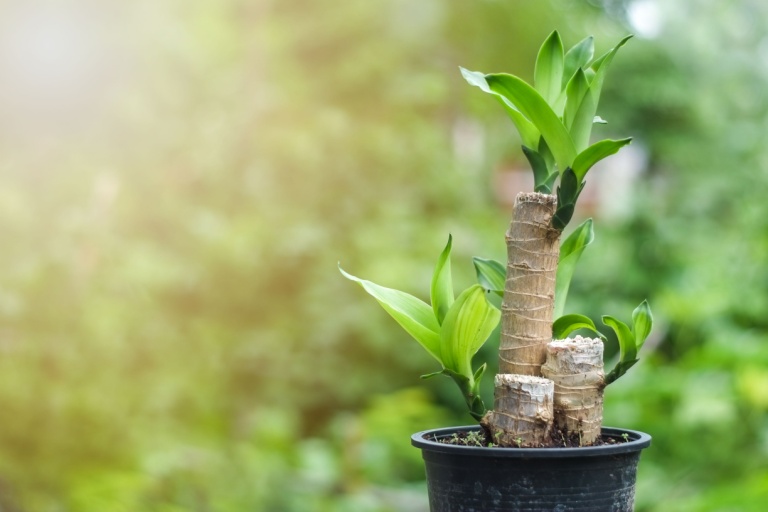
Throughout history, many ordinary flowers and plants have been surrounded by stories of the extraordinary, revealing hidden wonders in the natural world.
One such plant is the “quyi,” or bending grass. According to legend, this remarkable grass could bend its leaves to indicate treacherous visitors, helping Emperor Yao distinguish loyalty from deceit. Because of this ability, it became known as the “pointing-at-treachery grass.”
Skeptics may question how a small grass could possess such “superpowers.” Yet, modern scientific inquiry suggests that plants may exhibit surprising forms of awareness. This idea is exemplified in the experiments of Cleve Backster, a CIA expert in lie detector research, whose work with a dracaena plant hints at the subtle and mysterious capabilities of plants.
Backster’s lie detector experiments
On the morning of February 2, 1966, Backster was watering a Dracaena massangeana, an ordinary indoor houseplant, when an unusual thought struck him: He decided to attach a lie detector to the plant’s leaves to measure changes in electrical resistance. To his surprise, the instrument registered a distinct curve, lasting about a minute, which some interpreted as resembling a human reaction to happiness.
Backster was shocked! Intrigued, he later had a thought: “I wonder what would happen if I burned its leaves?” The moment he formed this intention, at 13 minutes and 55 seconds into the recording, the electronic pen of the lie detector suddenly shot to the top of the paper, creating a curve remarkably similar to the reaction of a human experiencing fear.
This experiment suggested a startling possibility: could plants possess thoughts, reactions, or even awareness akin to human emotions? Fascinated by this idea, Backster went on to conduct many further experiments with plants and other living systems, ultimately publishing his findings and sparking debate about plant perception, sensitivity, and the subtle intelligence of life.
If so, the magical plants described in ancient texts may not have been mere imagination — they may well reflect a genuine, intuitive understanding of nature’s subtle powers.
The sentient Bauhinia tree
While Backster’s research is surprising, he was not the first to suggest that plants might have feelings. An older story, recorded in Xu Qixieji (Continued Records on Universal Harmony), also points to this idea.
During the reign of Emperor Cheng of Han, there were three brothers named Tian Zhen. Though wealthy, they were constantly at odds with one another. One day, they discussed dividing their family property. A large Bauhinia tree in the courtyard made the division difficult, so they considered cutting it into three parts. After some discussion, they decided to postpone action until the next day.
That night, however, something extraordinary happened. The Bauhinia tree’s branches and leaves withered, and its roots and trunk appeared shriveled, as if scorched by fire. The brothers were stunned. Tian Zhen sighed and said, “Even this tree understands brotherly love. Upon hearing that we planned to divide the family, it withered in sorrow. How little we resemble it.”
Deeply moved by this mysterious event, the brothers abandoned their plans to divide the property. Miraculously, the tree revived, its leaves turning green and lush once more. From that day forward, the brothers set aside their selfishness, grew harmonious, and became a family renowned for filial piety and unity.
This story illustrates a timeless lesson: kindness, respect, and harmony resonate beyond humans, teaching that even nature can mirror our moral choices.

The juniper tree predicted the rise and fall of dynasties
In the Confucius Temple in Qufu, Shandong, stands a remarkable juniper tree, said to have been planted by Confucius himself. Legend holds that the tree’s cycles of withering and flourishing conceal secrets about the rise and fall of dynasties.
This ancient juniper has endured for over a thousand years, witnessing the Zhou, Qin, Han, and Jin dynasties. It first withered in the third year of Emperor Huai of Jin’s reign and remained lifeless for 309 years. In the first year of Emperor Gong of Sui’s reign, it revived and lived for another 51 years before withering again in the third year of Emperor Gaozong of Tang’s reign, remaining dormant for 374 years.
The tree revived once more in the first year of Emperor Renzong of Song’s reign. By the third year of Emperor Xuanzong of Jin’s reign, it was destroyed in a war, leaving only its trunk. After another 81 years, it revived in the 31st year of Emperor Shun of Yuan’s reign. In the 22nd year of Emperor Hongwu of Ming’s reign, the juniper sprouted new branches and became lush, only to wither again in the fourth year of the Jianwen Emperor.
Observers have noted that the tree’s cycles mirrored historical events. For example, it withered shortly after the fall of the Western Jin dynasty. It revived during times of renewed stability and expansion, such as under Li Shimin of the Tang dynasty. Over the centuries, the descendants of Confucius have watched the juniper’s condition closely, using its withering and flourishing as a symbolic gauge of the world’s fortunes and misfortunes.
As recorded in Memories of Tao An: “The descendants of Confucius always observe the juniper trees’ withering and flourishing to predict the fortunes of the world.” This extraordinary tree serves as a living testament to history, endurance, and the enduring link between nature and human destiny.
The sacred udumbara flower
While the miraculous juniper tree at the Confucius Temple may be rare, an even more extraordinary plant appears in Buddhist texts: the udumbara flower, also called Utpala in some accounts. Legend holds that when this flower blooms, it signals the arrival of an enlightened being — one who comes to save all sentient beings and restore virtue to the world.
The udumbara itself is described as tiny and snow-white, shaped like an ancient bell, with a stem as fine as silk and a faint halo. Remarkably, it has no roots and can appear anywhere — on fruits, glass, steel, paper, fallen leaves, and even tires — demonstrating its miraculous, otherworldly nature.
In 1997, South Korean media reported the appearance of a small udumbara on a golden Buddha statue at Cheonggye Temple, an event that quickly drew worldwide attention. According to the Lotus Sutra, the udumbara is a divine omen, appearing once every 3,000 years to herald the coming of the golden Law Wheel King. The Huilin Sound Meaning describes it as a “heavenly flower,” one that does not exist naturally in the ordinary world. Its sudden bloom signifies extraordinary virtue and power, preparing humanity for renewal and salvation.
Buddhist commentaries describe the udumbara as a “celestial flower,” not born of soil or ordinary growth, but appearing in response to great virtue and compassion. Its rare bloom reminds the faithful that even in a world filled with suffering, corruption, or moral decline, a beacon of virtue can rise. Its appearance symbolizes hope, renewal, and the potential for a new era.
The legend of the udumbara endures because it resonates with a universal longing for meaning, hope, and moral clarity. It teaches that true greatness and compassion are rare, like a flower that blooms only once every thousand years, and that when virtue rises, it can transform the world.
The udumbara calls on us to cultivate compassion, generosity, mindfulness, and inner purity. Actual change does not come through force or greed, but through awakening the heart, spreading virtue, and preparing ourselves — and our world — for the arrival of goodness.
Whether one believes in its literal bloom or understands it as a powerful symbol, the udumbara teaches a timeless lesson: even in the darkest times, the possibility of renewal and salvation exists. The divine may well walk among us.

Reflections
Ancient Chinese scholars believed that all things possess a spirit or innate sentience. These magical plants recorded in historical texts remind us that the world is far richer, more intricate, and more mysterious than it often seems.
By observing these wonders, we are reminded that the extraordinary is not confined to legend alone — it can be found in our daily lives. Every act of kindness, patience, and generosity mirrors the quiet intelligence of the natural world. Just as a plant responds to care, attention, and intention, so too does life respond to our choices.
These magical plants teach us that virtue is active, not passive. Compassion is not simply a feeling; it is an action that transforms both the giver and the recipient. Mindfulness is not merely awareness; it is a way of participating fully in the unfolding of life. When we cultivate integrity, patience, and respect, we are sowing seeds whose effects may ripple far beyond what we can see — shaping relationships, communities, and the world itself.
Perhaps the remarkable plants recorded in ancient texts hint at hidden realities within our complex world. Their lessons reach far beyond the natural or spiritual realms, inviting us to live with awareness, act with intention, and recognize that even the smallest gestures can carry profound significance. By attuning ourselves to these principles, we honor the subtle magic woven throughout life and awaken the potential for wonder, compassion, and transformation within ourselves and the world around us.
Translated by Joseph Wu and edited by Tatiana Denning
Follow us on X, Facebook, or Pinterest
