
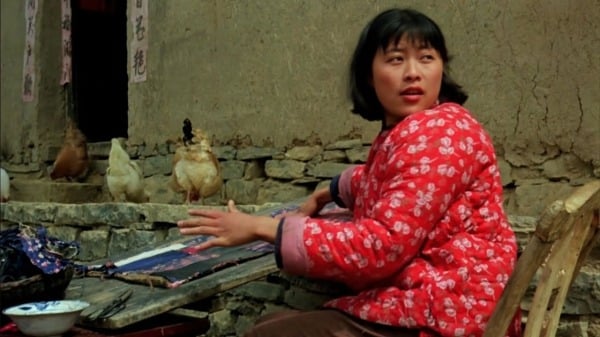
No one could have imagined that this woman, who had most of her stomach removed, not only survived, but also stood before cameras in 2024. Twenty-three years later, the cancer cells haven’t returned. She smiles: “Cancer didn’t steal my life — it taught me how to live.”
The dramatic turn of fate occurred in May 2002. Born in 1962 to an ordinary working-class family in Chengdu, China, Yue Hong failed her first two acting auditions. In 1980, she entered the examination hall for the third time and, finally, gained admission to the Central Academy of Drama. In 1985, her portrayal of the feisty village woman Gui Lan in the film Wild Mountain earned her the Golden Rooster Award for Best Actress.
From then on, she worked nonstop on film sets, surviving on biscuits and instant noodles during shoots. When her stomach ached faintly, she would swallow a handful of pills: “It’ll be fine once this busy period passes.”
Yue Hong learns she has stomach cancer
In May 2002, while filming a night scene, Yue Hong suddenly collapsed to her knees, vomiting blood-tinged fluid. In the hospital, during an endoscopy, the doctor pointed to the images and said: “The tumor’s location is unfavorable. We can only remove four-fifths of it.”

At that moment, she was clutching the script for Love’s Ups and Downs, and her daughter was only 12. A single thought consumed her mind: “I have to see my daughter grow up.”
The night before surgery, Yue Hong did something that shocked the doctors; She had a friend bring over a bowl of spicy water-boiled fish, its red oil bubbling fiercely. The chili in it made her teary, yet she couldn’t stop shoveling the food into her mouth. “If I don’t eat it now, I might never have another chance,” she said, explaining that it was her farewell to her fiery life.
On the tenth day after the procedure, the surgeon brought good news: The cancer hadn’t spread, and no chemo or radiation was needed. Hearing this, Yue Hong clutched the bed sheet and wept uncontrollably, repeating over and over: “I’ll get to see my daughter grow up.”
Her first meal after being discharged left her curled up in pain, after just two spoonfuls of chicken soup. She then decided to follow a strict rule: Regardless of her schedule or commitments, she would chew each mouthful 30 times before swallowing. She developed the “Ten-Minute Eating Method”: five minutes focused solely on chewing, followed by five minutes in which she attuned to her stomach’s signals.
Yue Hong’s checkup is better than a healthy person’s
Every morning at five, Yue Hong lay flat in bed, her palms gently massaging her abdomen in 36 clockwise circles. This routine began on her third day post-surgery, when doctors warned her about intestinal adhesions. Next came a cup of 40-degree water, sipped slowly. At her follow-up checkup, the physician stared at her report and exclaimed: “Your indicators are better than those of many healthy people!”
During her initial recovery, even walking a few steps would make her tired. Gradually, she progressed, and now she walks for half an hour every morning without fail. She dislikes the gym, preferring outdoor strolls: “The rustling leaves, birds flying overhead — my stomach seems to beat in rhythm too.”
When asked: “What’s the secret to your cancer survival?,” Yue Hong points to her head: “I won the battle here first.” In the early days after diagnosis, she cried every night, until she saw her puffy face in the mirror and suddenly realized — fear spreads faster than cancer cells.

She invented the “Happy Stomach Exercise”: Every day, she’d face the mirror and shout three times: “I am happy, I am healthy!” At first, it sounded hollow and unreal, but later, she genuinely felt her stomach pain lessen. The scientific explanation is that positive emotions promote endorphin secretion — mindset truly matters.
Once, before a gastroscopy, the young nurse was nervous, and her hands were shaking. Yue Hong comforted her: “We’re old acquaintances — catching up once a year.” After the exam, the doctor murmured at the images: “Your gastric mucosa looks smoother than last year.” She beamed: “Of course! I pamper it daily.”
At production dinners, while young colleagues devour skewers and drink ice-cold beer, she sips her longan-jujube tea. When offered a skewer, she refuses with a smile: “My stomach is a protected cultural relic.”
A red circle appears on Yue Hong’s calendar — every year it indicates the day of her gastroscopy follow-up. Regardless of how busy filming gets, she never misses her appointment. A junior colleague once asked in puzzlement: “The cancer hasn’t recurred in over 20 years — can’t you relax?” She pointed to her stomach: “An old tenant lives here. I need regular structural inspections.”
Every year, when her test results come back, doctors marvel that her metrics rival those of a young person. She pulls out of her pocket a yellowed and frayed 2002 diagnosis: “I signed a truce agreement with my tumor. The terms are simple: “I don’t provoke it, it doesn’t cause trouble.”
Translated by Audrey Wang and edited by Laura Cozzolino
Follow us on X, Facebook, or Pinterest
