

In 1843, Hans Christian Andersen wrote a very special fairy tale called “The Nightingale.” This is the only piece of work in which he chose China as the setting, despite never having visited it. Andersen’s vivid imagination of this distant, ancient land led him to describe a beautiful nightingale in the garden of the Chinese imperial palace, whose song touched the emperor’s heart. This story contains many secrets: a revelation about true human feelings and life. This timeless piece remains relevant to this day.
The story goes like this: In nature lived a small nightingale. It looked pretty ordinary, but its song was lovely! Even the poorest people who heard it forgot their worries and praised its song. Later, the emperor heard of this nightingale and went to great lengths to bring it from the forest to the palace, where it sang for him every day. From then on, the nightingale became the emperor’s “royal singer.” Soon after, a mechanical nightingale was gifted to the palace as a tribute. It was splendidly adorned with beautiful jewels and fitted with a winding mechanism. Once wound up, it could sing exquisite songs exactly as commanded. It was convenient and lovely, and the emperor and his ministers loved it even more. The real nightingale, feeling neglected in the palace, quietly flew away.
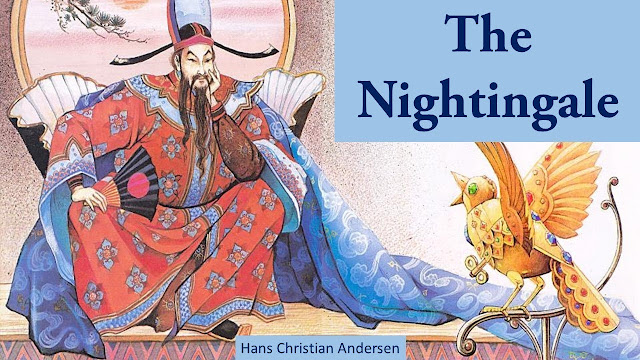
Years passed, and the emperor fell gravely ill. Lying in bed, he longed to hear the nightingale sing again. But the mechanical bird would not sing — its spring was worn out. The emperor was on the verge of death, and the atmosphere was heavy and bleak. At that moment, the true nightingale suddenly returned, perched on a branch outside the window, and sang its most beautiful song, gently comforting the emperor’s heart. Its song drove death away, and the emperor slowly regained life. Through his fine artistry, Hans Christian Andersen vividly portrayed the emperor and his officials, showcasing their love for novelty and captivation by glamorous appearances. Yet the nightingale never allowed itself to be manipulated by the powerful and wealthy; its sincerity and deep affection were truly moving.
Why did Hans Christian Andersen write a fairy tale set in China? He traveled to many places throughout his life, including Turkey, France, and Italy, but he never went to China. That distant and mysterious Eastern land was a dreamlike existence for him. In his autobiography The Fairy Tale of My Life, he revealed a childhood fantasy: “One bright moonlit night, I sat by the little river in my hometown Odense, thinking to myself, how wonderful it would be if a beautiful Chinese princess could dig a tunnel from the other side of the world to come and sing to me, then fly me to China, and take me into a completely different, noble and illustrious life!” Later, a nightingale living in the Chinese palace appeared in his story. Writing this fairy tale was a small realization of Anderson’s childhood dream, allowing us to experience timeless innocence and beauty as we listened to the story.
The beautiful nightingale in Hans Christian Andersen’s tale was actually a real-life inspiration, a girl he secretly admired — Jenny Lind, the famous Swedish soprano. Jenny’s origins are similar to the nightingale in the fairy-tale forest — both are ordinary, coming from humble beginnings. Moreover, she was an illegitimate child, born into a poor family. At age nine, she entered the Royal Swedish Opera. Through unwavering effort, talent, and determination, she became the most dazzling soprano of 19th-century Europe, lovingly referred to as the “Swedish Nightingale.”
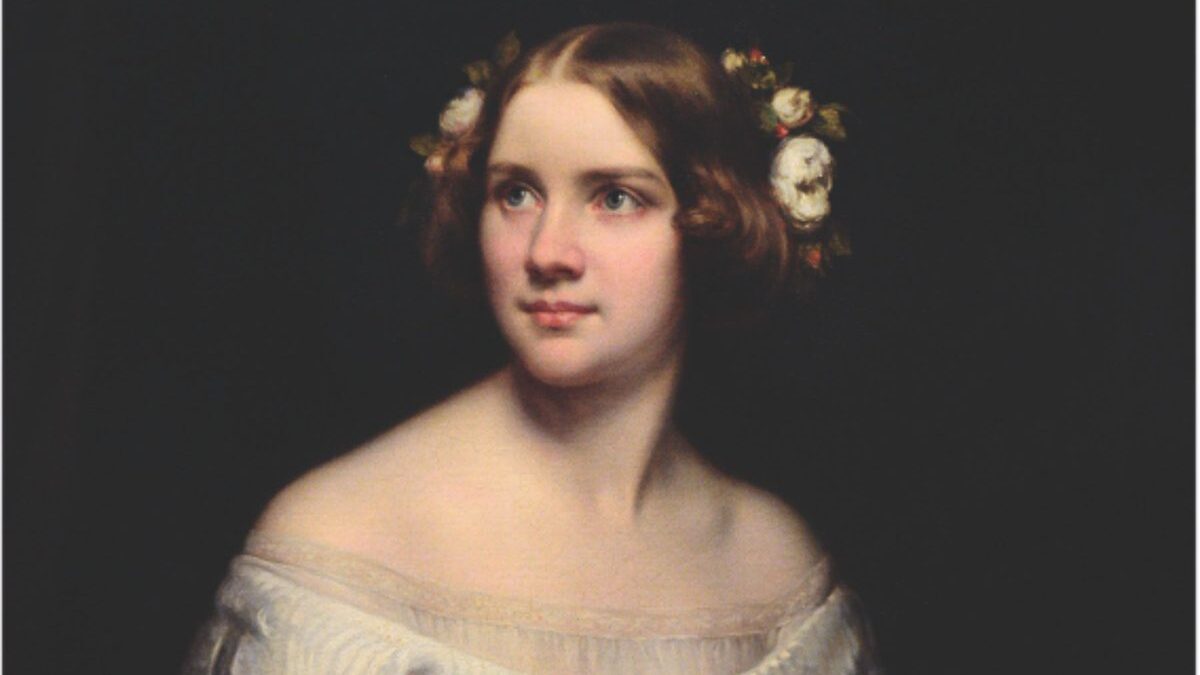
Hans Christian Andersen met her in 1840, but she was initially indifferent to him, and the two had little interaction. When they met again in 1843, Jenny was living in Copenhagen, and he visited her daily, sharing his thoughts. They grew familiar, but while Andersen quietly admired her, Jenny regarded him only as a brother. Later, she married a pianist, and Andersen buried this love in his heart forever, never loving anyone else again. His unfulfilled affection was sublimated into his work, shaping a pure and beautiful nightingale. The Nightingale expressed Hans Christian Andersen’s longing for the mysterious East, for ideal love, and his deep inner dreams.
In this classic story, the contrast between the real nightingale and the mechanical one is a stroke of genius. People admired the artificial bird — it was precise, controllable, and flawless, with each note perfect like a computer program. The entire palace is captivated by this “industrial technology.” While the real nightingale, which sings freely, pales in comparison. The true nightingale sang out of emotion, while the mechanical one served only those who wound it up. This is like the difference between an artist’s genuine expression and a technological tool. Isn’t modern society the same? People are increasingly fascinated by controllable, standardized perfection, gradually forgetting what it means to express genuine feelings from the depths of one’s soul.
Translated by Cecilia and edited by Maria
Follow us on X, Facebook, or Pinterest
