
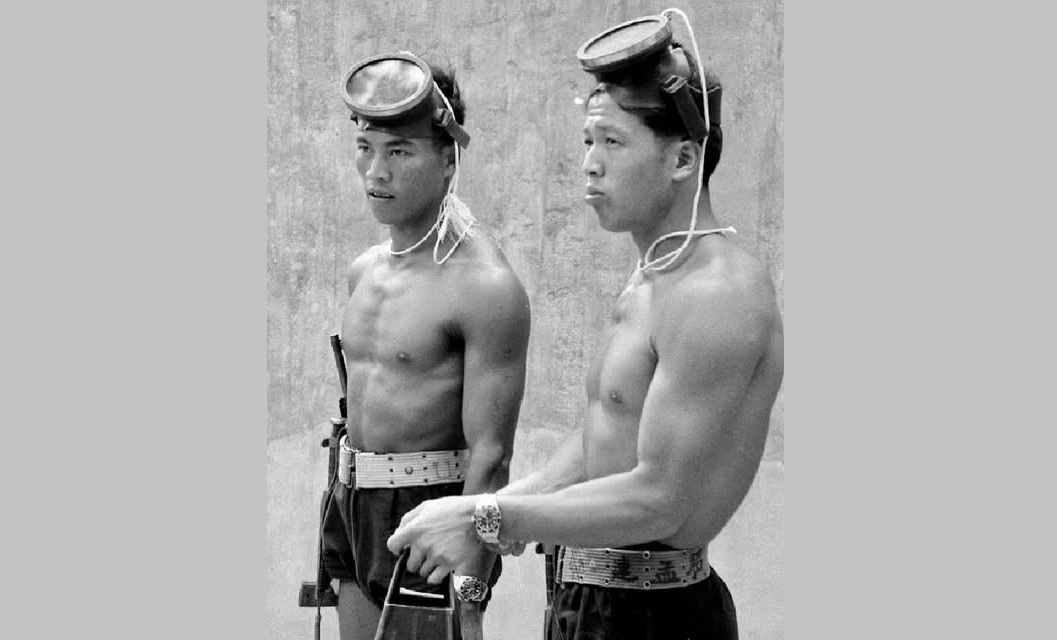
The Second Taiwan Strait Crisis (also known as the 823 Artillery Battle) was a series of battles fought between 1958 and 1979 (the most intense period being between August 23 and October 5, 1958), which happened between the Matsu and Kinmen islands of Taiwan and the southeastern coast and islands of mainland China. The People’s Liberation Army (PLA) in mainland China and the National Revolutionary Army (NRA) of the Republic of China in Taiwan primarily used artillery across the strait as their primary tactic, hence the term “823 Artillery Battle.”
After the 823 Artillery Battle, the standoff between mainland China and Taiwan on the front lines was severe. Mainland guards in Xiamen were always vulnerable to threats from Taiwanese frogmen (“water ghosts”). However, even during that period of heightened tension, a touching incident occurred, leaving one mainland resident with a deep sense of gratitude toward the kind-hearted Taiwanese “frogmen” years later.
According to the Taiwan Revelation, mainland artist Zheng Ruiyong, at the age of 15, was serving on Dadeng Island in Xiamen when he encountered “frogmen” sent by the NRA on Kinmen (Quemoy) twice. He dozed off while on guard duty at night, and when he woke up, he discovered his rifle was missing. Losing his rifle was a serious matter and could result in punishment by his superiors.

After a thorough search, they finally found his gun beneath the pier, along with a note. The note was written in large characters: “Young man, don’t risk your life for the communists. Don’t sleep anymore; this time, I can’t bring myself to kill you.” It turned out that the frogmen from Kinmen, seeing the young and sleeping Zheng Ruiyong, couldn’t bring themselves to kill him. They stole the guns and left them on the pier as a sign that he had been there. This merciful “frogman” even left a note advising him not to serve the communists anymore.
Years have passed. The boy from back then is now grown up, has a family, and has even built his own art museum. Even after all these years, Zheng Ruiyong still feels grateful for the other party’s mercy and wonders if that dear Kinmen soldier is doing well.
A Taiwanese netizen shared his experience online on the PPT Bulletin Board System. His father served in the military on the small island of Kinmen. Because the island was so small, only 12 men were stationed there, making life extremely boring and the atmosphere in the army very tense. Strangely, they later encountered “water ghosts” sent by the People’s Liberation Army (PLA). Surprisingly, their encounters were devoid of any hostility or fear. Instead, they displayed remarkable teamwork.
One day, the netizen’s father and several fellows were on sentry duty on a cliff about two stories high. Someone spotted a small light on the shore. Everyone was very tense, because on such a small island, there was no need to shout a password to know the other side was PLA. In this tense moment, the other side’s first words brought them a sigh of relief.
The PLA water ghost broke the silence first, saying: “Do you have any cigarettes?” Kinmen NRA soldiers: “No cigarettes, do you want some grenades?” PLA water ghost: “Don’t be like that, we’re all just trying to make a living. How about trade?” Then they placed a pack of cigarettes on a rock and left.
The next day, everyone went to check and found a pack of mainland cigarettes. Later, the Kinmen soldiers reciprocated by leaving a pack of Taiwanese cigarettes at the same spot. From then on, every so often, packs of cigarettes wrapped in plastic bags would be placed on the rocks. A few days later, someone would come and take the Taiwanese cigarettes, and then new cigarettes would be placed on top, with various brands available.

However, the quality of the mainland cigarettes varied. Sometimes, when PLA soldiers brought a whole carton of mainland cigarettes, Taiwanese soldiers, finding the quality poor, would leave only two or three packs in return as a protest. Next time, PLA soldiers would understand that people didn’t think the brand was good, so they would change the brand or leave a few more cartons.
After some time, the PLA soldiers would only leave and collect cigarettes on the shore, take some proof, and leave. They never tried to enter the island, let alone attack, and never spoke to each other. They maintained this tacit understanding until his father retired and handed over his duties to the next batch of recruits.
During the cross-strait standoff, the “water ghosts” sentry duty included tasks like cutting off ears or taking lives. Despite the tense relations, some showed kindness, while others were forced to fulfill their duties. Looking back at the note written by the Kinmen soldier, what was left for Zheng Ruiyong was not just the mercy of not being killed, but also a call for goodwill toward the communist army: “You’re so young, don’t risk your life for the communists.”
Translated by Patty Zhang and edited by Amanda
Follow us on X, Facebook, or Pinterest
