

Picture a family gathered around a round table on New Year’s Eve. Steam rises from a whole fish resting on a red plate, its body scored with delicate cuts, each one holding a thin slice of ginger. Scallions are scattered across the top like green confetti. The grandmother sits at the head of the table, and the fish head points directly toward her. A young child eagerly reaches for a piece, and a parent places a gentle hand on the child’s small wrist. “Not yet,” the mother whispers. “We leave some for tomorrow.”
In that simple exchange lives thousands of years of Chinese wisdom about abundance, respect, and hope for the future. Why do the Chinese eat fish on New Year’s Day? The answer begins with a single sound and unfolds into one of the world’s richest food traditions. The Chinese New Year fish is far more than a delicious centerpiece for the reunion dinner. It is a living wish, spoken not in words but in the language of food, sound, and shared ritual.
Of all the lucky foods served during Chinese New Year festivities, fish holds a place that no other dish can replace. In this article, you will discover the deep symbolism behind this tradition, the specific fish that carry the most auspicious meanings, the sacred rules for serving, and something most guides never mention: the ancient wisdom of traditional Chinese medicine (TCM) hidden in every ingredient on that plate.
Chinese New Year fish symbolism: The hidden meaning behind the tradition
The Chinese New Year fish tradition begins with a single sound. In Mandarin, the word for fish (鱼, yu) is pronounced exactly the same as the word for surplus or abundance (余, yu). This is not a coincidence. In Chinese culture, the sound of a word carries as much weight as its meaning. When families serve fish at the reunion dinner, they are not simply providing a meal. They are making a spoken wish for the year to come.
The phrase most closely associated with this tradition is 年年有余 (nian nian you yu), which translates to “May you have abundance every year.” The nian nian you yu meaning carries the hope that each year will bring not just enough, but a generous surplus to share. Because 余 (surplus) and 鱼 (fish) share the same pronunciation, placing a whole fish on the table transforms the dinner into an act of hope. The family is literally saying, through the presence of that dish, that they wish for more than enough in the year ahead.
This practice reflects a profound aspect of Chinese philosophy. Abundance in this context does not mean excess or greed. It means having enough to share, enough to carry forward, and enough to feel secure. The auspicious symbols of Chinese New Year are rooted in this same spirit: gratitude for what you have, and gentle hope for what is to come.
The fish must always be served whole, with head and tail intact. This is not merely tradition for tradition’s sake. The complete fish symbolizes a good beginning and a good ending. Just as families hope for a year that starts well and finishes well, the fish on the plate mirrors that wish in physical form.
There is also a deeper layer of meaning. A whole fish represents unity and completeness. At the reunion dinner, where family members travel great distances to sit together at one table, the fish’s unbroken body reflects the family’s unbroken bond. Nothing missing. Nothing lost. Everyone present, from head to tail.

The legend of the Dragon Gate: Why carp hold special powers
Among all Chinese New Year fish, carp holds a unique place of honor, a tradition rooted in one of the most beloved legends in Chinese culture. According to ancient texts, including the Classic of Mountains and Seas (山海经), there exists a place on the Yellow River called the Dragon Gate (龙门), where the waters surge through a narrow gorge with tremendous force. Every spring, thousands of carp swim upstream against the raging current, fighting to reach the top of the waterfall. Most fail. They are swept back downstream by the torrent. But the rare carp that summons the strength and perseverance to leap over the Dragon Gate is transformed into a dragon.
This legend, which dates back to the Later Han Dynasty (25-220), became one of the most enduring metaphors in Chinese culture. The phrase 鱼跃龙门 (yu yue longmen), meaning “the fish leaps over the Dragon Gate,” is still used today to describe someone who achieves extraordinary success through determination, particularly in examinations and career advancement. When a family places carp on their Chinese New Year table, they are not just wishing for surplus. They are invoking the spirit of the Dragon Gate: the belief that perseverance is rewarded, that transformation is possible, and that the year ahead holds the potential for breakthroughs. It is a wish whispered to every child at the table: keep swimming, even against the current.
Which lucky fish to choose for Chinese New Year: A guide to the most auspicious varieties
Not all fish carry the same meaning at the Chinese New Year table. Each species brings its own symbolic resonance, rooted in the sound of its Chinese name. Choosing the right lucky fish, which Chinese New Year families have treasured for generations, is a way to set an intention for the year ahead.
Crucian carp (鲫鱼, Ji Yu): Good luck and health
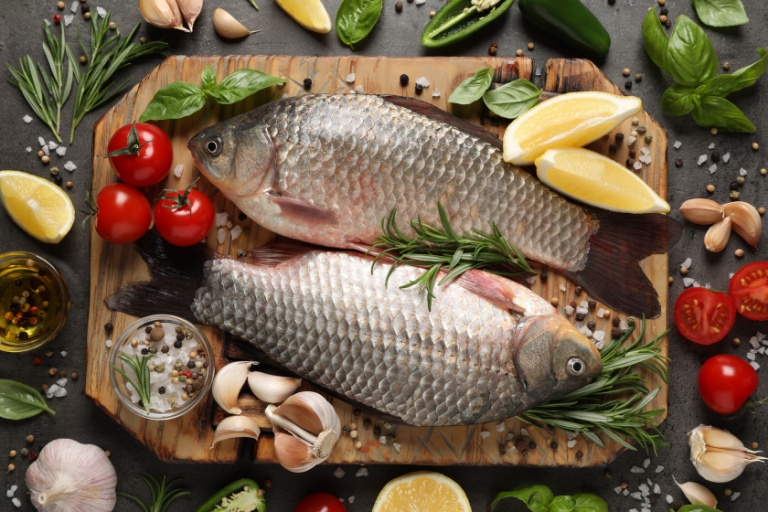
The first character of crucian carp, 鲫 (ji), sounds remarkably similar to 吉 (ji), the Chinese word for good luck and auspiciousness. This makes crucian carp one of the most popular choices for families looking to welcome good fortune and well-being into the new year. In traditional Chinese medicine, crucian carp is particularly valued. It is known to tonify the spleen, promote healthy digestion, and support the body’s fluid balance. Crucian carp soup, simmered slowly until the broth turns milky white, is a classic, nourishing dish that Chinese families have relied on for centuries.
Chinese mud carp (鲤鱼, Li Yu): Gifts and fortune
The pronunciation of 鲤 (li) echoes the word 礼 (li), meaning gifts, propriety, and good fortune. Serving mud carp at the reunion dinner symbolizes a year filled with blessings and meaningful exchanges. This is also the species most closely associated with the Dragon Gate legend, making it a powerful choice for families with students or anyone pursuing ambitious goals. Carp has been cultivated in China for over 4,000 years, making it one of the oldest farmed fish in human history. Its presence on the Chinese New Year table connects the modern family to an unbroken lineage of tradition.
Catfish (鲶鱼, Nian Yu): A year of surplus
The Chinese name for catfish, 鲶鱼 (nian yu), sounds nearly identical to 年余 (nian yu), which means “year of surplus.” This direct phonetic connection makes catfish especially popular in northern China, where families prize hearty, braised preparations that fill the house with rich aroma on cold winter evenings.
Sea bass (鲈鱼, Lu Yu): Resilience and success
Sea bass is favored for its association with strength and advancement. The fish itself is known for swimming against strong currents, and its name carries connotations of success and prosperity. Steamed sea bass, prepared simply with ginger and scallion to highlight its delicate, clean flavor, is a centerpiece at many upscale reunion dinners, particularly in southern China.
Pomfret (鲳鱼, Chang Yu): Prosperity and purity
In the coastal provinces of Fujian, Guangdong, and Zhejiang, pomfret is the fish of choice for the Chinese New Year. Its flat, silvery body and mild, refined flavor make it ideal for steaming. The name 鲳 (chang) carries associations with prosperity, and the fish’s elegant appearance symbolizes purity and grace at the table.
The ancient wisdom of steaming: Why the Chinese New Year favors this fish preparation
The Chinese New Year tradition of steamed fish is far more than a culinary preference. It reflects centuries of food therapy wisdom passed down through generations. If you look carefully at how Chinese families have prepared their New Year fish for centuries, you will notice something remarkable. The classic preparation is not random. It is, in fact, a perfectly balanced meal according to traditional Chinese medicine principles.
In TCM, every food has a thermal nature: warming, cooling, or neutral. Fish, particularly freshwater varieties like carp, are generally classified as neutral to slightly cooling. It nourishes Qi (vital energy), supports the spleen and stomach, and promotes healthy fluid balance without being heavy or difficult to digest.
This makes fish an ideal food for the transitional period of Chinese New Year (also called the Spring Festival), which follows the lunar calendar and falls in late winter or early spring. The body needs nourishment during this season, but not the heaviness of lamb or beef. Fish provides gentle, restorative energy, exactly what TCM practitioners have recommended for thousands of years.
Here is what most Chinese New Year fish guides never tell you: the classic steamed fish garnish of ginger, scallion, and soy sauce is not simply about taste. It is food therapy. Ginger is one of the most important warming herbs in TCM, with documented medicinal use spanning over 2,500 years. When placed inside the score marks of a cooling fish, ginger balances the dish’s thermal nature, preventing the cooling energy from overwhelming the digestive system. Scallion serves a complementary role. In TCM, scallions are known for dispersing cold and promoting the smooth flow of Qi. It opens the channels, aids digestion, and helps the body absorb nutrients more efficiently.
Together, ginger and scallion transform a cooling protein into a harmoniously balanced dish. This is the TCM principle of balancing Yin and Yang in every meal, applied with elegant simplicity. What looks like a humble plate of steamed fish is actually a masterpiece of ancient nutritional wisdom.
Five sacred rules for serving Chinese New Year fish
The rituals and customs of the Chinese New Year are specific and meaningful, and the fish tradition is no exception. These five rules have been passed down through generations, and each one carries symbolic weight.
1. Always serve the fish whole
The fish must arrive at the table with its head and tail intact. A whole fish symbolizes a complete beginning and ending, a year lived fully from start to finish. Cutting or filleting the fish before serving removes this symbolism. Even if the fish is large, it should be presented whole, then shared among the family at the table.
2. Point the fish head toward the eldest
When the fish is placed on the table, its head should face the most senior family member or the most honored guest. This positioning is a mark of deep respect. The eldest “receives” the symbolic fortune first, and their blessing then flows outward to the rest of the family. In many households, the person facing the fish head also has the honor of taking the first bite, signaling permission for the meal to begin.
3. Never flip the fish over
This is one of the most important rules, and its origin is rooted in maritime culture. In fishing communities along the coast of China, flipping a whole fish was considered equivalent to capsizing a boat, an omen of disaster and misfortune for the family. The practical solution is elegant. After eating the flesh on one side, diners carefully lift out the central backbone and set it aside on the plate. This reveals the meat underneath without ever turning the fish over. It is a custom that also makes practical sense, since flipping a whole steamed fish onto a plate usually results in a broken, messy dish.
4. Leave some fish uneaten
Perhaps the most counterintuitive rule for guests unfamiliar with the tradition: you should not finish the fish. Leaving some on the plate is the entire point. The leftovers represent the surplus, the 余 (yu), that you are wishing into existence for the year ahead. In northern China, families often leave the entire fish dish untouched until the next day. In southern regions, particularly Cantonese households, the head and tail are specifically preserved and eaten on New Year’s Day, ensuring that the year begins and ends with abundance.
5. The two-fish tradition
Some families take the symbolism a step further by preparing two fish for the New Year period. One is served at the reunion dinner on New Year’s Eve. The second is saved for New Year’s Day. This ensures that abundance is not a single moment but a continuous thread woven from the old year into the new. The fish you eat today blesses today. The fish waiting for tomorrow blesses tomorrow.

How do different regions honor the Chinese New Year fish tradition
China is vast, and the way families prepare and serve their Chinese New Year fish varies dramatically from region to region. Each approach reflects the local climate, available ingredients, and culinary philosophy.
Northern China: Braised carp and catfish
In the cold northern provinces, the fish for the reunion dinner is typically braised in a rich sauce of soy, sugar, vinegar, and aromatics. Carp and catfish dominate, prepared in hearty, warming styles that suit the frigid winter climate. The entire fish is often left on the table overnight and eaten the following day, with the leftovers symbolizing surplus carried forward.
Cantonese: Steamed sea bass with light soy
Cantonese cuisine prizes the natural flavor of ingredients above all else. The preferred Chinese New Year fish is sea bass or grouper, steamed to silky perfection with nothing more than ginger, scallion, and a drizzle of light soy sauce. Hot oil is poured over the fish just before serving, creating a sizzle that fills the room with fragrance. Simplicity and freshness are the guiding principles.
Fujian and coastal provinces: Pomfret and snapper
Along the southeastern coast, families choose saltwater fish like pomfret, snapper, or yellow croaker. These fish are lightly steamed or pan-fried to preserve their delicate ocean flavor. The coastal connection is deep, and the “never flip the fish” rule holds particularly strong significance in these fishing communities.
Shanghai: Smoked fish
Shanghai has its own distinctive take on the New Year fish. Shanghai smoked fish (熏鱼, xun yu) is a cold appetizer made by deep-frying fish slices and then soaking them in a sweet-and-savory marinade. Despite the name, the fish is not actually smoked. It is a beloved dish served during Chinese New Year celebrations in Shanghai, offering a completely different texture and flavor profile from the steamed preparations found elsewhere.
Chinese diaspora: Adapting the tradition abroad
For Chinese families living outside Asia, the New Year fish tradition requires adaptation but never abandonment. Whole fish can sometimes be difficult to source in Western supermarkets, so many diaspora families seek out Asian grocery stores or fish markets that carry whole sea bass, tilapia, or branzino.
The key is not the specific species. What matters is that the fish is whole, that it carries the family’s wishes into the new year, and that some is left behind for tomorrow. The tradition travels wherever the family goes.
Bringing this tradition to your table
You do not need to be Chinese to welcome this beautiful Chinese New Year fish tradition into your home. Steamed whole fish is one of the simplest and most rewarding dishes you can prepare, and it brings a spirit of hope and abundance to any table.
Choose a whole fish between 1 and 2 pounds (sea bass, tilapia, or snapper work well). Clean the fish and score three diagonal cuts along each side. Tuck thin slices of fresh ginger into the score marks. Place the fish on a heatproof plate, scatter scallion pieces around and beneath it, and drizzle with a small amount of Shaoxing wine.
Steam over high heat for 10 to 12 minutes, until the flesh is opaque and flakes easily. While the fish steams, heat 2 tablespoons of light soy sauce with a pinch of sugar. When the fish is done, pour off any excess liquid, arrange fresh scallion shreds on top, drizzle with the warm soy mixture, and finish by pouring 2 tablespoons of smoking-hot oil over the scallions. The sizzle is the final blessing.
Serve the fish whole, head facing the most honored person at your table. And remember: leave some for tomorrow. Along with fish, consider adding other auspicious foods to your celebration. Lucky fruits for the Chinese New Year carry their own beautiful symbolism and make wonderful companions to the centerpiece fish.
A dish that has endured for thousands of years
Return to that table for a moment. The steam has thinned, the fish is half eaten, and the grandmother smiles at the plate with its remaining portion. The leftovers are not waste. They are the wish made visible, the hope that tomorrow will bring enough, and the day after that, and every day of the year to come.
The Chinese New Year fish is not just food. It is a conversation between generations, spoken in the language of sound and symbol, of ginger and scallion, of heads facing elders and bones carefully removed. It is a Lunar New Year tradition practiced by over 2 billion people worldwide, yet it begins each year in the most intimate setting imaginable: a family, a table, and a whole fish that carries a single, ancient wish. May your table be full, your year overflow with blessings, and your family always have more than enough.
Follow us on X, Facebook, or Pinterest
