

Chinese scholars have long cherished orchids for what they represent: refinement, elegance, and inner purity. Within China’s millennia-old civilization, the literati elevated four plants — the orchid, plum blossom, bamboo, and chrysanthemum — collectively known as the “Four Gentlemen.” Each embodies a moral ideal deeply woven into traditional Chinese thought and culture.
The orchid, subtle in fragrance and form, stands for elegance, restraint, and quiet virtue. The plum blossom, which blooms bravely in winter, symbolizes integrity, resilience, and an unyielding spirit, while also serving as an emblem of good fortune. Bamboo, straight yet flexible, represents uprightness, humility, purity, and moral strength. The chrysanthemum, flourishing late in the year, signifies detachment from worldly concerns, nobility of character, endurance, and longevity.
These symbolic meanings extend far beyond botany. They shape idioms and expressions in classical literature, giving rise to phrases that praise “lofty integrity” and “moral steadfastness.” Even in family traditions, these ideals endure: cultured households often incorporate the characters for orchid, plum blossom, bamboo, or chrysanthemum into their daughters’ names, expressing the hope that they will embody the same grace, strength, and virtue represented by these timeless plants.
A closer look at the orchid
The reverence for orchids is not limited to symbolism or art; it extends into Chinese medicine, where orchids are celebrated for their healing properties. Chinese herbal medicine is known among the Chinese people as “national medicine,” while in Korea and Japan it is commonly referred to as “Han medicine.” Within this vast tradition, several well-known medicinal plants — such as Gastrodia, Dendrobium Bletilla, and Mountain Lily — belong to the orchid family. However, not all perennial plants bearing the character “lan” (orchid) in their names are true orchids. For example, hoya belongs to the Apocynaceae family, malan to the Asteraceae family, and milan to the Fabaceae family.
Beyond their medicinal value, orchids also hold a cherished place in everyday life. In Chinese households, the orchids most commonly cultivated include cymbidium, spring orchid, cold orchid, Jian orchid, ink orchid, Dendrobium orchid, slipper orchid, and butterfly orchid. While admired for their vivid blossoms and delicate fragrance, these plants are scientifically classified under the family Orchidaceae, a group remarkable for its diversity and global distribution.
Orchidaceae is the second-largest plant family in botany, encompassing approximately 870 genera and more than 28,000 species found in nature. Including horticultural hybrids, the number of orchid varieties rises to nearly 128,000. Among orchids, the most brilliantly flowering species are tropical orchids, with Dendrobium alone comprising about 1,400 species.

Dendrobium: Beauty and medicinal power
Everyone knows that the eyes are vital sensory organs for vision. Yet human life inevitably follows the natural laws of birth, aging, illness, and death, and over time, the body’s organs gradually decline and lose function. Dendrobium is regarded as a precious medicinal herb for nourishing the eyes and slowing age-related vision degeneration. Its value is evident even today: in New York, a 6-ounce (170-gram) bottle of Huoshan Dendrobium sells for approximately forty dollars, while a 16-ounce bag can cost as much as one hundred and fifteen dollars, reflecting both its rarity and esteemed status.
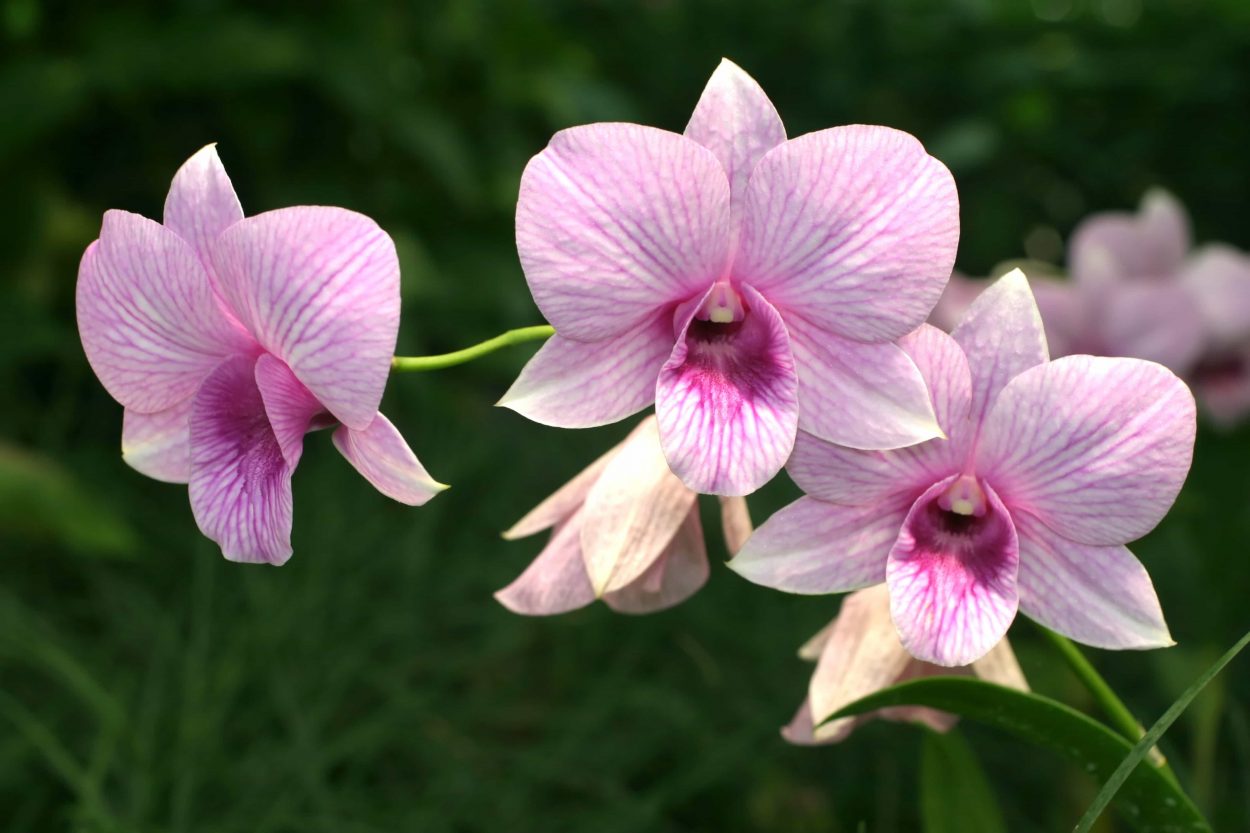
In China, Dendrobium grows primarily in subtropical regions and exists in many varieties. It is also known by evocative names such as “gold hairpin flower” and “thousand-year moist,” reflecting its perceived vitality-nourishing qualities. The plant has upright, fleshy stems shaped like slightly flattened cylinders. Its leaves are long, oval, and leathery. The flowers grow in racemes, with broad, slightly slanted petals and oval stamens. Depending on the species, the blossoms may be pink, white, or pale yellow. The fruit is a long, oval capsule containing numerous tiny seeds, and the flowering season typically occurs from April to May. Dendrobium thrives in warm, humid, and shaded environments, and in the wild, it commonly grows on moss-covered tree trunks or rocks in mountain valleys.
According to the Shennong Bencao Jing, an ancient classic of Chinese Materia Medica, “Dendrobium tastes sweet and neutral. It treats internal injuries, dispels numbness, regulates qi, replenishes the five organs, and strengthens yin. With long-term use, it nourishes the stomach and intestines, lightens the body, and prolongs life. It is called forest fungus and grows in mountain valleys.”
In plain language, Dendrobium is valued for its ability to generate bodily fluids, nourish the stomach, moisten the lungs, support kidney function, brighten the eyes, and strengthen the bones. Beyond its medicinal uses, Dendrobium also has high ornamental value. Numerous cultivated varieties display a rich diversity of flower colors and forms, making them well-suited for potting or bonsai cultivation in the home, where they offer both beauty and symbolic vitality.
Huoshan: The ‘Hometown of Dendrobium’
Huoshan, a mountain in the Dabie Range of Anhui Province, and Huoshan County, located in this mountainous region, are widely known as the “Hometown of Dendrobium.” Today, more than 10,000 people are employed in the local Dendrobium industry. A few years ago, the county’s annual output value of Dendrobium surpassed 4 billion yuan, underscoring its economic and cultural importance.
The most prized cultivated variety from this region is known as “Mihu.” It originated from wild Dendrobium collected from narrow crevices in cliffs and was gradually domesticated into a distinct cultivated species. Mihu has since been listed as a nationally protected species. Its leaves and stems are short and compact, with stems resembling the thick thighs of a grasshopper. The plant grows slowly, requiring five to six years of cultivation before it can be harvested.
Huoshan’s Dendrobium breeding base covers more than 100 acres of forest and contains approximately 500,000 clumps of Dendrobium. Artificial cultivation is carried out either in forest understories or in holes drilled into rocks and filled with soil, closely mimicking the plant’s natural habitat. Because each plant has a lifespan of only about six years, it must be harvested before it naturally withers. Rock cultivation, in particular, depends on careful propagation: seedlings are first grown in sterile bottles for 1 year, transferred to greenhouses for another 1 year, and finally transplanted into soil-filled rock crevices, where they grow for 3 additional years before reaching maturity.
Conclusion
In the delicate blooms of orchids — and especially in the slow-growing stems of Dendrobium — we see more than beauty or medicinal value; we see life itself unfolding. These plants remind us that growth takes time, and that patience and care are the foundations of strength and resilience. Just as orchids flourish when nurtured, the qualities we value in ourselves and in life — resilience, integrity, and grace — develop gradually through steady attention and mindful effort. In every bloom, there is a quiet lesson: lasting growth comes from attentiveness, persistence, and respect for the natural rhythm of life.
Translated by Cecilia and edited by Tatiana
Follow us on X, Facebook, or Pinterest
