
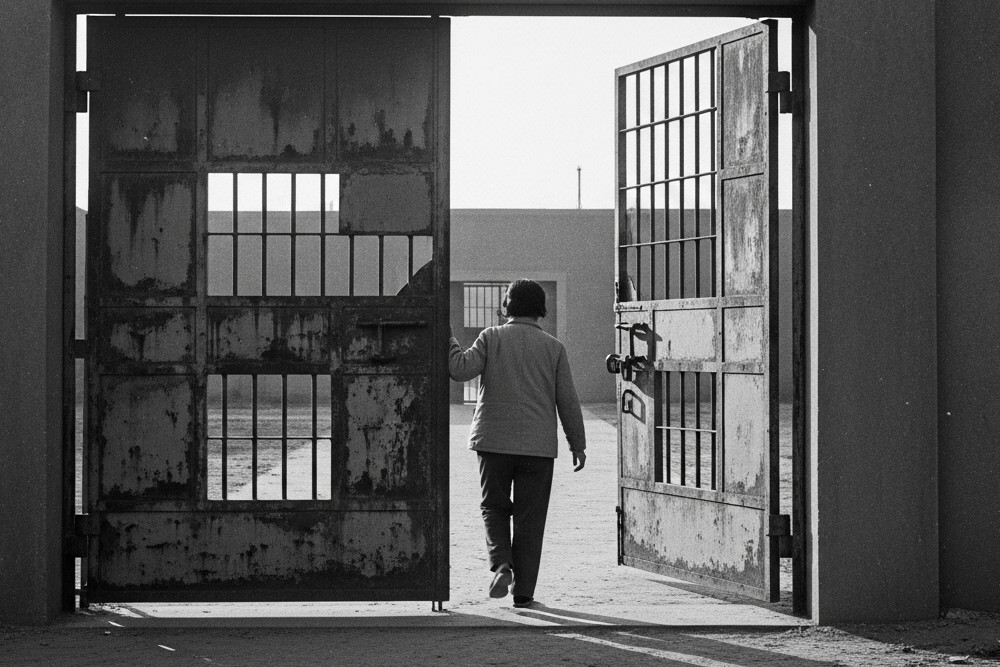
Wang Rongfen was 19 years old when she wrote a letter directly to Mao Zedong condemning the Cultural Revolution and renouncing the Communist Youth League. After mailing the letter, she swallowed four bottles of pesticide in an attempt to protest through death.
She did not die that day. When she regained consciousness, she found herself in a hospital run by China’s public security authorities, surrounded by police officers.
She remained there for two days before being formally arrested and transferred to Gongdelin Prison in Beijing. From there, she was moved repeatedly — from a juvenile correctional facility outside Deshengmen, where detainees were subjected to political “study sessions” and public denunciations, to the Beijing Municipal Detention Center at Banbuqiao.
In 1969, as tensions with the Soviet Union escalated and China prepared for the possibility of war, Wang was sent to a detention center in Linfen, in southern Shanxi Province. Later, she was transferred again, this time to Jincheng, in southeastern Shanxi.
A life sentence
On January 10, 1976 — nearly 10 years after her arrest — Wang was formally sentenced to life imprisonment. The charge was “current counter-revolutionary activity.” Her crime, according to the verdict, was using “the most vicious language” to attack Chairman Mao, described in official rhetoric as “the reddest sun in our hearts.”
Following the sentencing, she was transferred to the Women’s Prison in Yuci, also known as Shanxi Fourth Prison, where she was assigned to forced labor.
The year leading up to her sentencing was the most brutal period of her confinement. She was subjected to a form of torture in which her hands were cuffed behind her back and her feet bound with heavy iron shackles. The restraints, forged in a blacksmith’s furnace, cut deeply into her flesh.
Wang later recalled that within hours, the pain became unbearable, constricting blood flow so severely that her heart felt as though it might fail. Most prisoners, she said, would beg for mercy under such conditions. She did not.
Eventually, a forensic doctor was called in. After examining her, he warned the guards that she would die if the restraints were not removed. By then, her skin and flesh had fused with the iron. When the shackles were torn away in midwinter, strips of skin came off with them. The guards threw the blood-stained metal into a stove, where it hissed as it burned.
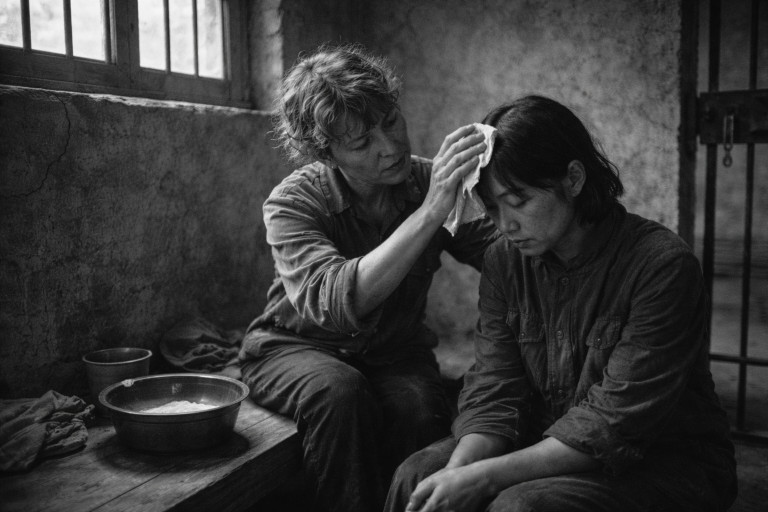
During this period, Wang shared a cell with a woman from the Soviet Union. The woman, horrified by what she witnessed, helped care for Wang when she was too weak to care for herself.
Release and renewal
Less than a month after Mao Zedong’s death, on October 6, 1976, Mao’s wife Jiang Qing and the other members of the so-called Gang of Four were arrested, bringing the Cultural Revolution to an end.
After China’s leadership announced a policy of reform and opening up in late 1978, the government began reviewing wrongful convictions from the previous decade. On March 11, 1979, after twelve and a half years in detention, Wang was suddenly informed that she was not guilty and would be released.
She had entered prison at nineteen. She emerged at 32.
In the years that followed, Wang rebuilt her life. She worked briefly as a substitute German teacher before applying to the Chinese Academy of Social Sciences, which was reestablishing its sociology program. An academic paper she submitted caught the faculty’s attention, and she was admitted after an interview.
She went on to work in the preparatory group of the Chinese Sociological Association and later became a researcher at the Institute of Sociology. Over time, she developed a scholarly focus on the German political economist and sociologist Max Weber, translating several important works into Chinese, including Confucianism and Taoism.
The scholar Fu Guoyong later remarked that a slim volume Wang translated — containing Weber’s lectures “Politics as a Vocation” and “Science as a Vocation” — had become a personal source of inspiration, with passages he copied into his diary as guiding maxims.
In June 1989, Wang moved to Germany, where she has continued to write.
June Fourth and hard-earned clarity
In the spring of 1989, Wang once again found herself standing at a moment of national crisis. After the death of former Communist Party general secretary Hu Yaobang on April 15, student-led demonstrations spread across Beijing. Protesters called for an end to corruption and demanded greater political freedom, drawing support from intellectuals and ordinary citizens alike.
Wang was living in Beijing at the time. She went to Tiananmen Square every day.
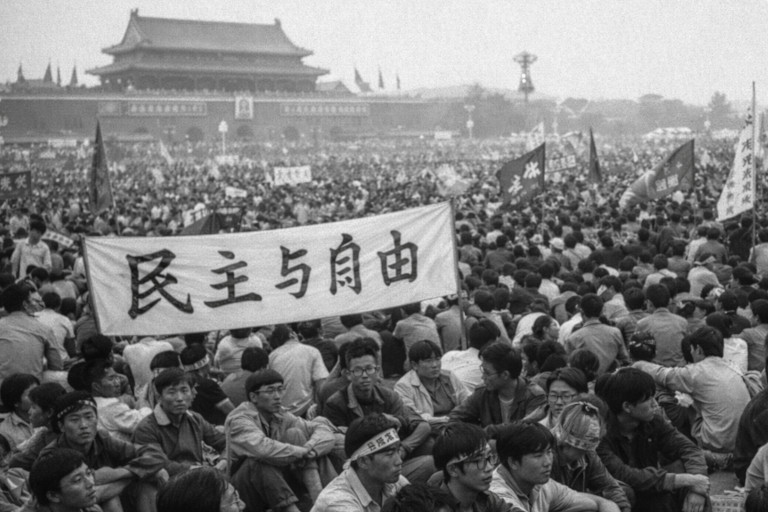
“I joined a group of intellectuals in the capital to support the students,” she later recalled. “They asked us to go on a hunger strike, and I joined that as well.”
Before leaving home, she made arrangements for her family. She left her child in her mother-in-law’s care, who handed her a thick cotton-padded coat.
“She told me: ‘Don’t get cold at night,’” Wang said.
On June 4, the demonstrations were crushed by military force. Troops entered Beijing with tanks and automatic weapons, firing on civilians and clearing the square. Wang spoke later not as a distant observer, but as someone whose remaining faith in political reform was extinguished that night.
“I once had a certain degree of recognition and gratitude for Deng Xiaoping,” she said. “Partly because of my own experience, and partly because I believed economic reform began with him. But once people were killed, that was the end. A line was crossed. Everything that came before no longer mattered.”
She did not speak in abstractions. She spoke of responsibility.
“To send hundreds of thousands of soldiers to suppress students and civilians — this is outrageous,” she said. “To open fire on ordinary people like that is an unforgivable crime.”
From that point on, Wang no longer believed that internal reform or factional change within the Communist Party could prevent future violence.
“When the Party’s fundamental interests are touched,” she said, “it will always resort to force. It will use guns. That will never change.”
Remembering, and bearing witness
In January 2008, Wang published an open letter addressed to China’s leadership, calling the Cultural Revolution a catastrophe against humanity and urging authorities to confront the crimes of the past rather than bury them.
Looking back on Wang Rongfen’s life, observers have often highlighted three extraordinary aspects of her fate: her moral clarity and courage in an era of collective madness; her survival through years of imprisonment when execution would not have been surprising; and her ability, after enduring extreme suffering, to rebuild her life and achieve lasting scholarly contributions.
Her story stands as a reminder of the cost of conscience — and of the resilience required to survive it.
See Part 1 here
Translated by Chua BC
Follow us on X, Facebook, or Pinterest
