
For most of human history, food production depended on forces no one could fully control. Seasons shifted, weather patterns disrupted plans, and even skilled farmers worked within limits set by land and climate. Agriculture was never fully predictable — it was something to manage, not command.
That dynamic is beginning to change, at least for certain crops.
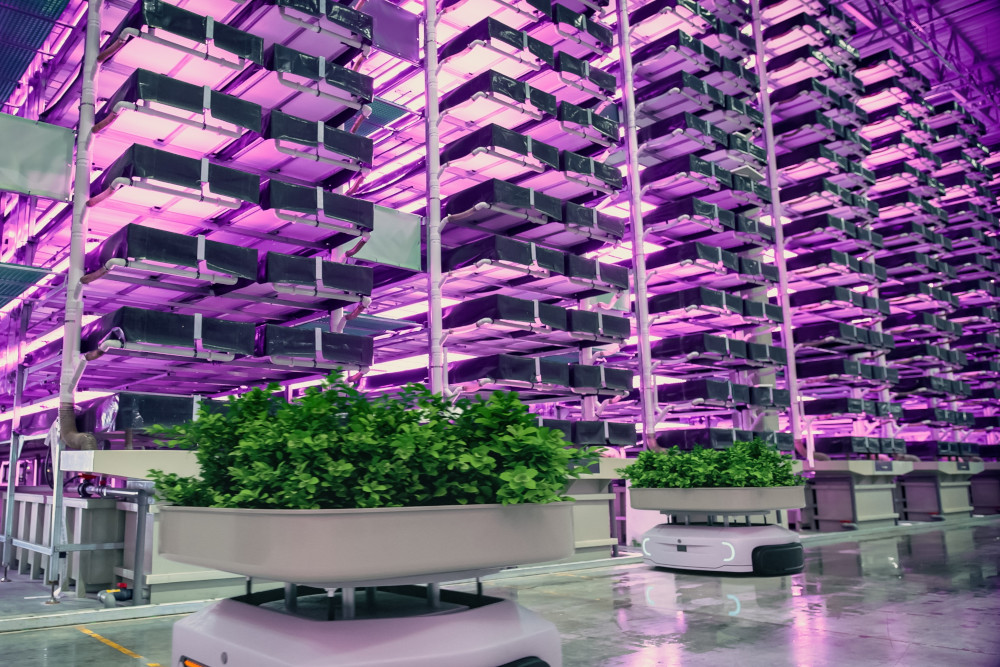
Inside a growing number of indoor farms, plants are raised in stacked layers under tightly controlled conditions. Light, humidity, nutrients, airflow, and temperature can all be adjusted with precision. In advanced systems, sensors track growth in real time while software helps manage everything from irrigation to harvest timing.
Robotic vertical farming is not just changing how food is grown. It is changing how food production is designed, measured, and scaled — and that shift has broader implications than it may first appear.
Vertical farming 2.0: Beyond the hype of leafy greens
At its core, vertical farming means growing crops indoors in stacked layers rather than across open fields. In practice, it relies on controlled environments, artificial lighting, automation, and systems such as hydroponics or aeroponics that deliver nutrients without soil.
The advantages can be significant. Compared with conventional agriculture, vertical farms can use far less water, require much less land, and avoid many pesticides. Crops can be grown close to urban centers and produced year-round without relying on local weather conditions.
Investment has followed that promise. The global vertical farming market was valued in the range of several billion dollars in 2024, with projections pointing to continued growth over the next decade. Companies such as Plenty, 80 Acres Farms, and Little Leaf Farms have attracted major funding, and partnerships with large retailers show how quickly the model is being tested at scale.
At the same time, the limits are just as important to understand. Vertical farming is currently best suited to high-value, fast-growing crops such as leafy greens and herbs. Staple crops remain far more expensive to produce indoors, largely because of energy demands. The closure of high-profile companies like Bowery Farming has also highlighted how difficult the economics can be.
Taken together, this is not a replacement for traditional agriculture. It is a new layer being added to it — one that works well in specific contexts and remains constrained in others.
Growth recipes: The logic of controlled environment agriculture (CEA)
One of the most interesting aspects of vertical farming is how it turns growing conditions into something closer to a managed system.
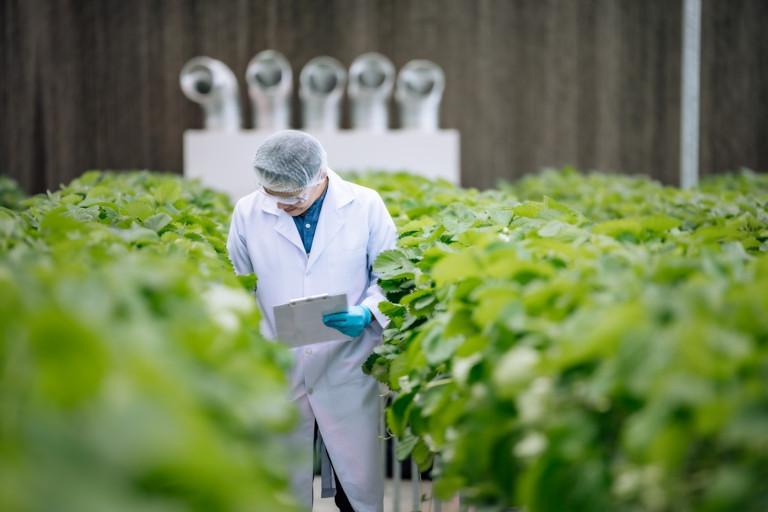
In a traditional field, a crop reflects a mix of environmental conditions and human judgment. In a controlled indoor farm, those variables are far more explicit. Light intensity, nutrient delivery, and airflow can all be adjusted, tested, and repeated. Over time, this allows growers to refine what are essentially “growth recipes” that can be reused and improved.
This is where comparisons to software begin to emerge — not because food literally becomes software, but because the process becomes more structured and repeatable. Systems can be standardized, monitored across locations, and refined using data.
That said, the comparison has limits. Plants remain living organisms shaped by biology, not code. Disease, genetics, and environmental stress still matter in ways that cannot be fully abstracted away. The value of the analogy is in explaining scalability, not in redefining what food is.
Once a growing system is standardized, it becomes easier to replicate. Expansion depends less on local conditions and more on whether the system itself can be reproduced efficiently. That is a meaningful shift in how agriculture can scale.
From fields to infrastructure
Traditional agriculture has always been tied to place. Even large-scale industrial farming still depends on land, water, climate, and regional conditions. Vertical farming loosens some of those constraints.
When crops can be grown indoors under controlled conditions, production can move closer to population centers. For certain foods, that can reduce transportation needs and make supply more consistent throughout the year.
At the same time, food production becomes more dependent on infrastructure — facilities, energy systems, automation, and data. The field is replaced by a controlled environment that requires significant investment and technical expertise.
This changes who can realistically participate. While traditional farming allows for a wide range of scales and ownership models, vertical farming tends to favor organizations that can manage capital-intensive systems.
That shift does not determine the outcome on its own, but it does make questions of ownership and governance more important.
Why ownership matters more in controlled systems
As food production becomes more system-driven, control over those systems carries more weight.
Decisions about which crops are grown, how they are optimized, and what trade-offs are made do not disappear — they become embedded in the system itself. In more distributed agricultural models, those decisions are spread across many producers. In centralized systems, they can become more concentrated.
This is not unique to agriculture. Other infrastructure-heavy industries have followed similar patterns, where efficiency and scale often lead to consolidation.
In the case of food, that raises practical questions rather than abstract ones. How transparent are production methods? Who sets nutritional priorities? How much diversity is preserved within the system? And how easily can alternative approaches coexist?
These are not arguments against the technology. They are questions about how it develops.
Nutrition, efficiency, and trade-offs
Controlled environments make it possible to optimize crops in new ways. Taste, growth speed, shelf life, and nutritional content can all be adjusted within certain limits.
None of these capabilities are inherently negative. In fact, they can improve consistency and reduce waste. But they also introduce trade-offs.
When production systems are optimized for efficiency, multiple goals compete: yield, cost, energy use, transport, and product consistency. Nutrition becomes one of several variables rather than the defining constraint.
That does not mean nutrition will be ignored. It does mean it has to be actively prioritized rather than assumed.
What changes when feedback becomes indirect
In traditional agriculture, environmental consequences are often visible. Soil depletion, crop failure, and ecological imbalance show up in ways that are difficult to ignore.
Indoor farming changes how those signals appear. Instead of direct environmental feedback, performance is measured through data — yield metrics, energy consumption, and system efficiency.
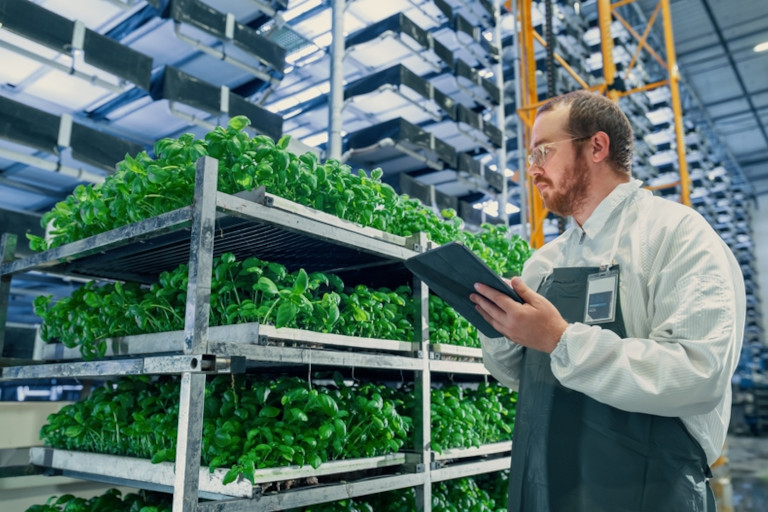
That shift can make problems easier to manage in some ways and harder to detect in others. When feedback is mediated through systems rather than observed directly, it becomes more dependent on how those systems are designed and what they measure.
Possible paths forward for vertical farming
A decentralized resilience path
In this trajectory, vertical farming develops alongside traditional agriculture rather than replacing it. Ownership is more distributed, and systems are built with transparency and public accountability in mind. Farmers, municipalities, and consumers remain part of the conversation, and the technology strengthens local food systems without concentrating control.
An infrastructure consolidation path
In another direction, vertical farming follows the pattern seen in other infrastructure-heavy industries. High capital costs and technical complexity favor a small number of dominant players. The system becomes efficient and scalable, but less visible and more centralized, with fewer participants shaping how it evolves.
A volatile growth path
A third possibility is uneven expansion. Investment surges ahead of stable economics, leading to cycles of rapid growth followed by contraction. Failures consolidate assets into fewer hands, and the system that remains is technically advanced but less resilient to disruption.
Why inclusion still matters
Technological transitions often sideline existing expertise. In agriculture, that would be a mistake.
Farmers bring practical knowledge about variability, resilience, and failure — things that controlled systems can struggle to replicate. Incorporating that knowledge into new models is not about preserving tradition for its own sake; it is about maintaining robustness in systems that might otherwise become too narrow.
Participation also matters at a broader level. Food systems affect everyone, yet the shift toward controlled production can reduce public visibility. Maintaining transparency and accountability becomes more important as systems become more complex and less accessible.
Keeping the system grounded
Vertical farming is often framed in terms of efficiency, and that is part of its appeal. But food systems are not purely technical. They involve trust, access, and long-term stability.
If these systems are developed with transparency, diverse participation, and clear standards, they could strengthen parts of the food system that are currently fragile.
If they are shaped only by efficiency and scale, they may solve some problems while creating others that are harder to see.
The technology itself does not determine the outcome. The surrounding choices do.
That makes this a good moment to pay attention — not because the shift is inevitable, but because it is still taking shape.
Follow us on X, Facebook, or Pinterest
