
A boat that would not move
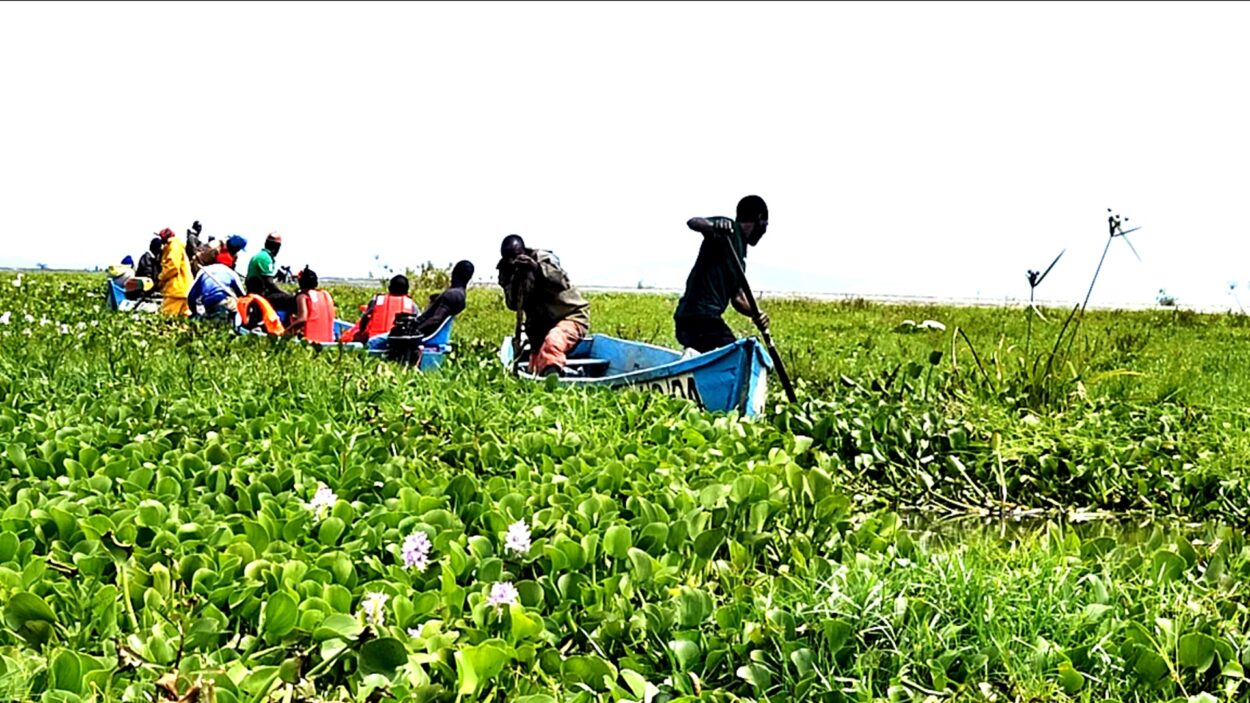
Water hyacinth packaging did not begin in a laboratory or a venture capital pitch deck. It began on a hot afternoon in Lake Naivasha, somewhere in Kenya’s Rift Valley, when a small wooden boat carrying a group of engineering students from Egerton University stopped moving. Not because the engine had failed. The water itself had thickened. A mat of glossy green leaves and lavender flowers had closed around the hull like a living net, and the lake — one of the country’s most photographed freshwater jewels — refused to let them through. They were stuck for hours. The plant suffocating their boat was water hyacinth, and one of the students, Joseph Nguthiru, would spend the next several years building a company around the question that began forming in his head while he waited.
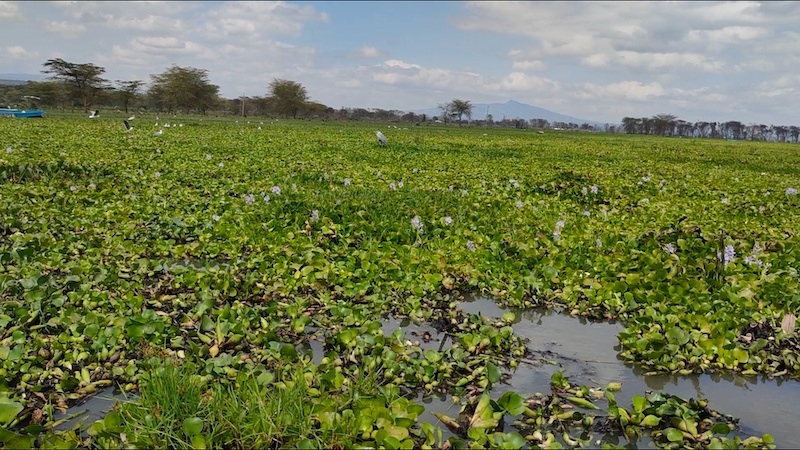
Water hyacinth packaging is, on its face, a strange phrase. Most people have never heard of the plant. Those who have tend to know it the way the fishermen of Naivasha know it — as an enemy. Originally from South America, it was introduced to Kenya in the 1980s, reportedly brought in as an ornamental novelty by tourists who liked its purple blooms. Within a generation, it became, by UNEP’s reckoning, the world’s most invasive aquatic weed. It blankets surfaces. It blocks sunlight. It strangles oxygen out of the water column. It chokes nets, snaps propellers, and turns breeding grounds into dead zones. A 2023 study cited by the East African Journal of Environment and Natural Resources estimated annual losses across Kenya’s fishing, transport, and tourism sectors at somewhere between 150 and 350 million dollars.
At Lake Naivasha, the fisherman Simon Macharia describes the collapse in his own register. He used to bring in around ninety kilograms of fish a day. Now he is lucky to bring in fifteen. His income has fallen from roughly $210 to $35. “It grows back faster than we can remove it,” he told the Associated Press. The hyacinth, in his telling, is not a weed. It is a slow-motion economic disaster moving across the surface of his livelihood. “What struck me was that no one was doing anything about it,” said Joseph Nguthiru, founder of HyaPak.
How water hyacinth packaging began as a refusal of the conventional ledger
The conventional response to an invasive species is to spend money killing it. Mechanical removal. Herbicides. Sometimes, the release of weevils or other biological control agents may not go as planned. In every case, the plant is treated as a cost — something to be reduced, suppressed, hauled away, or written off. The line item is always negative.
Nguthiru’s change of his final-year university project after that stranded boat was, in a quiet way, a refusal of that ledger. Water hyacinth grows fast because it is biologically efficient. Its leaves and stalks are roughly seventy percent cellulose, the same long-chain sugar that makes wood structural and paper foldable. It aggressively absorbs nutrients from polluted water, concentrating them in its tissues. In other words, the plant is doing something useful — pulling carbon and minerals out of compromised lakes — and then being treated as garbage for doing it well. If you look at the same biomass through a different lens, it stops being a weed and starts being a feedstock. A free, self-replicating, locally abundant, carbon-rich fiber that wants to be harvested.
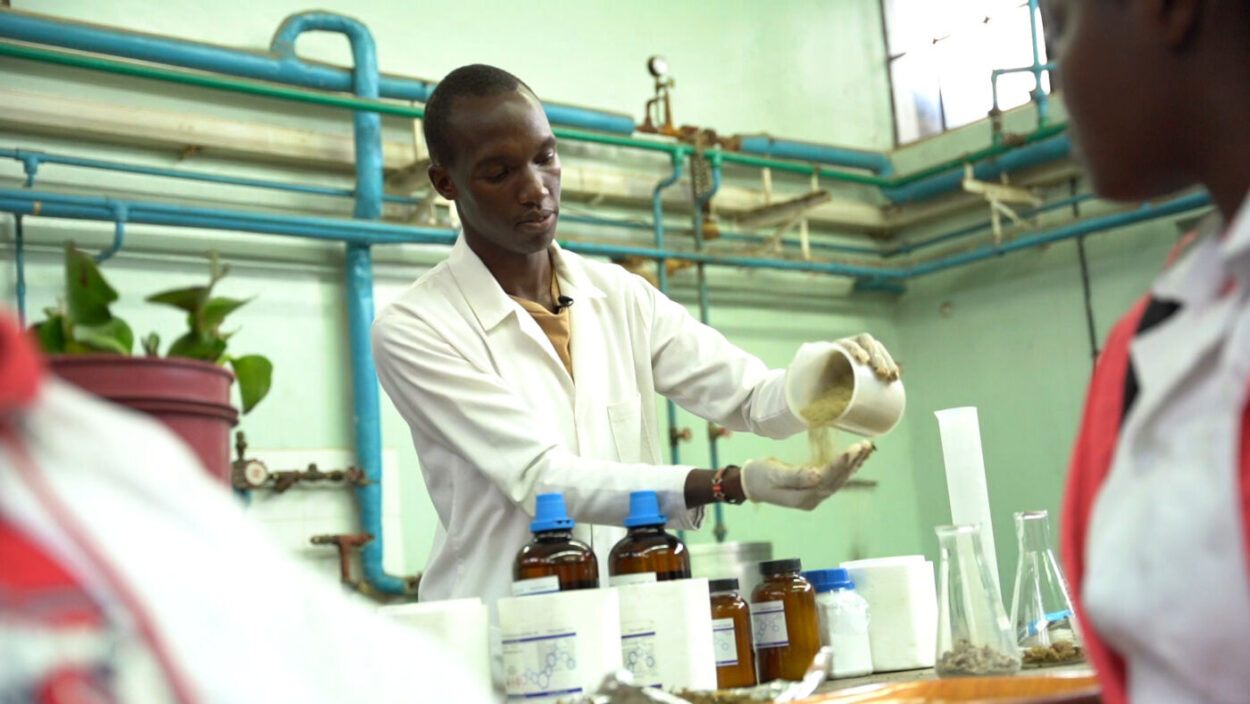
This is the small reversal on which the entire HyaPak idea rests. Nothing changed about the hyacinth itself. What changed was the category it had been filed under. The question moved from how to get rid of this to what this is for. Once that question is asked seriously, the engineering becomes tractable. Crush the dried plant. Mill it. Mix it with binders. Run it through biodigesters. Press it into sheets and bags. The result is a material that, in Nguthiru’s own description, “feels like plastic, performs like plastic, but biodegrades after a short time.”
What HyaPak actually makes
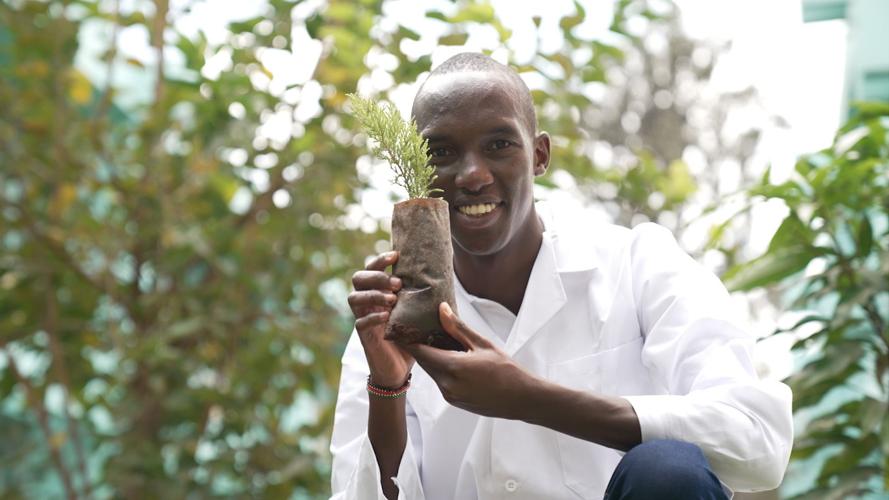
Founded in 2022 as HyaPak Ecotech Limited, the company has spent four years moving from campus prototypes — Nguthiru describes the early ones as clunky — to a small but real product line, all of it derived from harvested hyacinth pulp. The headline product is a biodegradable seedling bag. Traditional plant nurseries hand out millions of black polythene bags every year; the bags are stripped off when the seedling goes into the ground and become some of the most stubborn micro-litter in agricultural landscapes. HyaPak’s version is planted directly into the soil along with the tree. Within roughly six months, it has decomposed, releasing nutrients that, according to the company and partner trials, accelerate plant growth and reduce the irrigation water required during establishment.
Beyond seedling bags, the company makes biodegradable parcel packaging for courier services and a carton lining designed to keep fresh produce viable during transit without refrigeration. That last application is quietly interesting. East African cold-chain infrastructure is patchy at best, and a packaging material that slows spoilage on its own, then disappears into compost when the journey ends, sits at the intersection of two problems most logistics companies treat separately: food loss and packaging waste.
The supply chain is deliberately local. Fishermen on Naivasha — the same people whose boats the plant once trapped — are contracted to harvest the hyacinth. The wet biomass is dried onshore, then trucked to Egerton University for processing in collaboration with the university’s research labs. Real-world testing has been done with the Kenya Forest Research Institute, the Kenya Defense Forces, the agricultural nonprofit One Acre Fund, DHL, and Plant Village, among others. In 2024, the company partnered with the Government of Kenya to integrate the bags into Jaza Miti, the national reforestation program committed to planting 15 billion trees over the next decade.
The material itself falls into a category the bioplastics industry has been chasing for years: a packaging substrate that genuinely returns to the soil rather than fragmenting into microplastics. Most so-called biodegradable plastics on supermarket shelves — PLA, oxo-degradable polyethylene blends, certain starch composites — require industrial composting conditions to actually break down. Buried in a field or dropped in a lake, they behave much like ordinary plastic for years. A cellulose-and-binder composite derived from hyacinth biomass is structurally different. It is, more or less, dense plant fiber held together by additives. When the bag is buried with a seedling, the soil microbiome treats it as it would any other dead plant tissue. There is no special infrastructure required. The decomposition is occurring wherever the bag happens to be. Nothing changed about the hyacinth itself. What changed was the category it had been filed under.
The numbers and the honesty about them
It is tempting, when writing about climate-tech startups, to surrender to the press-release voice. HyaPak’s numbers are real, but they are also small relative to the scale of the problem, and the company has been admirably clear about that. As of late 2025, the firm had cleared somewhere between 8 and 20 hectares of hyacinth from Lake Naivasha and created dozens of green jobs in the surrounding community. Different sources cite different figures, partly because clearance is ongoing and partly because hyacinth, left to itself, can regrow a hectare faster than most teams can harvest a hectare. The lake itself, at its worst, has had roughly fifteen hundred hectares under infestation. HyaPak is not, by itself, going to fix Lake Naivasha.
What the company has done is something more structurally important. It has been shown that the economics work — that an invasive plant, properly routed, can fund its own removal through a downstream product the market actually wants. HyaPak is now exporting biodegradable packaging to the United States and Germany, with plans to seed franchises in India and El Salvador, two countries that face their own hyacinth infestations. The model travels because the problem travels. Wherever there is a slow-moving freshwater body and enough nutrient runoff, the plant will arrive. HyaPak’s bet is that the response — harvest, process, sell — can be installed locally in each of those places, run by the communities most affected.
Recognition without inflation
Nguthiru himself has accumulated the kind of CV that international foundations build careers around: 2023 Obama Foundation Africa Leader, Prototypes for Humanity winner at COP28, One Young World ambassador, 40 Under 40 Africa, and in September 2025, the United Nations Environment Programme’s Young Champion of the Earth — an award that comes with twenty thousand dollars in seed funding, mentorship, and the kind of global stage that converts attention into capital. He is twenty-seven.
The recognition is deserved, but it would be a thin reading of HyaPak to treat the awards as the point. Awards are downstream signals. The upstream fact is that a kid who got stuck in a lake at twenty-one looked at the thing that had stopped his boat and refused to call it nothing. Most of the world’s hardest environmental problems are like this. They are not waiting for a breakthrough technology. They are waiting for someone to look at a piece of biomass, or a waste stream, or a stranded resource, and ask the unfashionable question: what if this is the answer to something else?
Nguthiru has not stopped at hyacinth. He runs M-Situ, an AI-based early-warning system for forest fires and illegal charcoal burning; AfroClimate, a nonprofit accelerator for African climate entrepreneurs; and the Adopt a River initiative, which has cleared more than 3 tons of waste from Kenyan rivers. The pattern is consistent. Each venture starts with something the conventional view has classed as a loss — an invading plant, an unmonitored forest, a polluted river — and rebuilds the economics around treating it as an input.
One problem solving another is older than the startup
There is a phrase Nguthiru returns to in almost every interview. “We decided to use one problem to solve the other.” It is the cleanest possible statement of what HyaPak does, and it sounds, the first time you hear it, like the kind of motto a marketing team would polish. It is also, on closer inspection, a description of how almost every functioning ecosystem on the planet works.
In a forest, dead leaves are not a disposal problem; they are next season’s soil. In a healthy lake, fish waste is not pollution; it is the nitrogen budget for algae, which is the nitrogen budget for the next generation of fish. The closed loop is not a matter of aesthetic preference. It is the only configuration in which complex systems persist over time. What human industrial production has done, for roughly two centuries, is run the loop open: extract on one end, dump on the other, externalize the bill to a future no one in the present has to look at. Plastic is the most visible symptom of that openness. Invasive species are another. Both are what happens when something gets added to a system without a return path.
HyaPak’s elegance is that it inserts a return path where there had been none. Hyacinth biomass, instead of accumulating until it kills the lake, leaves the lake as packaging. Packaging, instead of accumulating until it kills the soil, decomposes back into the soil. The two open loops are combined into a single closed loop. This is not a metaphor for circularity. It is, in the most literal sense, what circularity is. The hardest environmental problems are not waiting for a breakthrough. They are waiting for someone to refuse to call a thing nothing.
What does this mean if you are building anything?
There is a temptation, upon reading a story like HyaPak’s, to file it under ‘inspiring African innovation’ and move on. That filing is comfortable, slightly condescending, and misses the actionable lesson. The lesson is general. It applies to anyone — engineer, founder, policymaker, farmer — who is currently treating something as waste.
Most waste streams are not waste. They are materials for which downstream applications have not yet been developed. Spent grain from a brewery is a feedstock for mushroom growers. Discarded fishing nets are feedstock for nylon recyclers. The carbon dioxide vented from a cement plant can be used as feedstock for synthetic fuels, provided there is enough renewable electricity and patience. The pattern repeats. The question is rarely, if ever, a use; the question is almost always who is willing to do the unglamorous work of building the bridge between the side that produces and the side that consumes.
HyaPak built that bridge with cellulose, fishermen, a university lab, and a willingness to start before the model was fully proven. It did not wait for a perfect process. It did not wait for venture capital. The first prototypes were, by Nguthiru’s own admission, clunky. The company exists because someone took a four-year, materially uncertain bet on the idea that one problem could be turned into the answer to another.
It is worth saying clearly: the conditions that produced HyaPak were not optimal. Kenya’s manufacturing infrastructure is thinner than that of the markets the company now exports to. University research labs running on academic budgets are not built for industrial throughput. Working with local fishermen as a supply chain rather than as beneficiaries requires logistics and trust that no business school course covers. None of these were arguments for waiting. They were the constraints within which the work happened. The constraints did not produce mediocrity; they produced specificity. The bag that gets planted with a Kenyan tree was designed by people who actually planted trees in Kenya. The carton lining that keeps produce fresh without cold storage was developed in a country where cold storage cannot be assumed. The work is shaped by where it happens, and that shaping is what makes it durable.
Lake Naivasha is still choked. The hyacinth has not been defeated. The seedling bags do not, by themselves, end plastic pollution. None of this is a triumphant ending. What HyaPak has demonstrated over the four years since a boat got stuck in green water is that the framing was the bottleneck — not the engineering, not the biology, not the market. Once the framing shifted, everything else became a matter of execution.
Somewhere on a Naivasha shoreline this morning, a fisherman is pulling up hyacinth he used to curse, drying it on a wooden rack, and watching it leave the lake as something a courier company in Germany will pay for. The plant did not change. The lake did not change. The plastic problem did not change. What changed was that someone, having been stopped by the thing, decided to ask what it was actually made of.
Follow us on X, Facebook, or Pinterest
