
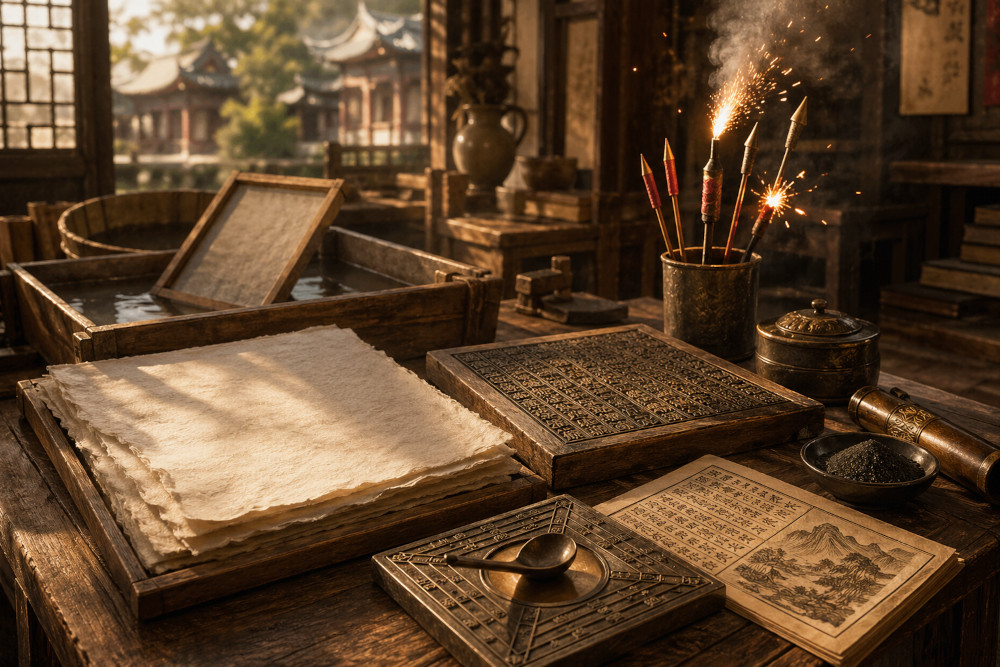
Late one evening, in a quiet workshop along the Yellow River, a Han Dynasty alchemist ground sulfur and saltpeter together by candlelight. He was searching, as so many of his order had searched before him, for the elixir of immortality. What he found instead was huoyao (火藥), fire medicine. We know it today as gunpowder.
For more than 1,500 years, much of the world ran on ancient Chinese inventions, unaware of their origins. The book in your hand, the compass on your phone, the printing that shapes every newspaper and street sign, each can trace its earliest origins to a workshop, monastery, or imperial court somewhere in the long arc of Chinese history.
In this article, we’ll explore the Four Great Inventions that quietly helped build the modern world, look at lesser-known wonders that still surprise scholars, and consider the cultural soil, the patient observation, the alchemical curiosity, and Confucian record-keeping that made all of it possible.
What are the four great inventions of ancient China?
The Four Great Inventions of ancient China are papermaking, printing, gunpowder, and the compass. Each emerged in China centuries, and in some cases more than a thousand years, before reaching Europe, and each transformed the course of human civilization. The phrase “Four Great Inventions” was coined by Western scholars in the 16th century and remains the most celebrated summary of Chinese technological priority.
Paper: A quiet revolution in A.D. 105
Before paper, the Chinese wrote on bamboo strips, silk, and bone. Bamboo was heavy. Silk was costly. A long letter could weigh as much as a small child.
The breakthrough came in A.D. 105, when Cai Lun (蔡倫), a court official of the Eastern Han Dynasty, presented Emperor He with a remarkable new material. He had pulped tree bark, hemp ends, fishnet, and worn rags into a smooth, light, writable sheet. The emperor was delighted. Within decades, Cai Lun’s method had spread across China, and within centuries, it had spread across Asia.
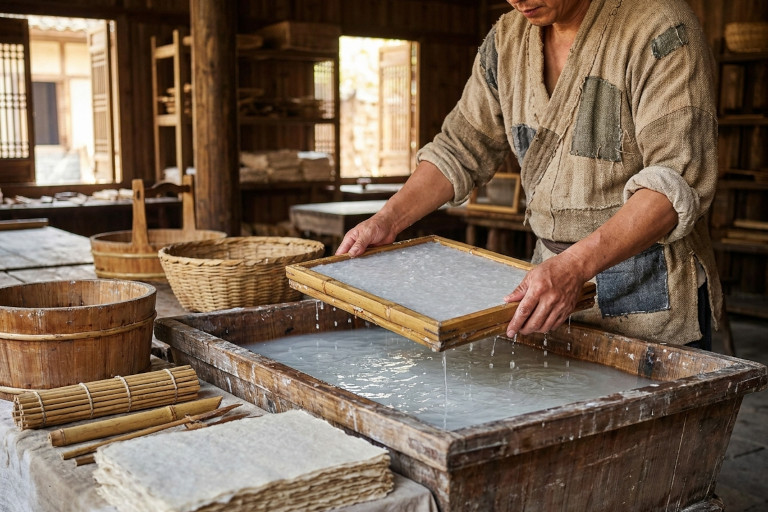
Paper traveled westward slowly and along strange routes. After the Battle of Talas in A.D. 751, Tang Dynasty papermakers captured by Arab forces taught their craft in Samarkand and Baghdad. Paper reached Europe through Islamic Spain by the 12th century, six hundred years after it was already commonplace in Chinese homes and libraries.
It is hard to imagine a more modest revolution. A pulp, a screen, a press, a sheet. And yet without it, there would be no books, no records, no ledgers, no banknotes, no civilization as we recognize it today.
Printing: From woodblock to movable type
China invented printing twice. First came woodblock printing, perfected during the Tang Dynasty (A.D. 618-907). A craftsman would carve an entire page in mirror-image relief on a wooden block, ink it, and press paper against it. The world’s oldest dated printed book, a copy of the Diamond Sutra held by the British Library, was printed this way in A.D. 868, almost six centuries before Gutenberg.
Then, around the year 1040, an artisan named Bi Sheng (畢昇) of the Song Dynasty made an extraordinary leap. He fashioned individual Chinese characters from baked clay, set them into iron frames with hot wax, and rearranged them for each new page. This was movable type, and it appeared in China four hundred years before Europe’s printing press.
Why did movable type spread more slowly in China than it later did in Europe? The answer lies partly in the language itself. Chinese has thousands of distinct characters; an alphabet of 26 letters is simply easier to typeset. But Bi Sheng’s insight, carved into his clay characters, would eventually shape every printed word in every language on earth.
Gunpowder: The accidental elixir
The story of gunpowder is, at heart, a Chinese cultural irony. Daoist alchemists of the Tang Dynasty were not seeking weapons. They were searching for the elixir of life, the formula that would grant the emperor immortality.
Mixing sulfur, saltpeter, and charcoal in their search for harmony, they discovered something else entirely: a substance that flashed, banged, and burned. The earliest written formula appears in a Tang Dynasty text from around A.D. 850, with the cautionary note that those who experiment with it “have had their hands and faces burnt, and even the whole house where they were working burned down.”

By the Song Dynasty, military engineers had refined the discovery into fire arrows, bombs, and primitive cannons. By the 13th century, gunpowder had reached the Islamic world and Europe through Mongol expansion and Silk Road trade.
The Chinese name for gunpowder, huoyao (火藥), literally means “fire medicine,” a small linguistic memory of its origins as something the alchemists hoped would heal, not harm.
The compass: From spiritual tool to navigation
Long before the compass guided ships, it guided seekers of harmony. The earliest Chinese magnetic devices, known as south-pointers (司南, sīnán), were spoon-shaped pieces of lodestone used in feng shui and divination as early as the Han Dynasty. They sat on bronze plates, indicating the auspicious orientations of buildings, tombs, and altars. Readers familiar with our piece on ancient Chinese cosmology will recognize the same impulse to align human life with the deeper rhythms of the cosmos.
By the 11th century, Song Dynasty scholars had refined the principle. Magnetized iron needles, floated on water or balanced on pivots, were now reliable enough for navigation. The polymath Shen Kuo described the device in his Dream Pool Essays (夢溪筆談) around A.D. 1088, including a careful note about magnetic declination, the small difference between true north and magnetic north, that European navigators would not document for another four centuries.
The compass enabled the great sea voyages of Admiral Zheng He’s treasure fleets in the early 1400s, and it later enabled the European Age of Exploration. From a meditative tool of cosmic alignment, it became the instrument by which the world drew its maps.
Beyond the four: Lesser-known wonders that changed the world
The Four Great Inventions are only the beginning. Across two thousand years, Chinese workshops, courts, and monasteries produced a quiet stream of discoveries, some accidental, some systematic, all remarkable.
Silk: The thread that built an empire
According to legend, Lady Leizu (嫘祖), wife of the Yellow Emperor, was sipping tea in her garden around 2700 BC when a silkworm cocoon fell from a mulberry tree into her cup. The hot tea loosened the cocoon, and a single, shimmering thread began to unwind. So begins the story of silk.
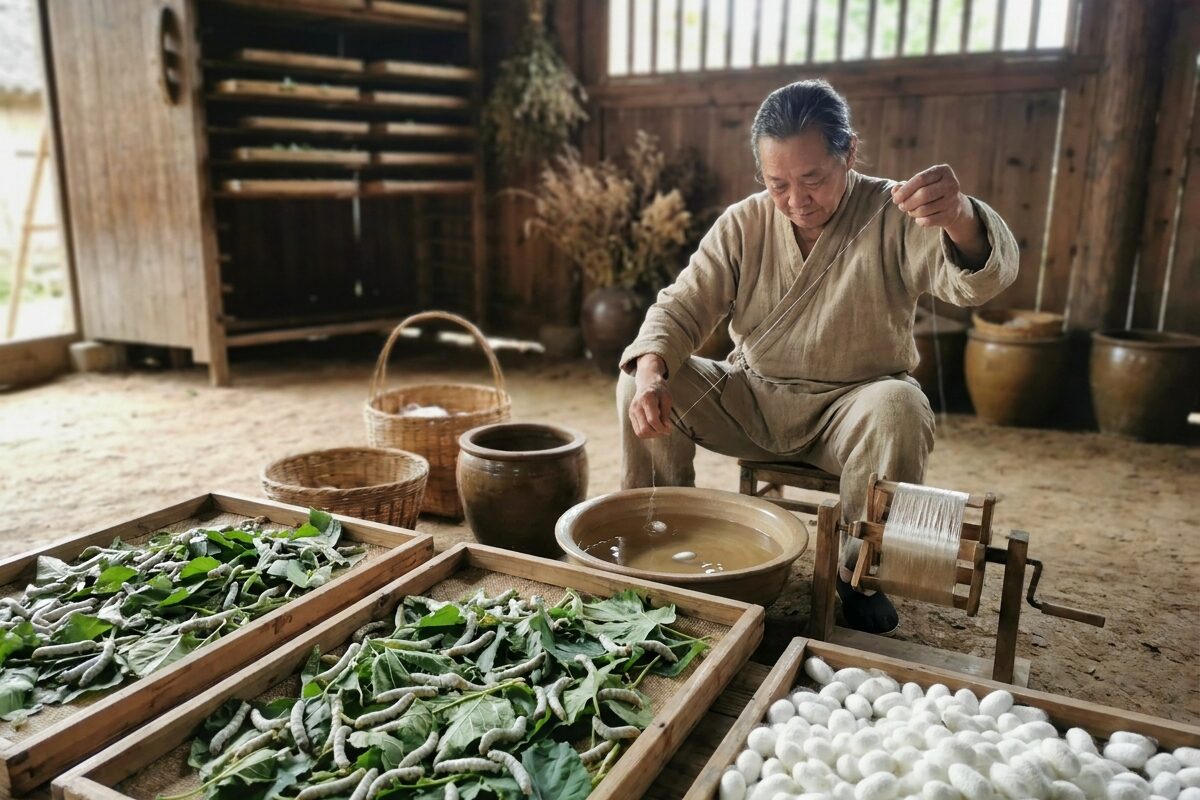
Whether the legend is literal history or a beautiful metaphor, the archaeological record is clear: the Chinese were producing silk by the fourth millennium BC, and they kept the secret of sericulture for nearly two thousand years. Silk became China’s most valuable export, the currency of empires, and the namesake of the great trade route that would carry Chinese inventions westward, the Silk Road, now recognized by UNESCO as one of the most significant cultural corridors in human history.
The seismograph: Zhang Heng’s A.D. 132 earthquake detector
In A.D. 132, the polymath Zhang Heng (張衡) presented the imperial court with a strange and beautiful bronze instrument. Eight dragon heads ringed an urn, each holding a bronze ball in its mouth, with eight bronze toads waiting open-mouthed below. When the earth trembled even faintly, a single ball would drop into a single toad, indicating the direction of the quake.
Court officials were skeptical. Then one day, a ball fell with no perceptible tremor. Days later, a messenger arrived from a city more than four hundred miles to the west, reporting an earthquake. The instrument had detected what no human in the capital had felt.
mechanical time
Western science would not produce a comparable seismometer until the early 18th century, more than 1,500 years later.
Mechanical time: Su Song’s astronomical clock
In A.D. 1088, a Song Dynasty official named Su Song (蘇頌) completed a forty-foot-tall water-driven tower in the imperial capital of Kaifeng. It tracked the heavens, struck the hours, and rotated a celestial globe, all powered by a steady stream of water and a mechanical escapement that predated the European equivalent by some two hundred years.
When the Jin armies sacked Kaifeng in 1127, the tower was dismantled and never rebuilt. The plans, miraculously, survived in Su Song’s manuscripts and have allowed modern scholars to reconstruct what was, for its age, almost unimaginably sophisticated machinery.
Other inventions worth knowing
The list runs longer than any single article. The wheelbarrow appeared in Han Dynasty China around A.D. 100 more than a thousand years before Europe. Deep drilling for natural gas was practiced in Sichuan as early as the 3rd century BC. Paper money emerged in the Song Dynasty. The toothbrush, made of hog bristles bound to a bamboo handle, was a Tang Dynasty innovation. Restaurant menus, suspension bridges, blast furnaces, kites, and the foundations of acupuncture and traditional Chinese medicine (TCM), all traveled outward from China to enrich the world.
For more on the symbolism that surrounded so many of these inventions, you may enjoy our exploration of the symbolism of flowers in Chinese culture.
Why did so many inventions come from ancient China?
It is one thing to list the inventions. It is another to ask why they came from this particular civilization, in this particular part of the world, over this particular span of centuries. The answer is not simple, but its broad outlines are visible.
A civilization that watched the sky and listened to the earth
For more than two thousand years, the Chinese imperial bureaucracy maintained an unbroken tradition of record-keeping. Astronomers logged comets and eclipses. Physicians recorded herbs and meridians. Engineers documented bridges and locks. This Confucian habit of careful, generational record-keeping meant that knowledge was preserved, refined, and transmitted across centuries rather than rediscovered with every generation.
Daoist philosophy contributed something different. Where Confucianism preserved, Daoism observed. The Daoist sage watched water shape stone and learned about patience. He watched plants bend toward the sun and learned about qi (氣). The careful, attentive Daoist eye, trained on the natural world, was a powerful instrument of discovery.

And then there was alchemy. The pursuit of immortality, sometimes literal, sometimes metaphorical, drove generations of Chinese alchemists into laboratories with crucibles and minerals. They never found the elixir of life. But in their searching, they found gunpowder, porcelain glazes, distillation, and a thousand insights into chemistry and metallurgy that we still rely on today.
The Needham question
The British biochemist Joseph Needham spent half a century writing his monumental Science and Civilisation in China. He kept returning to a question that bears his name: if China was so far ahead for so long, why did the Industrial Revolution happen in Europe and not in China?
There is no single answer. Scholars point to imperial bureaucracy that resisted disruptive change, geographic conditions that limited competitive pressure, the difficulty of Chinese script for mass printing, and the late Qing turn inward against foreign influence. The question itself is debated, and probably always will be. What is not in doubt is the centuries of Chinese priority in nearly every field of premodern technology.
How these inventions reached the West
The Silk Road, more than any other route, served as the great conveyor belt of Chinese genius. For nearly two millennia, caravans carrying silk, paper, porcelain, and ideas wound their way across the deserts and mountains of Central Asia, exchanging goods and knowledge with Persian, Arab, and Mediterranean traders.
Marco Polo’s 13th-century travels from Venice to Kublai Khan’s court are only the most famous example of a much older trade. Long before Polo, Buddhist pilgrims had carried Chinese paper to India and back. Arab scholars in Baghdad had translated Chinese alchemy into the language that would shape European chemistry. Mongol conquests, brutal as they were, opened transcontinental trade routes that carried gunpowder west and the printed page south.

Each transmission added something. Arab papermakers refined Cai Lun’s recipe with cotton and linen. European printers paired Bi Sheng’s insight with the alphabet to produce Gutenberg’s press in 1450. The compass, in European hands, became the instrument of global exploration. China invented these wonders. The world inherited them, and reshaped them in turn.
What ancient Chinese inventions teach us today
There is something quietly instructive about how these inventions came to be. Cai Lun did not invent paper because he wanted to be famous. The alchemists who stumbled on gunpowder were not trying to revolutionize warfare. Zhang Heng did not build his seismograph for prestige. They were each, in their own way, paying patient attention to the world.
That patience may be the deepest lesson of all. We live in an age that prizes speed, disruption, and breakthrough. The ancient Chinese workshop reminds us of a quieter path: observation, repetition, and deep respect for craft. The papermaker who pulped a thousand batches before he found the right blend. The astronomer who watched a thousand nights before he understood the comet. The healer who tasted a thousand herbs before he learned which one calmed the heart.
Their inventions still travel with us. The book in your hand, the printed page, the compass that orients you, the gunpowder that lights every fireworks display in the sky, all of it began somewhere along the long arc of Chinese history. And the cultural disposition that made it possible, patient, attentive, hopeful, is still available to anyone willing to slow down and look closely.
For more on the gentle wisdom traditions that shaped this remarkable civilization, explore our Chinese culture coverage and our growing collection of history and insight pieces.
Conclusion: Wonder, quietly inherited
The Four Great Inventions, paper, printing, gunpowder, and the compass, are only the headline. Behind them stretches a longer story: of silk thread unwound from a fallen cocoon, of dragons whispering to toads about the trembling earth, of a forty-foot tower marking time with water, of patient alchemists searching for the elixir of life and finding something that would shape the world.
Every time we open a book, every time we glance at a map, every time we light a candle or set off a firework, we participate in an inheritance that began in workshops along the Yellow River, in monasteries in the Tang capital, in scholars’ studios in Song Dynasty Hangzhou.
These ancient Chinese inventions remind us that wonder does not always announce itself. Sometimes it arrives as a sheet of pulped bark. Sometimes as a small bronze ball falling from a dragon’s mouth. Sometimes, as a single thread unwinding in a cup of tea. All wonder asks of us is that we slow down, observe carefully, and honor the patient hands that came before.
Translated by Chua BC
Follow us on X, Facebook, or Pinterest
