

In 375 B. C., in a small village in Zou County, Shandong Province, a young widow named Zhang sat weaving cloth by lamplight while her 3-year-old son slept nearby. Her husband had just died, leaving her alone with a child to raise, no family wealth to fall back on, and a society that offered few paths for women on their own. She had every reason to despair. Instead, she made a decision that would echo through more than 2,000 years of Chinese history.
That woman was the mother of Meng Ke, the boy who would grow up to become Mencius, one of the most influential philosophers in Chinese history and the “Second Sage” of Confucianism. But before Mencius shaped the philosophy of an entire civilization, his mother shaped him through a series of bold, creative, and deeply loving choices that remain among the most celebrated parenting stories in Chinese culture.
Her story offers a window into ancient Chinese parenting wisdom that still resonates: the environment we create for our children matters more than the words we say, honesty costs something but is always worth the price, and persistence, taught by example, can change the course of a life.
A single mother in ancient China
To understand the courage of Mencius’s mother, it helps to understand what she faced. In fourth-century B. C. China, during the Warring States period, a widow with a young child had almost no safety net. There was no public support, no extended schooling system for children, and few ways for a woman to earn a living beyond manual labor. Social expectations were rigid. A woman’s role was defined by her relationships with men: first her father, then her husband, and, after his death, her son.
Zhang, as history remembers her, chose a different path. Rather than remarrying or retreating into quiet survival, she poured her energy into one goal: giving her son, Meng Ke, the best possible foundation for a virtuous life. She could not give him wealth or status. But she could give him something more lasting. She could give him the right environment, an honest example, and a fierce belief in the power of persistence. What she did next became one of the most famous stories in Chinese culture, known by the idiom Meng Mu San Qian (孟母三迁), or “Mencius’s mother moved three times.”
Mencius’s mother moved three times
Living near the cemetery
The family’s first home sat near a cemetery on the outskirts of their village. It was affordable, which mattered for a widow living on almost nothing. But young Meng Ke, curious and observant as small children are, began watching the funeral processions that passed by regularly. He saw the mourners wailing, the burial rituals, the solemn bowing. And as children do, he began to imitate what he saw. He played at digging graves. He mimicked the paid mourners’ cries. He acted out the rituals of death with the serious concentration of a child who doesn’t yet understand what he’s copying.
His mother watched this with growing concern. She did not scold him. She understood something that many parents still struggle to see clearly: a child absorbs the world around him before he can judge it. If death and mourning were the daily scenery of his life, those were the patterns his mind would learn. “This is no place to raise my son,” she said. And so she packed up their few belongings and moved.

Living near the marketplace
The second home was near a busy marketplace, full of merchants haggling over prices, traders shouting to attract customers, and the constant bustle of commerce. Meng Ke adapted quickly. He stopped playing funeral games and started new ones. Now he imitated the merchants, calling out imaginary prices, boasting about imaginary goods, learning the rhythms of buying and selling. He played at being a trader, a hawker, a shrewd businessman.
His mother saw the pattern repeating. The child was absorbing his environment again, and this environment was teaching him the values of the marketplace: cleverness over wisdom, profit over virtue, loudness over depth. “This is not the place either,” she decided. She moved again.
Settling near the school
The third home sat near a school where scholars gathered to study, debate, and practice the classical arts. Here, the daily sights were different. Meng Ke saw students bowing respectfully to their teachers. He heard the rhythms of reading and recitation. He watched the careful rituals of courtesy and learning.
And he began to imitate this, too. He arranged objects as if they were ritual vessels. He practiced bowing. He pretended to read. He began asking questions about the books the students carried. His mother watched, and this time, she smiled. “This,” she said, “is where I can raise my son.” They stayed. Meng Ke enrolled in school, studied the six classical arts, and began the intellectual journey that would eventually make him one of the most important thinkers in human history.
The principle behind the moves
Mencius’s mother understood, more than two thousand years before modern developmental psychology confirmed it, that children are shaped by their environment before they are shaped by instruction. A child doesn’t learn values from lectures. A child learns values from what surrounds them every day, what they see, what they hear, and what feels normal.
This insight, that environment shapes character, became one of the foundational ideas in Chinese educational philosophy. The Chinese proverb captures it well: “Live near ink, and you become black; live near vermillion, and you become red.” Her three moves were not random. They were a deliberate search for the right soil in which to plant a young life.
Teaching honesty through sacrifice
The three moves are the most famous of Mencius’s mother’s stories, but they are not the only ones. Another tale, less well known but equally revealing, shows her commitment to a different principle: absolute honesty with her child, even when it cost her.
While they were still living near the marketplace, young Meng Ke heard a neighbor slaughtering a pig. The squealing frightened him, and he ran to his mother to ask what was happening. Without thinking, she said casually, “They are killing the pig so you can eat the meat.” The moment the words left her mouth, she regretted them. It was a small lie, the kind parents tell every day to quiet a child’s questions. But she stopped and thought about what she had just taught her son. “If I lie to him now, even about something small, I am teaching him that dishonesty is acceptable,” she reasoned. “He will learn that words do not need to match reality. And once that lesson takes root, how will I ever teach him to value truth?”
So she did something remarkable. Despite their poverty, despite having barely enough to feed them both, she went to the market and bought pork with the little money she had. She kept her careless promise. Not because the meat mattered, but because the truth mattered more. The lesson was clear: children learn from what parents do, not just from what parents say. Integrity is not something you teach with words. It is something you demonstrate through choices, especially the ones that cost you something.

The cutting of the cloth
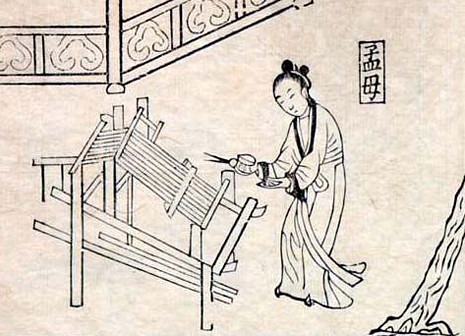
Perhaps the most dramatic of all the stories about Mencius’s mother involves a pair of scissors and a piece of woven cloth. By this time, they were living near the school, and Meng Ke was enrolled as a student. His mother spent her days weaving cloth to sell, the slow, painstaking labor that kept them fed. Thread by thread, row by row, she built each piece over days and weeks of steady work.
One afternoon, Meng Ke came home early. His mother noticed his clothes were soiled from playing outside and immediately knew he had skipped school. She asked him directly, and he confessed. He had gotten bored and left to play with other children. Without a word, his mother picked up her scissors and cut the cloth she had been weaving clean in half.
Meng Ke was shocked. He knew how many hours, how many days, of labor that cloth represented. He knew it was their livelihood. “Why did you do that?” he asked. “Your quitting school halfway through is exactly like this cloth,” she told him. “If you cut it in half before it is finished, it becomes useless. It cannot be sold. It cannot be worn. All the work that went into it is wasted. The same is true of your education. If you abandon it halfway, everything you have learned so far becomes worthless.”
The lesson was devastating in its simplicity. She did not lecture him about the importance of education. She did not threaten punishment. She showed him, in a single unforgettable moment, what quitting looked like. According to the historical accounts, Meng Ke never skipped school again.
From mother’s wisdom to philosopher’s legacy
What makes Mencius’s mother’s story more than a collection of charming parenting tales is what happened next. The boy she raised with such care went on to become one of the most important philosophers in Chinese history, and the ideas she planted in him can be traced directly through his teachings.
Mencius became the foremost interpreter of Confucius’ philosophy, earning the title “Second Sage” (亚圣). His central contribution to Confucian thought was his theory of innate human goodness, the idea that all people are born with the seeds of virtue: compassion, shame, courtesy, and a sense of right and wrong. These “four beginnings” (四端), as he called them, are innate. But they are like seeds. Without the right environment, without careful cultivation, they will not grow. Does that sound familiar?
It is, in philosophical form, exactly what his mother demonstrated when she moved three times to find the right neighborhood. It is what she showed when she bought meat she couldn’t afford to preserve her son’s trust in truth. It is what she taught when she cut her cloth to make quitting visible.
Mencius argued that moral development is not about imposing rules from outside. It is about creating conditions in which a person’s natural goodness can flourish. He used a famous metaphor: the heart’s natural tendencies toward virtue are like water’s natural tendency to flow downhill. You do not need to force water to flow; you just need to remove the obstacles. His mother had been removing obstacles from his entire childhood.
The four virtuous mothers of ancient China
Mencius’s mother holds a special place in Chinese culture, but she is not alone. Chinese tradition celebrates four women as the “Four Virtuous Mothers” (四大贤母), each remembered for the distinctive way she shaped her son into a person of exceptional character.
- Mencius’s mother (孟母) demonstrated that the environment shapes character and that honesty and persistence are taught through action rather than words.
- Tao Kan’s mother (陶母) taught integrity and generosity. When her son, who had become a government official, sent her a jar of salted fish from his government stores, she returned it with a sharp letter: using public resources for private gifts would corrupt his character. She had once cut off her own hair and sold it to buy rice for a visiting scholar, showing that generosity to others mattered more than personal comfort.
- Yue Fei’s mother (岳母) taught loyalty above all. Worried that her son, a military general, might waver under political pressure, she tattooed four characters on his back: “Serve the country with utmost loyalty” (尽忠报国). Those characters became one of the most famous symbols of patriotism in Chinese history.
- Ouyang Xiu’s mother (欧阳母) taught perseverance through poverty. After her husband died when Ouyang Xiu was four, she could not afford ink and paper. So she taught him to read and write by drawing characters in sand with a reed. He went on to become one of the greatest literary figures of the Song Dynasty.
What unites these four women is not wealth or status. None of them had either. What unites them is their understanding that a mother’s daily choices, small and large, shape the character of the next generation. They taught not through privilege but through sacrifice, creativity, and unwavering conviction.
Timeless lessons for today
The story of Mencius’s mother resonates across centuries because its core insights are universal.
- Environment matters more than instruction. Children absorb the world around them before they can evaluate it. The neighborhood, the friends, the daily routines, these shape character more powerfully than any lecture. Modern developmental research confirms what Mencius’s mother intuited: the environments in which children grow up are among the strongest predictors of who they become.
- Honesty has a cost, and it is always worth paying. It would have been easy for Mencius’s mother to let that small lie about the pig slide. No one would have noticed. But she understood that trust is built in small moments and, once broken, is difficult to repair.
- The best teaching is a demonstration, not a speech. She did not tell her son that quitting was wrong. She showed him by cutting something she had spent weeks working on. The most powerful lessons are the ones children can see and feel, not just hear.
- Small, consistent choices create extraordinary outcomes. Mencius’s mother did not have a grand plan. She had a series of small, thoughtful decisions: where to live, how to respond to a child’s question, what to do when he skipped school. Each choice was modest. Together, they shaped one of history’s greatest minds.
These are not ancient Chinese curiosities locked in the past. They are living wisdom, as relevant to a parent today as they were in fourth-century B. C. China. Every parent, in every era, faces the same fundamental questions: What kind of environment am I creating for my child? Am I teaching integrity through my actions, or just my words? Am I showing them what persistence looks like?
Mencius’s mother answered those questions with her life. And the philosopher’s choices went on to teach the world that goodness is not something imposed from outside. It is something already inside us, waiting for the right conditions to grow. May her story remind us that the most powerful force in shaping the future is not wealth, status, or grand ambition. It is the quiet, daily courage of a parent who refuses to settle for anything less than the best environment for their child’s heart and mind.
Follow us on X, Facebook, or Pinterest
