

In ancient China, when a couple faced separation, they would sometimes break a bronze mirror in half, each keeping one piece as a pledge of reunion. If fate brought them together again, the two halves would be matched, the circle restored, and the marriage made whole. This tradition gave rise to one of the most enduring Chinese idioms: “A broken mirror made whole again” (po jing chong yuan), a phrase still used today to describe reconciled love.
Chinese bronze mirrors carry 4,000 years of history within their polished surfaces and intricately decorated backs. Far more than mere tools for seeing one’s reflection, these remarkable objects served as symbols of love, instruments of spiritual protection, tributes to emperors, and among the finest works of decorative art the ancient world ever produced. Among all ancient Chinese metal inventions, bronze mirrors had the longest history and widest distribution, and were eventually replaced by glass mirrors only during the later Qing Dynasty.
What follows is a journey through the artistry, symbolism, and enduring mystery of these extraordinary cultural treasures.
A 4,000-year journey through Chinese bronze mirror history
The earliest mirrors: Qijia culture origins
The story of Chinese bronze mirrors begins in the remote northwest. Excavations from Qijia cultural ruins in Gansu and Qinghai Provinces revealed some of the earliest known examples, dating back roughly 4,000 years to around 2000 B. C. These early mirrors were simple in form, small in size, and likely reserved for the elite, prized as much for their rarity as for their reflective surface.
For the first millennium of China’s great Bronze Age, mirrors appeared infrequently in the archaeological record. They were uncommon, precious objects, more ritual artifact than household item.
From rare luxury to everyday essential
That changed dramatically after about 400 B.C. Bronze mirrors suddenly became a tremendously important part of Chinese material culture. By the Han Dynasty (206 B.C. to A.D. 220), production had shifted from individual craftsmanship to standardized mass production. What once belonged only to royalty and priests became available to ordinary families, though fine examples remained treasured possessions.
This transformation from elite ritual artifact to widely traded goods paralleled the broader democratization of Chinese culture during the Han period. The mirror’s reverse decoration began marking fashion and philosophy rather than ritual, reflecting the social ideology and aesthetic taste of its time.
The art of each dynasty: How bronze mirror designs evolved
The decorative patterns on the backs of Chinese bronze mirrors changed dramatically across the centuries, offering a vivid visual record of shifting artistic tastes, cultural values, and foreign influences.
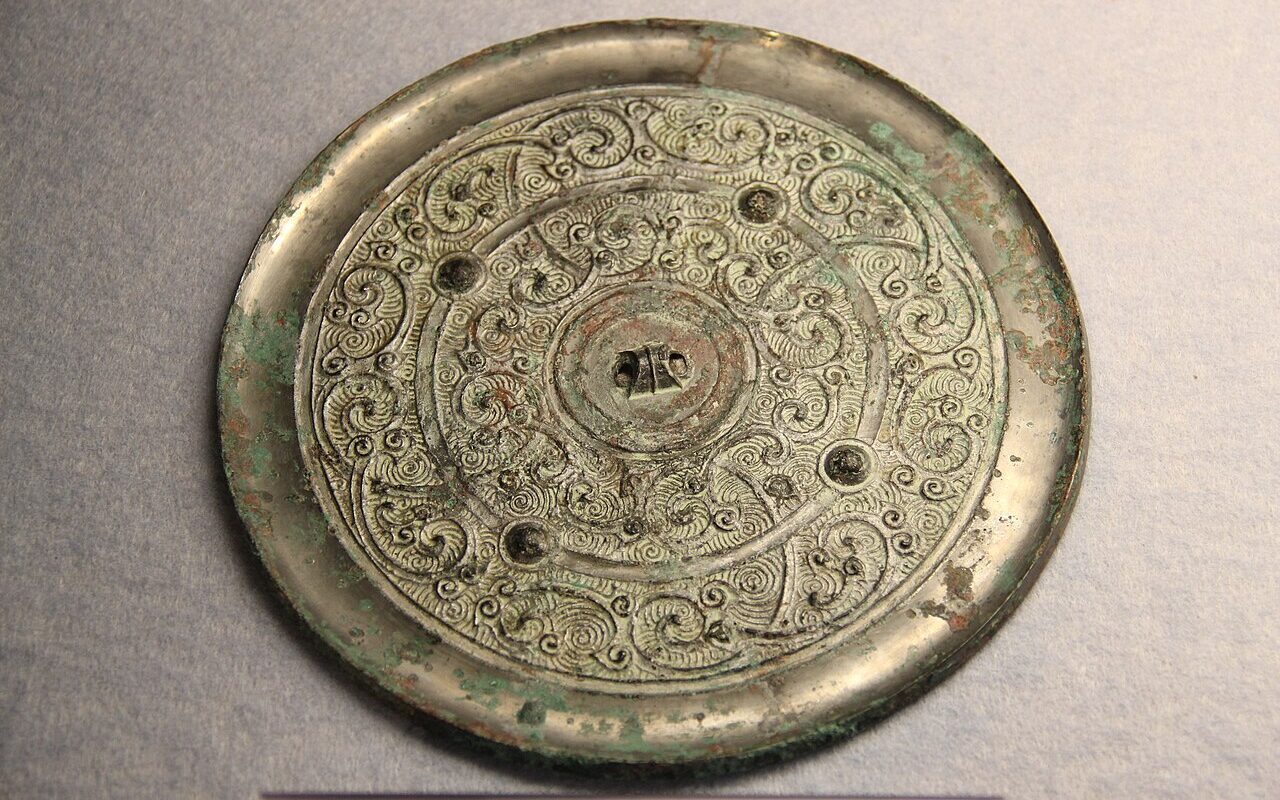
Warring States era (403 to 221 B.C.)
Mirrors from this period featured light construction, delicate engravings, and streamlined designs. Nearly all were round, with decorative patterns of petals, leaves, rope motifs, animals, and birds arranged in elegant symmetry. The craftsmanship was refined but restrained, emphasizing balance and precision over complexity.
Birds, dragons, and serpents were among the earliest and most common motifs. These were not merely decorative choices. Each creature carried symbolic weight, connecting the mirror’s owner to natural forces and protective spirits. The backs of Warring States mirrors often feel like miniature artworks, their designs compressed into a small circular canvas with astonishing precision.
Han Dynasty (206 B.C. to A.D. 220)
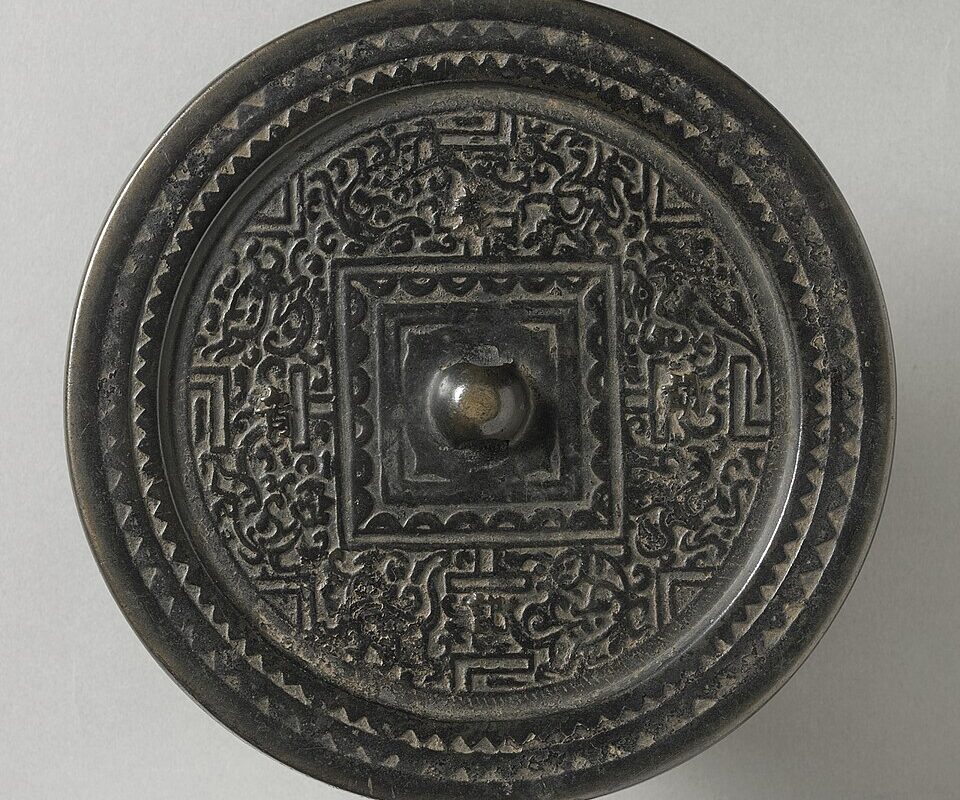
The Han Dynasty marked an important developmental period for Chinese bronze mirrors. While maintaining the traditional round shape, artisans introduced a wider vocabulary of decorative elements. Early Han engravings featured grass, stars, clouds, and auspicious characters. Many mirrors bore inscribed characters such as “sunlight” and “clear and bright,” reflecting beliefs about the mirror’s connection to cosmic energy.
One of the most distinctive Han creations was the TLV mirror, named for the T-shaped, L-shaped, and V-shaped markings on its back. These geometric patterns represented a cosmological map, with the round mirror symbolizing heaven and the square inner design symbolizing earth. TLV mirrors remain among the most studied and collected of all ancient Chinese bronze mirrors.
Tang Dynasty (618 to 907)
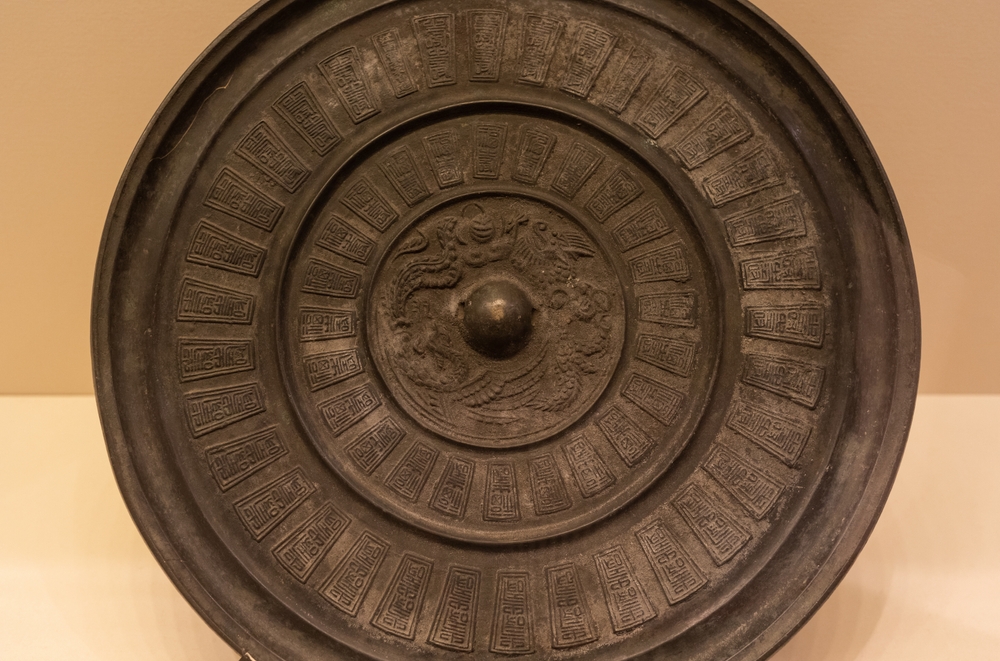
The Tang Dynasty is widely considered the golden age of bronze mirror artistry. For the first time, mirrors broke free from the exclusively round form. Square mirrors, lobed shapes, and complex designs appeared, with the water chestnut flower motif proving the most popular.
New patterns depicting grapes, birds, and exotic animals arrived through Central Asia along the Silk Road, reflecting the cosmopolitan spirit of the Tang court. Where earlier dynasties favored restrained elegance, Tang mirror designs featured unicorns, horses, phoenixes, and lions, symbolizing the confidence and splendor of a dynasty at the height of its power.
Tang artisans also refined the alloy itself, adding more tin to the bronze to create a more highly reflective surface. Some mirrors featured intricate inlays of silver, gold, glass, and even synthetic materials resembling jade.
Why round? The deep symbolism of Chinese bronze mirrors
Most Chinese bronze mirrors are round, and this was no accident. In Chinese cosmological theory, the round form represented the “hemispherical dome” of heaven. The circle symbolized perfection, completeness, and bliss.
Round shapes in ancient China also carried deep personal meaning. A full circle represented reunion, fortune, and satisfactory love and marriage. This is why bronze mirrors were so often used as pledges of love or as part of a bride’s dowry. In many excavated tombs of married couples, archaeologists have discovered two halves of a single mirror, one placed in each spouse’s burial, a testament to the belief that even death could not break the bond the mirror represented.
The Chinese idiom “A bright mirror hung high” (ming jing gao xuan) carries an entirely different layer of meaning. It describes a judge or official of perfect impartiality, someone who sees the truth as clearly as a polished bronze mirror reflects light.
Beyond these well-known sayings, the mirror’s symbolism extended to concepts of “full moon and blooming flowers,” representing a state of perfect happiness and completeness. When a bronze mirror was given as a wedding gift, it carried the wish that the couple’s life together would be as complete and luminous as the mirror’s unbroken circle.
These expressions and customs reveal how thoroughly bronze mirror symbolism became woven into the fabric of Chinese thought, language, and daily life. No other household object in ancient China carried such a rich cargo of meaning.
More than reflection: The spiritual power of bronze mirrors
Guardians of the living and the dead
Ancient Chinese bronze mirrors served purposes far beyond vanity. In many periods of Chinese history, people believed mirrors possessed supernatural properties. The polished surface that captured and reflected light was thought to store sunlight itself, giving mirrors the power to illuminate both literal and spiritual darkness.
This belief made bronze mirrors essential funerary objects. Placed in tombs alongside the deceased, they served as everyday articles for the afterlife and as spiritual guides, believed to light the way through the underworld. Influenced by the ancient custom of “regarding the dead as alive,” bronze mirrors became among the most commonly found burial objects in ancient tombs.
In Buddhist and Taoist rituals, bronze mirrors served as important worship paraphernalia. Taoist priests used them to ward off evil spirits and negative energies, while Buddhist practice incorporated mirrors as symbols of clarity and enlightenment. Ancient peoples attributed light-emitting supernatural powers to mirrors, and stories circulated about mirrors that could reveal a person’s true character or expose hidden spirits disguised as humans.
Mirrors were also placed strategically in homes and temples to deflect harmful influences. This protective function was so widely believed that even imperial palaces featured bronze mirrors at key entry points, their polished surfaces standing guard against unseen threats.

From ancient bronze to modern feng shui
The spiritual beliefs surrounding ancient bronze mirrors did not vanish when glass replaced bronze. They evolved. Today, the feng shui Bagua mirror, an octagonal mirror featuring the eight trigrams of the I Ching and the yin-yang symbol at its center, carries forward the ancient conviction that mirrors can manage energy, deflect negativity, and protect a household.
When someone hangs a Bagua mirror above their doorway to ward off negative energy, they are participating in a tradition that stretches back thousands of years to the bronze mirrors ancient Chinese families kept for exactly the same purpose. The materials have changed. The belief in the mirror’s protective power has not.
The unsolved mystery: How did ancient bronze mirrors resist corrosion?
Among the most puzzling aspects of Chinese bronze mirrors is their remarkable preservation. Many mirrors excavated from tombs after spending millennia underground show exceptional resistance to corrosion. Their surfaces remain smooth and their decorative details sharp, even after 2,000 years buried in damp earth.
Modern scientists have studied these mirrors extensively, yet the precise casting and anti-corrosion techniques used by ancient Chinese metallurgists remain largely mysterious. The alloy compositions varied across dynasties, and some formulations appear to have produced a natural patina that actually protected the underlying metal.
This unsolved puzzle speaks to a depth of metallurgical knowledge in ancient China that modern technology has not fully replicated. Recent forensic studies published in scientific journals have begun analyzing the surface chemistry and alloy compositions of individual mirrors, in hopes of unlocking the ancient formula. Yet the full picture remains elusive.
It is a humbling reminder that ancient wisdom sometimes exceeds our expectations. The artisans who cast these mirrors left no written manuals. Their knowledge passed from master to apprentice, embedded in the work itself, and the mirrors they made have outlasted nearly everything else from their era.
Beyond China’s borders: Bronze mirrors on the Silk Road
Chinese bronze mirrors were never confined to China alone. During the Han Dynasty, they traveled as diplomatic gifts and imperial tributes to Japan, Vietnam, Russia, Afghanistan, and Iran, carrying Chinese artistic traditions and cultural symbolism across vast distances.
During the Tang Dynasty, cultural exchange flowed in both directions along the Silk Road. Central Asian motifs, such as grape vines and foreign animal designs, made their way onto Chinese mirrors, while Chinese mirror-making techniques and decorative traditions influenced artisans across East and Central Asia. Archaeological discoveries of Chinese-style bronze mirrors in Japanese tombs from the Western Han period confirm the depth and reach of this cultural transmission.
Bronze mirrors also served as imperial rewards for nobility and as tributes presented to foreign rulers. A single mirror could carry the full weight of Chinese diplomatic intention, its decorative patterns communicating wealth, sophistication, and cultural confidence. The fact that so many have been found far from their place of manufacture speaks to how highly they were valued across cultures. These exchanges remind us that even in the ancient world, art and ideas traveled far, carried by objects as small as a hand-held mirror.
Living wisdom in ancient reflections of Chinese bronze mirrors
Chinese bronze mirrors endured for 4,000 years not because they were the best technology for seeing one’s reflection, but because they carried something deeper: cosmological meaning, spiritual protection, pledges of love, and the artistic ambitions of entire dynasties.
Today, their legacy lives on in Chinese idioms about truth and reunion, in feng shui practices that honor the mirror’s protective power, and in museum collections that draw visitors from around the world to marvel at the artistry of their decorated backs. The manufacturing secrets behind their remarkable preservation continue to challenge modern science.
These ancient objects invite us to look beyond the surface, both literally and figuratively. In a bronze mirror, the ancient Chinese saw not just their own faces, but the heavens, the bonds of love, and the boundary between the living and the dead.
Perhaps that is the most enduring lesson these 4,000-year-old artifacts offer: that the truest reflection is not the one we see on the surface, but the meaning we find when we look deeper. That depth of meaning is worth reflecting on.
Follow us on X, Facebook, or Pinterest
