

During the Qing dynasty, there was a legendary figure named “Shi the Blind,” who left a powerful mark in both folklore and historical records. He was not an ordinary fortune teller, but a famed seer in eastern Zhejiang, whose predictions of fortune and misfortune were astonishingly accurate.
His real name was Shi Guangyi, from Yin County in Zhejiang (today’s Ningbo). Though blind, he was said to possess extraordinary hearing and mental calculation skills, especially adept at divining through the Chinese calendar stems and branches as well as astrology. For men, he read fate by feeling their bones; for women, by listening to their voices. He could even judge a person’s destiny and lifespan from footsteps, speech, or breathing patterns.
Shi accurately predicted the careers and fortunes of several high officials. Records show he was connected with prominent ministers of the Yongzheng era, such as Li Wei and E’ertai. Li Wei served as Governor of Zhejiang, Minister of War, and Governor of Zhili; E’ertai was Grand Secretary of the Baohe Hall, Minister of the Grand Council, and Imperial Tutor. Shi’s reputation was well earned.
Life’s twists and turns
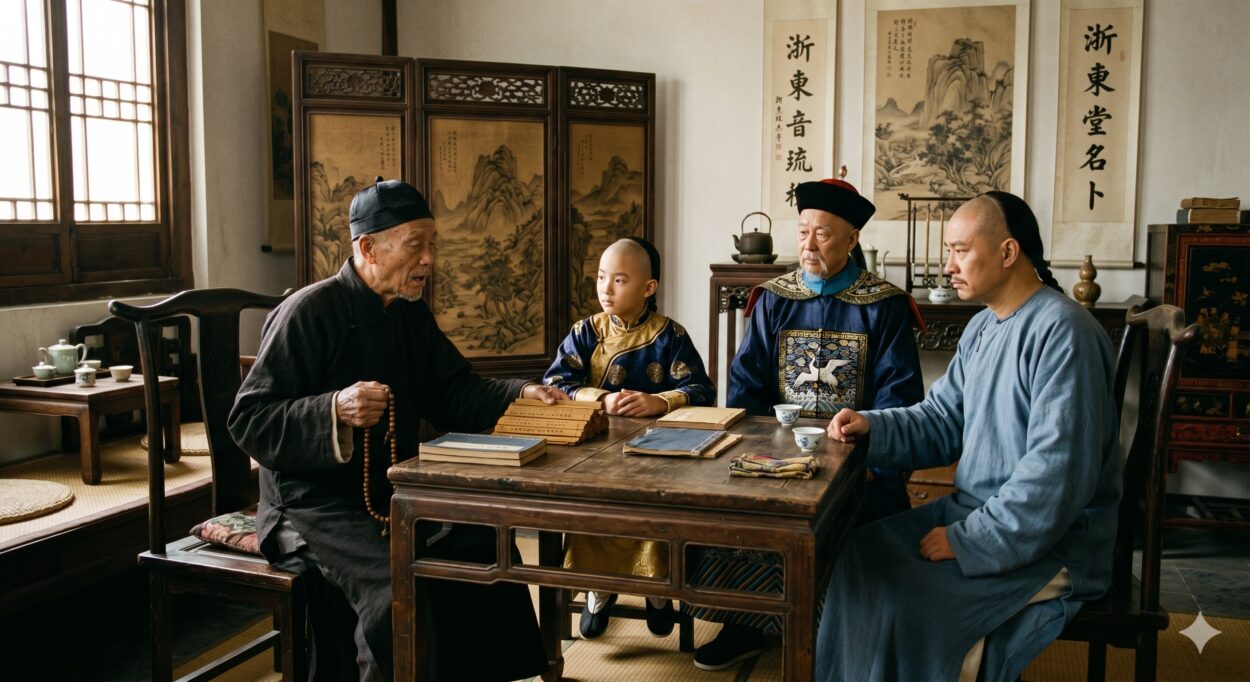
One striking case, verified over the course of twenty years, was also tied to his own fate. Once, Zhejiang Governor Xu Yuanmeng invited Shi to read to his grandson, Shu Hede, who had braided hair. His tutor, Wang Youdun, was also present. Shi declared both Shu Hede and Wang would rise to high rank. Shu Hede’s noble family background made the prediction plausible, but Wang, a poor scholar, doubted it, thinking Shi was merely flattering him.
That night, Shi told Wang privately: “Work hard, for your future rank and fame will surpass your master’s. I do not speak idly. You are a poor scholar — what benefit could I gain from flattering you? It is because my own fate holds a long calamity, and when it comes, I will rely on you to save me. Please remember my words.”
Later, Shi was recommended to Emperor Yongzheng, who was strongly interested in divination. After Shi read for him, perhaps touching on a taboo matter and fearing that he might divulge it, the emperor exiled him beyond Shanhai Pass for more than ten years. Ten years into his reign, Yongzheng decreed that all convicts sentenced to exile or lesser penalties would have their punishments lightened.
By then, Wang Youdun had risen to high office, having passed the imperial exam as a jinshi and was serving as Minister of Justice. Reviewing case files, he found Shi’s name. Though Shi’s exile was by imperial order and his crime unclear, Wang judged it within the scope of the pardon and petitioned for his release.
Moral cultivation
Shi returned to Beijing and lived in Wang’s residence, chastened and more restrained, no longer casually predicting fortunes. Later, Wang’s eldest son, Cheng Hang, was preparing for the imperial exam. Wang’s wife, eager for her son’s success, asked Shi to divine his fate. Shi said: “He will attain the rank of a sixth‑grade official.”
A sixth‑rank official refers to positions such as Compiler in the Hanlin Academy or Section Chief in the ministries. At that time, Wang Youdun was serving in the inner court. If his son were to pass the jinshi examination, he would certainly not be assigned to one of the Six Ministries. This seemed to imply that his eldest son would become the top scholar and, without doubt, take the post of Hanlin Academy Compiler.
Just as Madam Wang was quietly rejoicing, Wang Youdun was unexpectedly appointed chief examiner for that year’s imperial examination. As a result, his son Cheng Hang had to withdraw and was barred from taking the exam. People thought Shi’s prediction was wrong. Yet that winter, the emperor specially granted Wang Youdun the privilege of hereditary appointment for one son. Thus, Cheng Hang was appointed Section Chief, a sixth‑rank official. Shi’s words proved true.
Human fortune and misfortune are, after all, predestined, and sometimes revealed to people through fortune tellers — such as Shi the Blind. And so, one must ask: what deeper truths about life are reflected behind the uncanny accuracy and abilities of such seers?
Deeper truths of the interconnectedness of time and consequence
In the Qing dynasty worldview, fate was not a series of random accidents but a highly structured system, often visualized through Bazi (the Four Pillars of Destiny). Shi’s prediction for Wang’s son shows that while a destination (the sixth-rank post) may be fixed, the path to it is often a mystery until it unfolds.
Shi’s prediction of his own exile and his plea for Wang to save him highlight the concept of Yuanfen (karmic connection). He treated a “poor scholar” with the same gravity as a high official, proving that today’s kindness is the foundation of tomorrow’s rescue.

The logic of physical manifestation
Shi’s methods — feeling bones, listening to voices, and tracking breathing — reveal a belief that the internal spirit is always etched onto the external body. In traditional Chinese thought, a person’s Qi (vital energy) flows through their speech and movement. To a master like Shi, a person’s future wasn’t a secret held by the stars, but a vibration felt in their voice or a weight felt in their stride.
The truth is that we “wear” our characters. A person’s discipline, greed, or nobility eventually shapes their physical presence, making their life’s trajectory predictable or transparent to those with refined perception.
The paradox of knowledge
Shi’s exile by Emperor Yongzheng serves as a cautionary tale about the danger of knowing too much. In folklore, diviners who are “too accurate” often suffer physical ailments or political persecution. This reflects the philosophical idea that the “Will of Heaven” (Tianji) is not meant to be fully transparent.
Diviners like Shi posed a threat to absolute rulers because they suggested that even an Emperor is subject to a higher, unchangeable law. Shi’s subsequent “restraint” shows he learned that wisdom often lies in knowing what not to say.
Translated by Cecilia and edited by Helen London
Follow us on X, Facebook, or Pinterest
