
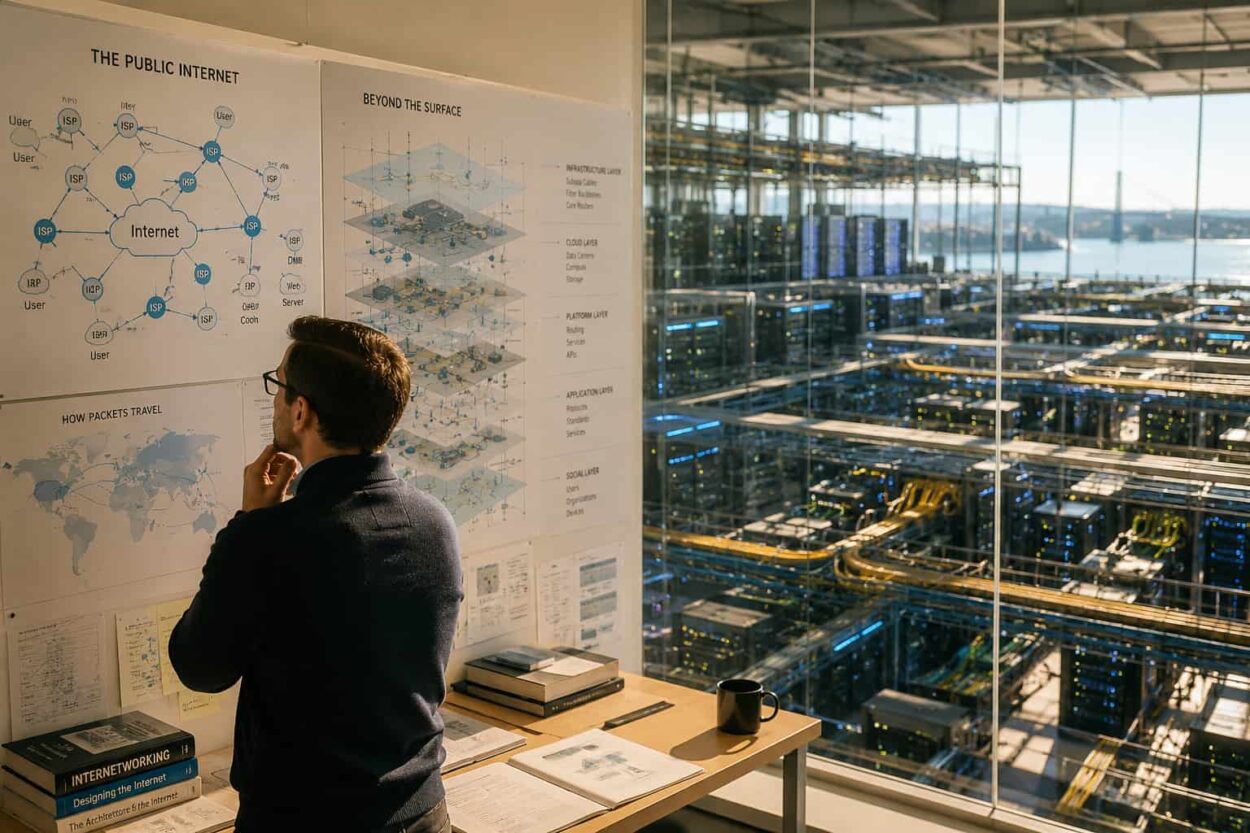
The ARPA-7 second Internet story landed on social media in early May and was already on its way around the world by the time I read it. The version that spread fastest came in declarative blocks, formatted like a leaked memo, with the kind of dramatic paragraph spacing that makes a confident assertion feel like a document rather than a guess.
The Internet you use, the post explained, is the surface layer — a lobby concealing something much larger. Behind it, according to the post, sits ARPA-7: a parallel network operational since 1977, unreachable from civilian hardware in every direction at once. No browsing. No indexing. No tunneling. No commercially available terminals. Access supposedly depends on cryptographic keys generated by a quantum-random algorithm that rotates every 11 minutes.
The post that broke out of Threads
The post named a source: an unnamed NSA contractor, under military protection at an undisclosed location, who had copied seven terabytes before extraction. It named a number: 147 private terminals, their locations now logged. It named an outcome: Every message ever sent across the system was now in the hands of a military tribunal.
It was, on its face, ridiculous. The fact-checkers got there inside forty-eight hours. And it was shared millions of times.
The interesting question is not whether the post was true. It wasn’t. The interesting question is why so many people were willing — eager — to forward something this strange without a single verifiable detail in it.
The post landed not because of what it proved but because of what it sounded like proof of: that the network you live inside has another network alongside it, and you were never told.
What actually happened on November 22, 1977
Here is the part that always gets buried under the conspiracy version. Something genuinely historic did happen in 1977, in late November, and the people who built it understood at the time that they were doing something that would not look like much for another 20 years.
On November 22, 1977, engineers at SRI International ran a demonstration from a converted GMC Value-Van — the Packet Radio Van — parked somewhere in the San Francisco Bay Area. The van was acting as a node on a packet radio network called PRNET. From inside the van, data was sent through PRNET into ARPANET, the early Pentagon-funded computer network connecting research universities. From there, it crossed the Atlantic via SATNET, a satellite-based segment, to nodes in London run by Peter Kirstein’s group at University College London. Then it came back. This was the first time three dissimilar networks had been bridged into a single conversation using a common protocol — a protocol called TCP, designed by Bob Kahn and Vint Cerf. The transmission is now considered the start of the Internet as a distinct thing — not a network, but a network of networks.
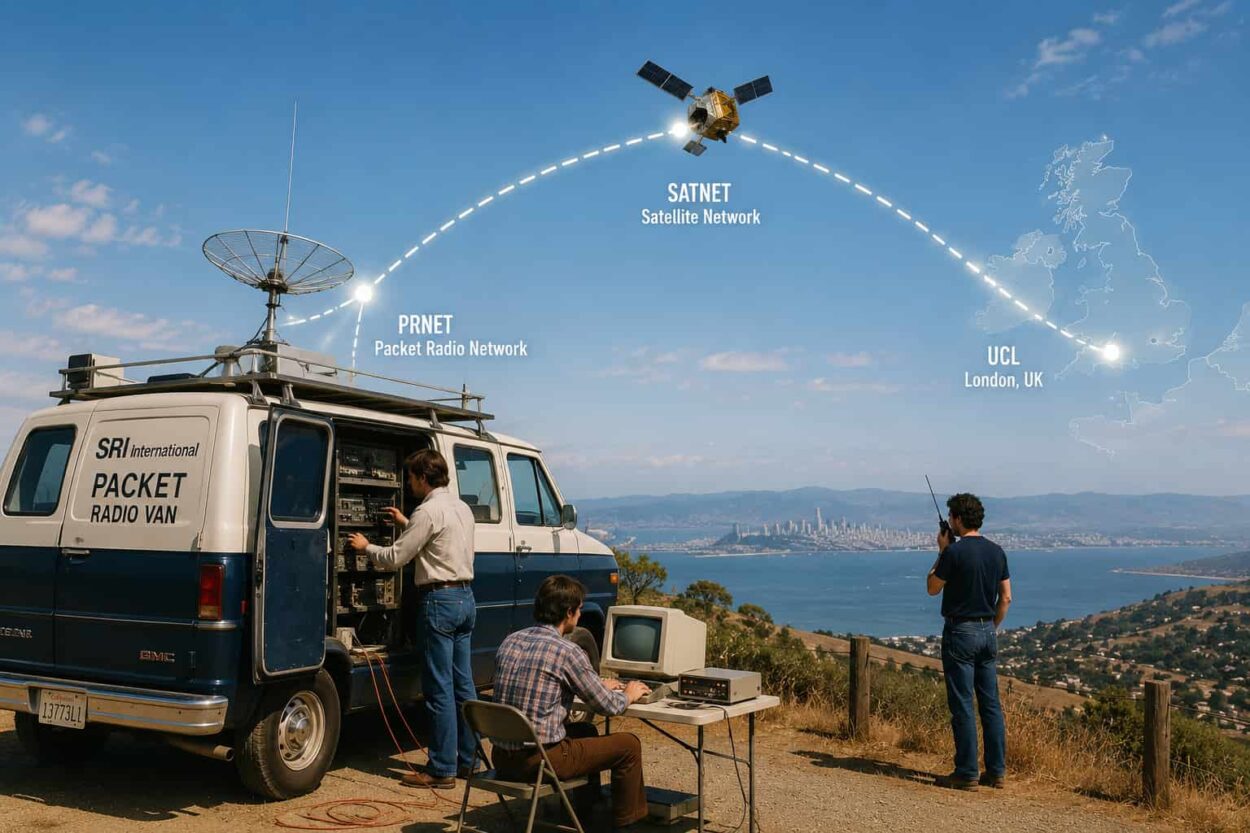
You can read it as a quiet, deeply technical event involving a van, a satellite, and some software. You can also read it as the precise moment the Internet stopped being singular.
From November 22, 1977 onward, the word Internet stops describing a thing and starts describing a method — a way of stitching different networks together so a packet leaving one of them can arrive intact at any of the others.
The viral post is fixed on that year for a reason. 1977 is the moment something did fork, just not the thing it claims.
The ARPA-7 second Internet that does not exist
There is no ARPA-7. This is not the kind of thing that requires nuance or careful sourcing to establish. The Defense Advanced Research Projects Agency — ARPA until 1972, then DARPA — operates under congressional oversight, publishes program names, awards public contracts, and has had its history written and rewritten by historians, journalists, and former employees for forty years. ARPA orders were numbered. ARPA Order 471, dated April 1963, is the originating contract for what became ARPANET.
None of the cataloged orders, none of the program histories, and none of the declassified internal evaluations contain a program called ARPA-7. The Internet Experiment Notes series — 206 documents published between March 1977 and September 1982 — contains no reference to it. Bob Kahn never mentioned it. Vint Cerf never mentioned it. Jon Postel, who edited both the IEN and RFC series, never mentioned it. No leak, no FOIA disclosure, no whistleblower has ever produced a document with the string ARPA-7 used to designate a network.
There is also no such thing as access codes rotating every eleven minutes against a quantum-random algorithm. Quantum random number generation exists. Quantum key distribution exists. Neither produces an eleven-minute key rotation that would be incompatible with commercial hardware. The technical claims in the post are not just unverified — they are constructed from words borrowed from real fields and reassembled into something that has the cadence of expertise without any of its content.
The fabrication is not careful. It is confident. It assumes — correctly — that very few people will check.
What is true is that the post is part of a recognizable lineage. Independent fact-checkers note there is no evidence — historical, technical, or governmental — for the existence of ARPA-7, and that the claim traces back to the same conspiracy-theory ecosystem that has been recycling variants of this story for years. The eleven-minute quantum keys, the 147 private terminals, the seven terabytes copied by an anonymous contractor, the military tribunal — these are the props of a specific genre. They show up in stories about the Quantum Financial System, about NESARA and GESARA, about white-hat military operations preparing for a global reset. The ARPA-7 piece slotted into that ecosystem cleanly because it was written by someone fluent in its grammar.
The Internets that do exist (and have never been secret)
Here is where it gets stranger. If you take the ARPA-7 post and strip out everything fabricated — the quantum keys, the contractor, the terminals, the tribunal — you are left with a structural claim: that more than one Internet runs in parallel, and most people only ever see one of them. That claim is, in a banal sense, completely true.
The United States Department of Defense operates three primary router networks, none of which are secret in their existence. SIPRNet, the Secret Internet Protocol Router Network, transmits classified information up to the SECRET level over TCP/IP — the same protocol stack that runs the public Internet. NIPRNet handles unclassified-but-sensitive government traffic. JWICS — the Joint Worldwide Intelligence Communications System — operates at TOP SECRET and SCI levels and is administered by the Defense Intelligence Agency. JWICS superseded earlier networks called DSNET2 and DSNET3, both higher-classification segments of the Defense Data Network, itself derived from ARPANET technology. There is also NSANet, the National Security Agency’s internal network, less publicly documented but openly acknowledged. On the British side: GCHQ’s networks. On the NATO side: CRONOS, the alliance equivalent of SIPRNet. Every modern military force of any size operates something like this.
These networks are not hidden. Their names appear in unclassified Department of Defense documents, in congressional testimony, in trade publications, and on Wikipedia. They sit in cyber operations centers next to the unclassified screens — color-coded so the operators don’t confuse them, red borders for SECRET, green for unclassified. They were the networks Chelsea Manning accessed in 2010. They were the networks Edward Snowden moved through in 2013. The reason most civilians don’t think about them is not that they are secret. It is because no civilian has any need to use them.
So are there other Internets behind the Internet? Several. Do they branch from the same ARPA-era technology stack that produced the public Internet? Yes — JWICS and SIPRNet both run TCP/IP, the same protocol the Packet Radio Van proved out in 1977. Did one of them effectively split from ARPANET? Yes — MILNET formally separated from ARPANET in 1983, taking the military traffic with it and leaving the academic side to evolve into what eventually became the consumer Internet. There is a real, documented sense in which a fork happened, and the year is not far off.
The viral post took something real, sanded the names off, replaced the documentation with a fictional contractor, and sold the result as a revelation.
The conspiracy lineage and the 11-minute quantum key
The ARPA-7 story did not arrive in a vacuum. It arrived inside an ecosystem that has been incubating versions of the same narrative for thirty years.
NESARA — the National Economic Security and Reformation Act — began circulating in conspiracy-truther communities in the late 1990s, originally as a misreading of a real (but never passed) 1980s economic reform proposal. Over the following two decades, NESARA picked up its global twin, GESARA, and accumulated a story about secret legislation, a coming financial reset, debt forgiveness, gold-backed currency, and an imminent moment of public disclosure.
Researcher Mike Rothschild, who has documented the QAnon movement, summarized the core promise: all currencies will be revalued, taxes and debts wiped away, and holders of certain low-value currencies will become instantly wealthy. The Quantum Financial System — QFS — emerged around 2017 as a technological gloss on the same theology: a quantum-secured, satellite-based, AI-administered ledger that would replace SWIFT and the central banks at the moment of the reset.
No central bank or financial regulator has ever confirmed its existence. The technical descriptions do not survive contact with anyone who actually works in quantum computing. Which, as we know from previous articles, does not mean much — when it comes to confirming whether something exists or not.
The ARPA-7 piece is structurally the network infrastructure version of QFS. Same shape, different domain. A parallel system that runs alongside the visible one. A hidden elite — 147 terminals — operating on it. A whistleblower under protection. An impending tribunal that will expose everything.
The eleven-minute quantum key rotation is QFS vocabulary transplanted into a story about packet networks. The QFS evidentiary network is named directly in the longer versions of the post as the place where the leaked data has supposedly been distributed.
Once you see the genre, the post stops looking like a leak and starts looking like a remix. The same beats. The same vocabulary. The same emotional arc — the same promise that someone, somewhere, has finally proved it.
The story is not new. Only the acronym is new.
What the story keeps trying to point at
And yet.
If the only thing worth saying about the ARPA-7 post were that it is a conspiracy theory in a recognizable lineage, do not share it, there would be no reason to write about it. Mainstream fact-checking already handled that part. What is harder to say is why the post worked — why millions of people, many of whom presumably do not believe in military tribunals or quantum-random eleven-minute keys, still felt the pull of it strongly enough to forward it.
The architecture of the public Internet has, over the last fifteen years, become genuinely unreadable to the people who live inside it. Search results are ranked by algorithms whose weights are not disclosed. Social media feeds are curated by systems whose objective functions are not published. The infrastructure layer is dominated by a small number of cloud providers whose internal routing decisions are private. Content can be deprioritized, demonetized, or removed by decisions made inside corporate trust-and-safety teams whose deliberations are not visible. None of this is secret in the conspiracy sense. All of it is opaque in a practical sense. The user can only see the output, not the function that produced it.
A network you cannot see the inside of, that shapes what you can see, that is operated by people you do not know — that is not the description of ARPA-7. That is the description of the everyday Internet.

The viral post misdiagnoses a real condition. It says: there is a second Internet running alongside the one you use, and you cannot get to it. The accurate version is closer to this: The Internet you use is running on top of layers of infrastructure and decision-making that you cannot get to, and the difference between what reaches you and what does not is being decided in rooms you will never enter. That is a less dramatic claim. It does not promise a tribunal. It does not name 147 villains. But it does explain why a story about a hidden network feels true to people who would never claim to believe in quantum financial resets — because the everyday Internet has begun to feel, experientially, like the lobby of something larger.
The ARPA-7 post will fade. Another post, in another six months, with another acronym and another date, will replace it. The shape of the story will be the same: a hidden infrastructure, a whistleblower, an imminent reckoning. The acronym is a placeholder. The yearning underneath it is consistent.
The fix is not to debunk faster. The fix is to make the visible Internet legible again — to publish the ranking signals, the moderation policies, the routing decisions, the takedown rationales, in forms ordinary users can actually read. A system that explains itself does not need a conspiracy theory to fill in its silences.
Until then, the silence will keep getting filled — with ARPA-7 or whatever comes next.
Follow us on X, Facebook, or Pinterest
