
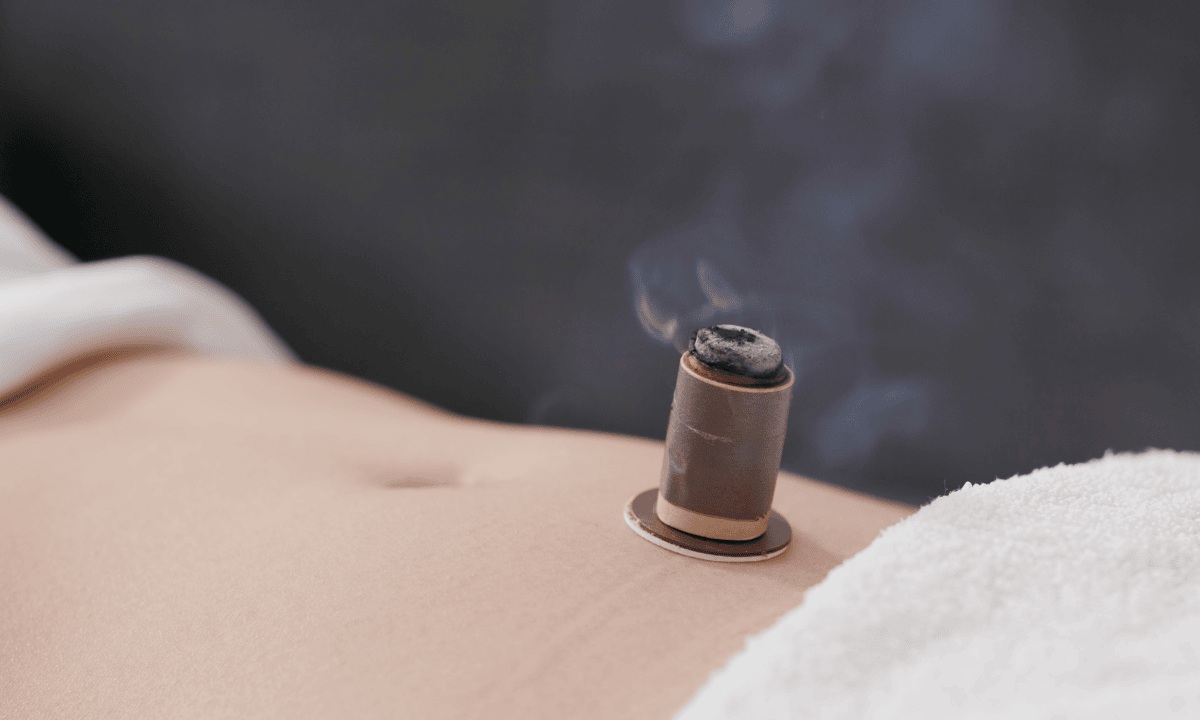
In a quiet traditional medicine clinic, a thread of fragrant smoke curls upward from a small glowing cone of mugwort, resting just above a patient’s navel. The warmth spreads slowly outward, and the patient lies still, breathing easily. This gentle scene is navel moxibustion, a practice that has centered on a single point of the body for roughly 2,000 years.
Why would warming the belly button matter so much? In traditional Chinese medicine (TCM), the navel is far more than a leftover mark from birth. It is home to what the ancients called the “Spirit Gate,” a place where the body’s vital energy gathers and can be nourished by gentle heat. In this guide, we will explore what navel moxibustion is, why this single point holds such meaning, what it has traditionally been used for, how it is carefully performed, who should avoid it, and what modern research is beginning to reveal.
What is navel moxibustion?
Navel moxibustion is a traditional Chinese medicine therapy that burns moxa, or dried mugwort, to warm the shen que (“Spirit Gate”) acupuncture point at the belly button. The gentle, penetrating heat is believed to improve circulation, dispel cold and dampness, and restore the body’s natural balance and healing.
Moxibustion is one of the oldest branches of Chinese medicine, often used hand in hand with acupuncture. Where acupuncture uses fine needles, moxibustion works through heat. The practitioner burns aged mugwort (艾, ài, Artemisia argyi), prepared as a soft wool, a compact cone, or a cigar-shaped stick. It’s a heat treatment that targets specific points along the body’s meridians, the channels through which qi (气, qì) is said to flow. Moxibustion belongs to the same deep herbal heritage that produced legendary remedies such as the immortality mushroom of Chinese tradition, where specific plants are carefully matched to specific needs.
The navel is one of the most treasured of these points. Because it is a thin-skinned, hollow area rich in tiny blood vessels, tradition holds that warmth and herbal essence applied here spread quickly to the meridians and internal organs. That is why navel moxibustion has long been regarded as an unusually direct way to reach the body’s core.
The Spirit Gate: Why the navel is so special
To understand navel moxibustion, it helps to understand why Chinese medicine gives the navel such reverence. This is where the practice moves from simple warmth to living tradition.
Shen Que, the “Spirit Gate”
The acupuncture point at the very center of the navel is called shen que (神阙, shén què), a name often translated as “Spirit Gate” or “Spirit Palace.” In TCM thought, it is not an ordinary point. Practitioners describe the navel as the body’s “first mouth,” the original channel through which we received nourishment in the womb long before we ever drew breath or tasted food.
The Spirit Gate also sits on the Conception Vessel (任脉, rèn mài), one of the body’s most important meridians, and it is considered a meeting place where the energy of many channels converges. For this reason, the shen que point is treated with heat rather than needles. The navel is not pierced in moxibustion; it is warmed, gently and with care.
Wei Qi and the warming principle
In traditional thinking, much of what ails the body stems from cold and stagnation. When qi and blood move freely, the body feels warm and well. When they grow sluggish or chilled, discomfort follows. Moxibustion answers this with its defining quality: warmth that sinks deep.
That warmth is also said to strengthen wei qi (卫气, wèi qì), often described as the body’s defensive or protective energy, the traditional counterpart to what we might loosely call immunity. By warming the Spirit Gate, navel moxibustion is believed to stir the stomach’s energy, clear the meridians, encourage blood flow, and help the organs return to balance. You can explore this line of thinking in Nspirement’s collection of traditional Chinese health practices.
The traditional benefits of navel moxibustion
In China, the benefits of navel moxibustion have been valued for centuries, drawn upon to address everyday complaints. It is worth remembering that these are traditional uses, described in the language of TCM rather than modern clinical proof. Still, they reveal why the practice has endured.
In traditional Chinese medicine, navel moxibustion is most often used to:
- Support digestion: easing diarrhea, abdominal pain, bloating, and poor appetite.
- Ease menstrual discomfort: warming a “cold womb” to relieve painful or irregular periods.
- Encourage fertility: traditionally linked to a warmer, more nourishing environment for conception.
- Strengthen the body’s defenses: bolstering wei qi, the protective energy tied to immunity.
- Bring calm: soothing restlessness and supporting more restful sleep.

Digestion: Diarrhea, abdominal pain, and bloating
The most common use of navel moxibustion is for the digestive system. Because the navel, or belly button, sits at the center of the body, warming it is traditionally believed to soothe the stomach and intestines. The heat is said to ease cramping and settle conditions linked to cold and dampness in the gut. Practitioners have long turned to it for chronic diarrhea, abdominal pain around the navel, bloating, and poor appetite. The principle is simple and intuitive: a warm center digests better than a cold one.
Women’s health and the “cold womb”
Navel moxibustion also holds a respected place in women’s health. In TCM, painful or irregular periods are often associated with a “cold womb,” a pattern of cold and stagnation in the lower abdomen. Warmth is the traditional remedy. By warming the area, moxibustion is believed to encourage circulation and ease menstrual discomfort. Tradition holds that a “warm” womb provides a more nourishing environment, which is why the practice has also been associated with fertility support. These are sensitive and important matters, and anyone exploring moxibustion for menstrual or fertility concerns should work with a qualified practitioner rather than self-treating.
Immunity, calm, and sleep
Beyond digestion and women’s health, navel moxibustion has traditionally been used to bolster wei qi, supporting the body’s resilience through the changing seasons. Its slow, radiating warmth is also deeply calming. Many people describe the treatment as profoundly relaxing, and in TCM it has been used to ease restlessness and insomnia. That sense of quiet warmth pairs naturally with other gentle traditions, such as the traditional remedies for calm and balance found across Chinese wellness culture.
How is navel moxibustion done?
People are often curious about what actually happens during a session. Below is a description for understanding, not a do-it-yourself manual. Burning moxa carries a real risk of burns, and navel moxibustion in particular is best left to a trained practitioner.
Indirect moxibustion
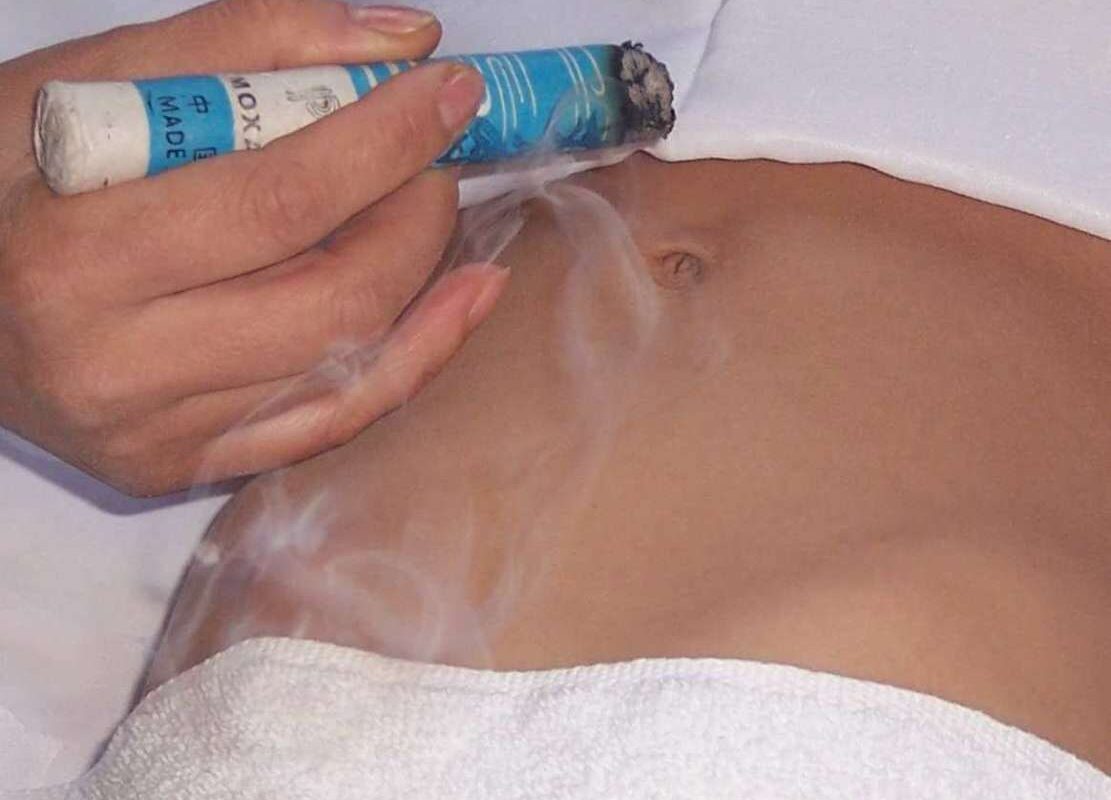
The gentler and more common method is indirect moxibustion. Here, the practitioner lights a moxa stick and holds it a short distance above the navel, close enough for the patient to feel a comfortable, glowing warmth, but without direct contact with the skin. The practitioner watches carefully, keeping the heat steady and pleasant, and moves the stick away the moment the warmth becomes too strong.
Salt- and ginger-partitioned moxibustion
The classic navel technique is salt-partitioned moxibustion, sometimes combined with ginger. A trained practitioner usually works through a few simple steps:
- Fill the navel with salt: Fine, dry salt is packed into the navel until it is level with the surrounding skin.
- Add a slice of ginger: Place a thin slice of fresh ginger on top of the salt.
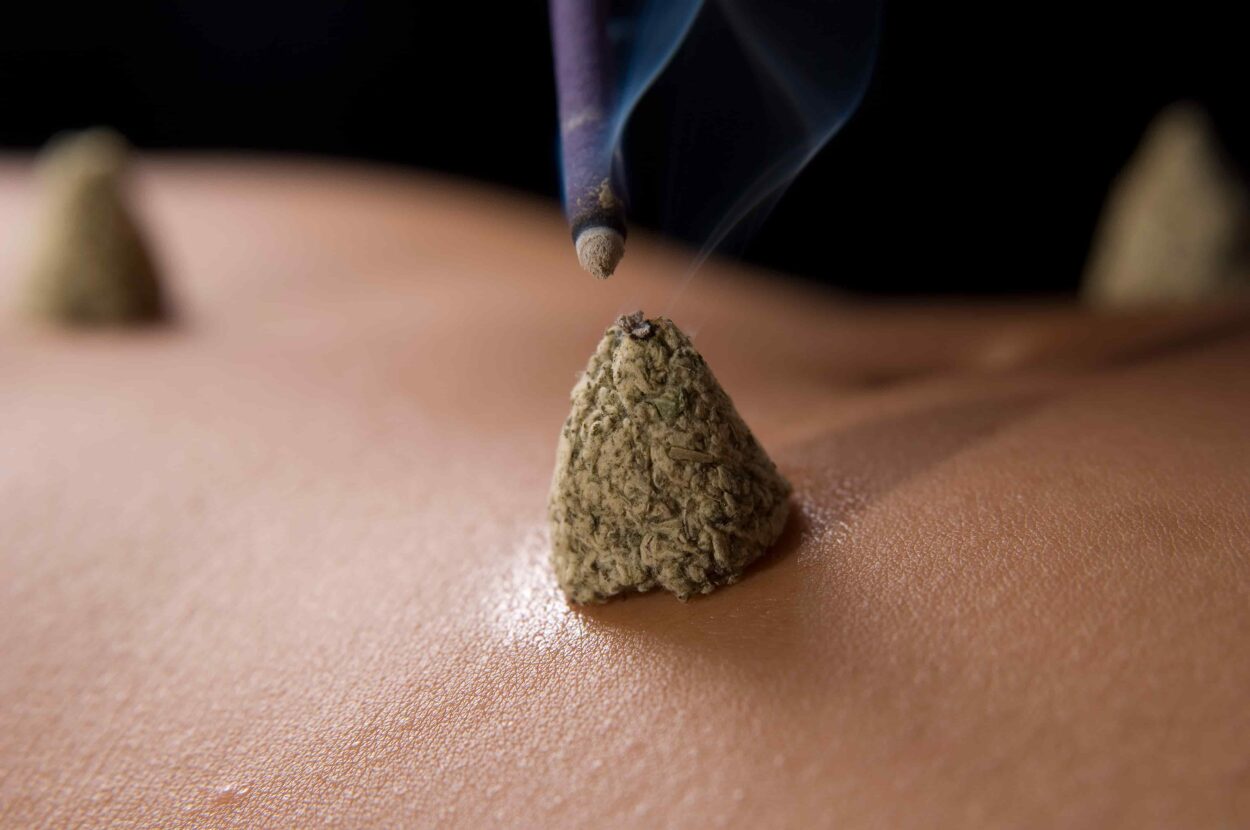
- Burn the moxa: A small moxa cone is placed on the ginger and lit, gently warming the point.
- Replace each cone: As a cone burns down and the warmth builds, it is replaced with a fresh one, usually after several rounds.
The salt and ginger are not decorations. The layer of salt protects the skin and spreads the heat evenly, while the ginger guards against cracking and burns and adds its own warming quality. The result is a deep, even warmth that tradition says carries the herbs’ essence straight through the Spirit Gate.
Patients often report a striking sensation during a good session: a sudden flow of warmth that seems to travel along a pathway through the body. In TCM, this is interpreted as qi moving and a channel opening, and it is generally regarded as a welcome sign.
Is navel moxibustion Safe? Who should avoid it?
Navel moxibustion is gentle in spirit, but it deserves genuine respect. The main risk is straightforward: fire and heat near the skin can cause burns, and the smoke can irritate the lungs or trigger allergies in sensitive people. A systematic review of moxibustion safety documented real adverse events, most often burns, which is exactly why training and attentive supervision matter so much. Mainstream health resources such as WebMD’s overview of moxibustion likewise note that burns and skin irritation are the principal concerns.
Some people should avoid navel moxibustion altogether, or use it only under professional guidance. Pregnant women should not undergo abdominal moxibustion except under the direction of a qualified medical professional. It is also generally avoided in cases of high fever, acute inflammation, or any wound, rash, or broken skin on the abdomen. Practitioners exercise caution when a person is very weak, frail, or unwell, and it is not a practice for unsupervised use on young children or the elderly at home.
A practical note: never leave burning moxa unattended, and if the heat shifts from comfortable to sharp, remove the moxa immediately. For any persistent or serious symptom, see your doctor. Traditional warmth is a complement to good medical care, not a replacement for it.
Used wisely and in the right hands, the practice has earned its reputation for being low-cost and gentle in effect, which is part of why it remains popular. It fits comfortably within a wider family of simple, no-cost wellness habits rooted in Chinese tradition.
What modern research says
For most of its history, navel moxibustion rested on tradition and lived experience. In recent years, researchers have begun studying it, and the early picture is intriguing, if still incomplete.
Several small clinical studies have examined the use of moxibustion at the navel for specific conditions. Trials have looked at its effect on primary dysmenorrhea, the painful menstrual cramps long treated with warmth in TCM. Other research has tested medicine-separated navel moxibustion combined with acupuncture for allergic rhinitis, reporting improvements in symptoms and quality of life.
Herb-partitioned navel moxibustion has even been studied as a support for women undergoing in vitro fertilization. The original Nspirement article noted research on moxibustion combined with acupuncture for active Crohn’s disease. The treatment appeared to offer benefits beyond a placebo effect, an early but encouraging finding. More recently, researchers have begun to examine moxibustion as a complement in managing abdominal weight, with small trials reporting modest changes. Here, too, the evidence remains early and limited.
These results are promising, yet honesty matters here. Many of the studies are small, preliminary, or conducted in particular settings, and good science is still catching up to a very old practice. What is fair to say is that modern research is beginning to examine, carefully and respectfully, what tradition has held for two thousand years. This meeting of old and new is a story Nspirement loves to follow, much like how Eastern and Western medicine see the body differently yet increasingly learn from one another.
A warm tradition worth understanding
Navel moxibustion is, at heart, a beautifully simple idea: that a little warmth applied to the right place can help the body find its balance. Around that idea, Chinese medicine has built a rich tradition, from the poetry of the Spirit Gate to the careful craft of salt, ginger, and glowing mugwort.
A few things are worth carrying away. The navel, in TCM, is a meaningful point and not merely a scar. Navel moxibustion has been used for generations to support digestion, ease menstrual discomfort, strengthen the body’s defenses, and calm a restless mind. It is gentle but not without risk, so it belongs in trained hands, and modern research, though still early, is beginning to take a serious look. For anyone drawn to time-tested, low-cost wellness, it is a window into how the old healers understood the body, with warmth as their quiet medicine.
There is something hopeful in that. Long before modern tools, people learned to care for one another with patience, attention, and the simplest of comforts. That wisdom is still here, still warm, and still worth knowing.
Follow us on X, Facebook, or Pinterest
