
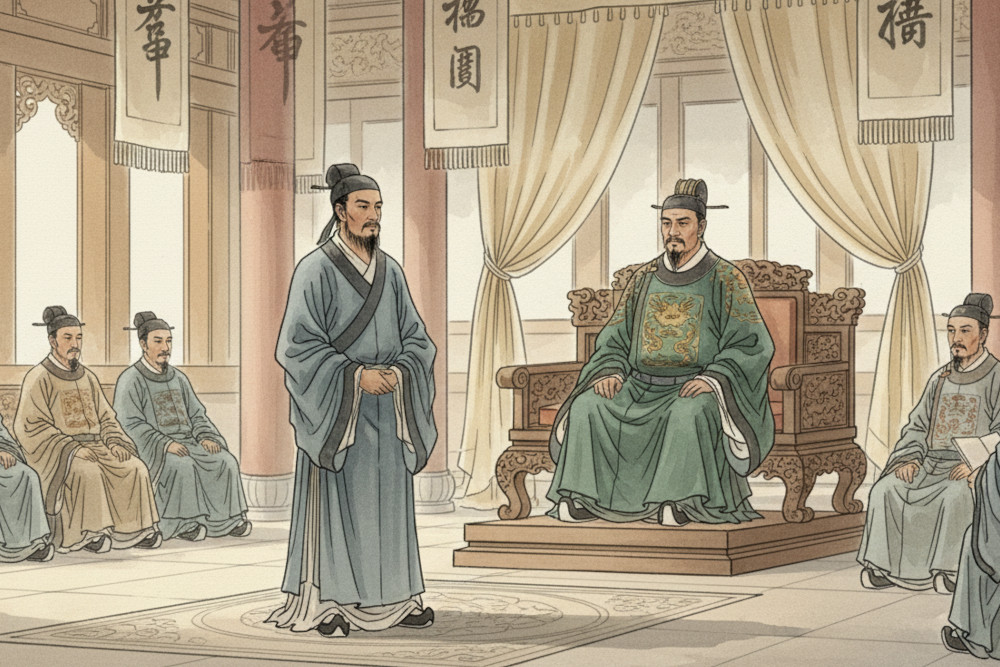
More than two thousand years ago, a single man’s conviction prevented a devastating war. His name was Mozi — a philosopher, inventor, and humanitarian whose clear reasoning and moral courage changed the fate of an entire nation.
A philosopher with purpose
Mozi, whose given name was Zhai, was a native of the State of Song during the Warring States period (475-221 B.C.). He later served as a minister of Song, authored philosophical texts, and founded the Mohist school — a movement that emphasized universal love, frugality, and practical wisdom.
Unlike many thinkers of his time who focused on self-cultivation or abstract virtue, Mozi’s philosophy was grounded in action. When he heard that the craftsman Gongsun Ban — known to later generations as Lu Ban, the patron saint of craftsmen — had built siege ladders for the powerful State of Chu to attack Song, he could not remain idle.
Without delay, Mozi set out for Chu. After seven days and nights of hard travel, his feet were covered in blisters. He tore strips from his robe to bind them, pressing forward despite the pain. His purpose was simple but urgent: to stop a war before it began.

A journey to stop a war
When Mozi finally reached Chu, he went first to see Gongsun Ban. “Why would you build siege ladders to help Chu attack Song?” he pleaded. “What wrong has Song committed?
“Chu already has vast lands, but too few people. To sacrifice your own scarce population for more territory is not wisdom. To attack a blameless state is not benevolence. To know something is wrong but fail to advise your king cannot be called loyalty. And to strive for victory but achieve nothing cannot be called strength.”
Gongsun Ban shook his head. “The decision to attack Song has already been made,” he said. “It is not up to me. I have already told the King of Chu that I agree with his plan.”
Mozi realized that reason alone would not sway the craftsman. To protect his homeland, he would need to convince the king himself.
Reasoning with kings and craftsmen
Before the King of Chu, Mozi spoke not of war or politics, but of common sense. “Your Majesty,” he began, “imagine a man who abandons his fine carriage to steal his neighbor’s broken cart, who leaves his brocade robes untouched to take another’s coarse shirt, and who forsakes the fish and meat in his own home to steal wild vegetables from a neighbor’s pot. What sort of man is this?”
The King laughed. “Such a man would be a madman.”
“Indeed,” said Mozi. “Chu has the deer of Yunmeng Marsh, the fish and turtles of the Yangtze and Han Rivers — riches beyond compare. Song, by contrast, has no great trees, no game, hardly a stream of fish or rabbits. If Your Majesty attacks Song, it is like that madman abandoning plenty to steal poverty.”
The King paused, impressed by the argument. “Well said! But Gongsun Ban has already built siege ladders for me. He claims they will surely capture Song.”
A battle of wits, not weapons
Determined to prove his point, Mozi met again with Gongsun Ban. He unfastened his sash and spread it across the table, representing the walls of Song’s capital. He then placed his headband upon it, symbolizing the soldiers and defenses.
Gongsun Ban demonstrated his siege tactics nine different times, using models to show how Chu’s army would attack. Each time, Mozi countered with a new defensive maneuver, blocking every assault. Finally, the craftsman exhausted his ideas, while Mozi still had strategies in reserve.
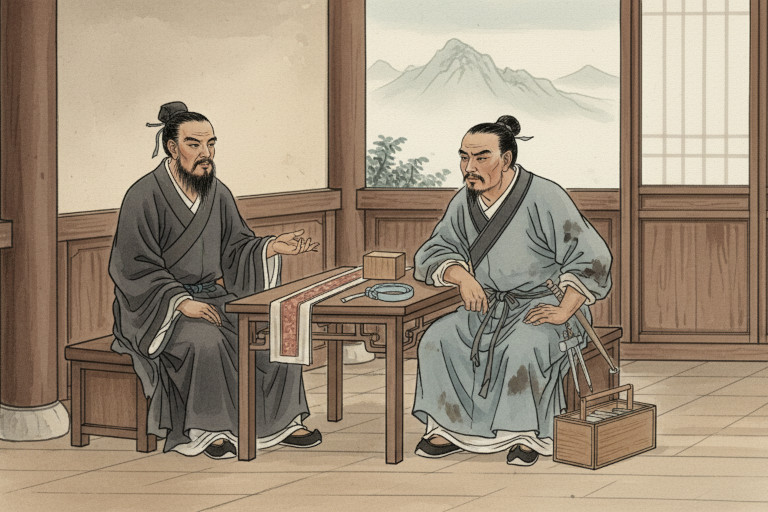
“I know how to breach your defenses,” Gongsun Ban admitted, “but I will not say.”
“I also know your next move,” Mozi replied, “but I too will remain silent.”
Wisdom that averted bloodshed
When the King of Chu asked what they meant, Mozi explained: “Gongsun Ban believes that if he kills me, the State of Song will fall. Yet he does not know that my disciples — two hundred strong — have already set up my defensive mechanisms on Song’s city walls, ready for any attack. Even if I were killed, victory for Chu would still be impossible.”
The King was astonished. Seeing the futility of war, he abandoned his plan to invade Song.
Mozi’s courage and wisdom had averted bloodshed. His story endures not only as a tale of intellect triumphing over aggression but also as a reminder that true strength lies in reason, compassion, and the will to protect others through peaceful means.
Translated by Audrey Wang
Follow us on X, Facebook, or Pinterest
