

On an unremarkable Tuesday morning in Paris, a dress the color of early spring light hangs from a padded muslin hanger in the Dior atelier. It looks, at first glance, almost fragile — an arrangement of mesh, silk thread, and embroidery that seems too delicate to hold its own shape. Draped over a simple wooden form, it is quiet, unassuming, nearly weightless. If you didn’t know any better, you might mistake it for just another garment awaiting its turn under the needle.
But the staff moves around it with a kind of unspoken choreography, altering their pace as they approach, their fingers hovering a few inches above the fabric before daring to touch it. A young seamstress adjusts a single embroidered petal by less than a millimeter. Another artisan, older and visibly accustomed to this ritual, watches the movement of the mesh as though listening for something — some faint tremor or imbalance invisible to anyone not trained to see it.
It is an odd sort of reverence to witness for something made, ultimately, from cloth. And yet the reverence is sincere.
For all the declarations of luxury marketing, a Dior dress remains a paradox: a fragile object constructed of the same raw materials available to any designer, yet endlessly pursued, studied, and fetishized, as though it possesses an interior life. It is neither mystical nor practical, neither purely artistic nor strictly functional. It occupies a narrow and curious space in the cultural imagination — a space where desire is shaped by things we are not sure we can name.
What, then, makes this dress different from all the others fashioned from needles, threads, and human hands? Is it merely the gravitational pull of the brand, refined over decades of glamour and mythmaking? Or is there something else — something quieter, more elusive — that sets it apart?
To find the answer, you have to follow the dress back to where it begins — not on the runway, not in the boutiques, not in the feverish world of fashion editors or influencers, but somewhere much less expected: a garden, a memory, and a woman who planted roses.
At first glance, a Dior dress is nothing more than cloth stitched into shape — silk, mesh, straw, thread. Fibers that exist by the ton in warehouses, fabrics that, stripped of branding, could be mistaken for the raw materials of any other garment. And yet, season after season, year after year, the dresses emerging from Dior’s Paris ateliers provoke a kind of reverence rarely extended to objects made for the simple act of wearing.
Why? Why should one dress — made of fabric like any other — be priced like a car, handled like a Stradivarius, and treated as if it contains a hidden interior life?
Consumers, critics, and fashion historians have spent decades trying to answer this. The old answer — “Because it is Dior” — feels increasingly insufficient in an age of transparency, sustainability, and digital dissection. Today’s global audience wants to see how the magic is made, not just the glamorous result. A brand name alone no longer satisfies.
But perhaps the story begins not with luxury markets or marketing psychology, but with a woman planting roses.
And that is where Dior chooses to begin.
Which is also where our next question arises: Is the soul of a Dior dress found in its history?
Catherine Dior and the invisible garden
Maria Grazia Chiuri, Dior’s artistic director since 2016, insists that every collection begins in the past. “If you know very well your past,” she once said in a Vogue interview, “you can understand more your present, and with creativity, you can propose your future.”
This season, the past she returned to was not the well-documented mythos of Christian Dior, but that of his sister — Catherine Dior, a Resistance fighter during WWII. Deported to Ravensbrück for her work with the French Resistance, she survived the unspeakable and returned home to resume her life quietly, choosing not couture fame, but gardening. She grew roses in Callian, selling them to perfumers in Grasse; she tended to flowers with the same discipline she once applied to smuggling intelligence.
In Chiuri’s hands, Catherine becomes a symbolic thread woven through the collection: a woman who embodies resilience, self-determination, and what Chiuri calls “a true feminine spirit.”
On the mood board for the season — pinned in the center — is a photograph of Catherine in her garden, surrounded by roses. Not posing, not posturing: simply planting. Work-worn hands. Plain clothes. Uneventful, but dignified.
In the narrative world of fashion, where fantasy often outweighs biography, this choice is radical. It reframes luxury not as excess, but as a form of care — the kind Catherine offered her plants.
But reverence for a muse still doesn’t answer what makes a Dior dress fundamentally different.
To get closer to that answer, we must move from the garden to the atelier.
When sketches become skin
As Chiuri explains her guiding ideas — flowers, leaves, endurance, sustainability, timelessness — a team of more than forty artisans gathers around her. They are pattern-makers, textile engineers, embroiderers, cutters, seamstresses: a collective sovereign state of technique.
Pascal Coppin, the chief engineer of Dior’s ready-to-wear women’s workshop, has worked at the house for more than thirteen years. His job is to take Chiuri’s drawings and turn them into dresses that obey the laws of physics, not fantasy.
“We talk about the drawings and exactly what she wants,” Coppin explained during a behind-the-scenes tour of the atelier.
Then he returns to his team and begins the translation process — from aesthetic idea to structural blueprint.
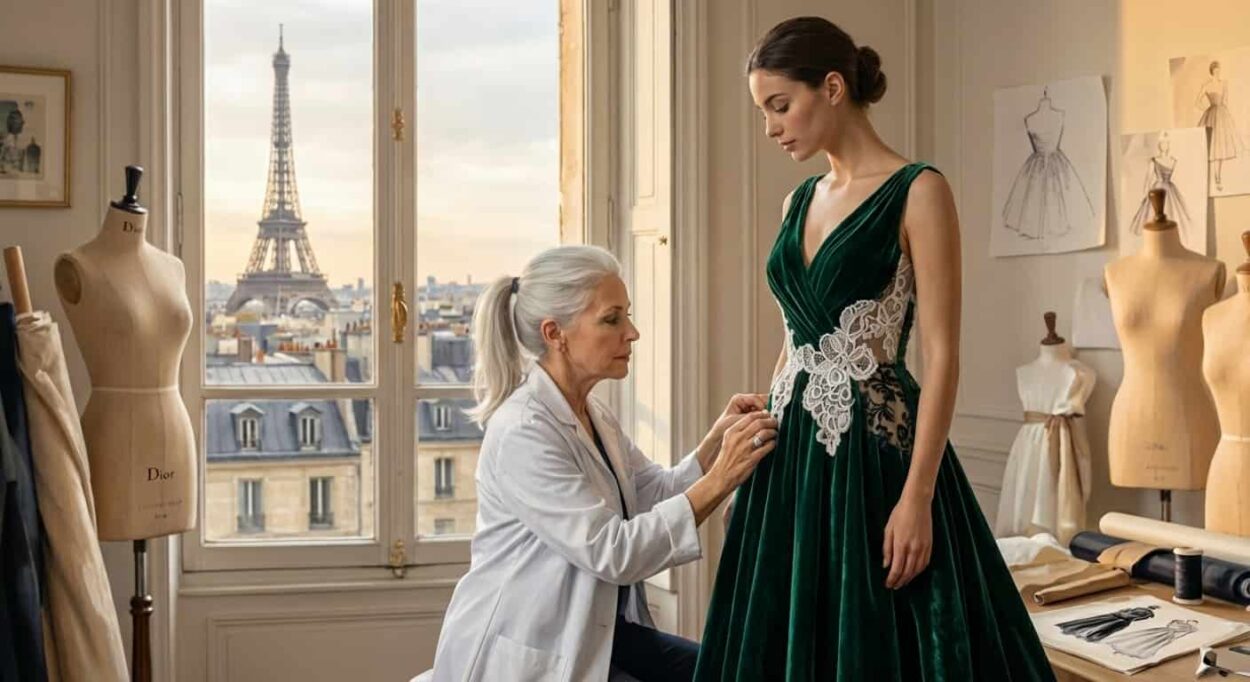
This step is seldom understood by the public. A dress is not simply cut from a flat pattern; couture dresses are engineered to move with the body’s micro-shifts, to flow with air, to maintain shape even when subject to stress, humidity, or the heat of a runway.
A Dior dress, before it is aesthetic, is anatomical.
That anatomical precision becomes especially challenging when the material refuses to cooperate.
Which brings us to fishnet.
And this is where the dress begins to reveal its true complexity.
The rebellion of fishnet
For this collection, Chiuri insisted on a near-impossible foundation material: mesh fishnet, elastic in every direction, prone to warping under the slightest tension.
One embroiderer explains it with the gravity of a scientist discussing unstable elements:
“The fishnet is very elastic, both lengthwise and crosswise. If we cut based on the wrong tension, we are all doomed.”
This is not an exaggeration. On fishnet, traditional embroidery techniques fall apart. Every pull of the thread alters the fabric’s geometry. A flower motif can tilt. A sun can collapse into a wrinkled oval. The garment becomes a moving target.
Yet this season required fishnet because it embodied the theme: lightness, vulnerability, the porousness of a garden exposed to wind.
What does Dior do? They don’t avoid difficulty; they assign their most qualified specialists to solve it.
Each embroidered flower in the dress must be placed with mathematical precision so it never overlaps another motif, even when worn on a moving body. When Chiuri says she wants the sun on the bust not to cross over the leaves, this means hours — sometimes days — of recalculation.
And yet, despite the punishing technical challenge, the embroidered fishnet dress feels effortless. It breathes. It moves. It whispers.
This quiet deception — intense labor disguised as simplicity — is one of the first clues to what makes a Dior dress different.
But embroidery is only half the story. The world in which the dress will be shown matters too.
Which leads us to a forest inside a fashion show.
A runway that grows back
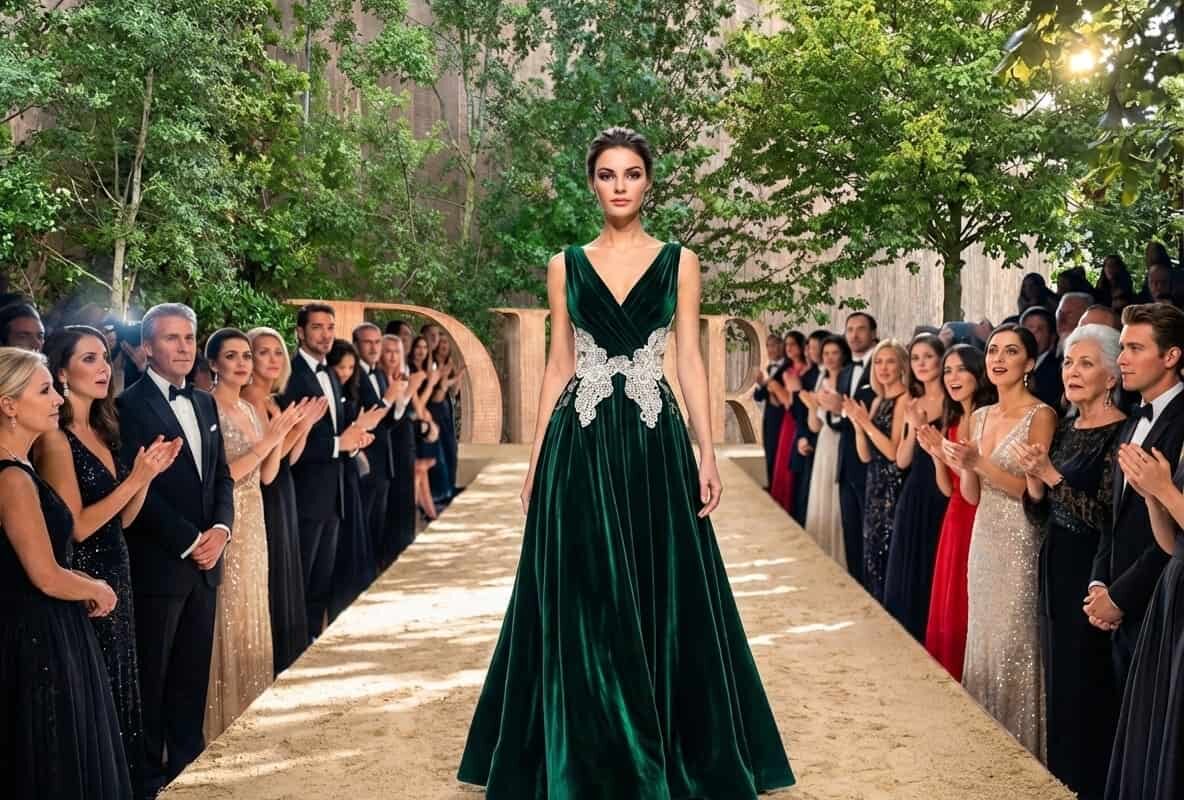
Enter Coloco, a collective of landscape architects who collaborated with Dior to create a fully living, replantable runway environment. “We have 160 trees,” Nicolas from the Coloco team explains. “Everyone says they want to do something for climate change. But what can we really do? Plant.”
The trees were not props. They were living organisms selected for post-show replanting across Paris. After the show, they were redistributed into community gardens, public spaces, and urban biodiversity projects — becoming part of the city’s ecological memory.
The runway becomes an ecosystem, not a stage.
By the time this immersive installation is complete, the dresses are no longer simply garments. They are part of a larger gesture — a world built around them.
Yet the answer still eludes us:
Is the magic in the craft? The history? The narrative? The symbolism?
Perhaps the most accurate insight emerges backstage, where the dress meets its wearer.
Backstage: where narrative becomes identity
Backstage at Dior is a curious mixture of chaos and serenity — dozens of models, stylists, dressers, makeup artists, photographers, and assistants all compressed into a space the size of a large apartment.
There, model Mona sees her assigned dress for the first time.

She had hoped to wear a long dress to the show. Chiuri takes one look at her and says simply:
“That’s it. You’re done.”
It is a moment of synthesis — the designer recognizing the right pairing of body and garment instantly. A decision made in seconds, built on decades of intuition.
Peter Philips, Dior’s creative director for makeup, builds on this principle by using only four or five products for the entire look. Minimalism, he says, keeps the focus where it belongs: on the atmosphere of the collection, not the artifice of beauty.
When the show begins, the dresses glide between the trees like spectral beings — not costumes, not commodities. They become something else: embodiments of memory, labor, narrative, and place.
And when the last model exits the runway, Chiuri breathes out. “It was intense,” she says. “You are worried everything won’t work. But now it is finished, so I feel very well.” She laughs, a quiet laugh — the laugh of someone who has given everything.
Yet still: What makes the dress different?
We have toured the garden, the sketch, the atelier, the embroidery, the runway, and the ecology behind it. We have seen the labor and the narrative. But the conclusion remains unresolved.
Which is why the answer deserves its own final section.
The true difference
A Dior dress is not different because of its price, materials, silhouette, or even its branding. Countless brands have beautiful fabrics, intricate embroidery, and storied founders.
The difference is this:
A Dior dress is the endpoint of an ecosystem of meaning.
It is:
- history transformed into fabric (Catherine Dior’s roses)
- philosophy woven into shape (timelessness, sustainability, resilience)
- craft elevated to engineering (fishnet mastery, embroidery algorithms)
- aesthetic merged with ecology (a runway that grows back into a city)
- a collaboration between dozens of artisans whose names seldom appear in magazines
- a vessel for the wearer’s identity chosen with intention, not randomness
A Dior dress is not simply worn. It is inhabited.
It is the intersection of memory and future, the tactile proof that something ephemeral — inspiration — can be made into something permanent.
In a world where fashion trends are increasingly disposable, a Dior dress insists on the opposite: permanence, craftsmanship, story, and lineage.
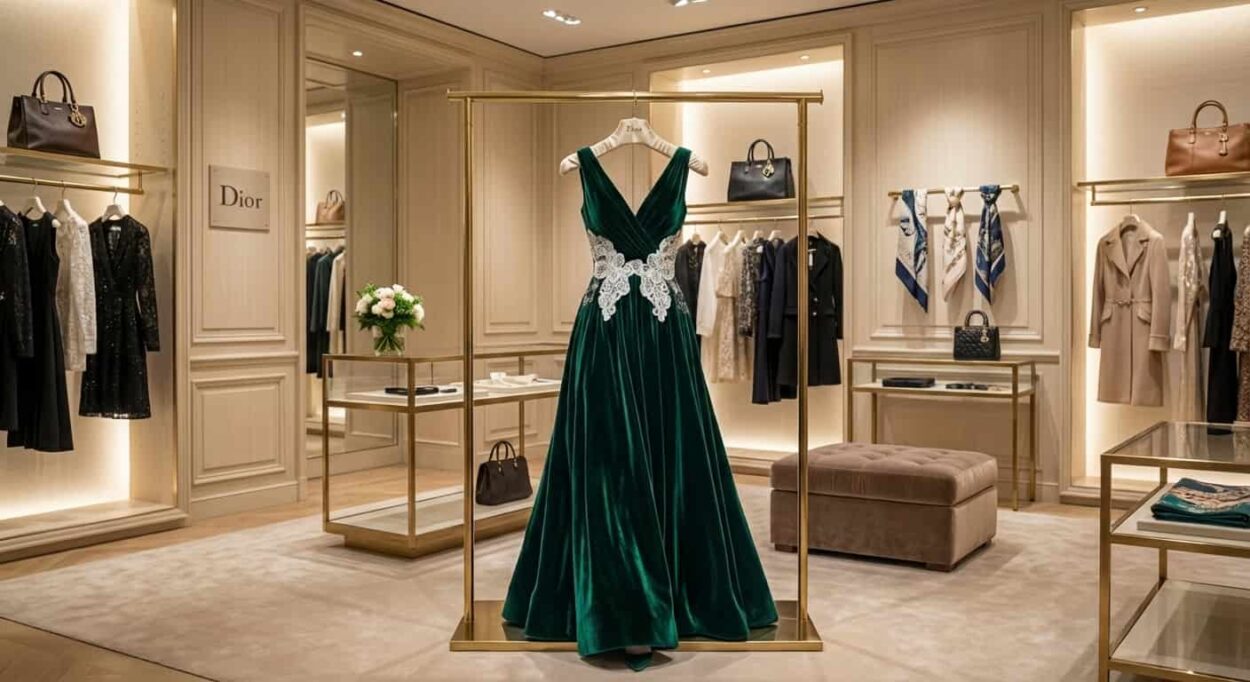
Which is why, in the end, it is not “just fibers and cloth.”
It is an invisible garden — tended by many, rooted in history, blooming on the body of the woman who wears it.
And that is what makes it different.
Follow us on X, Facebook, or Pinterest
