
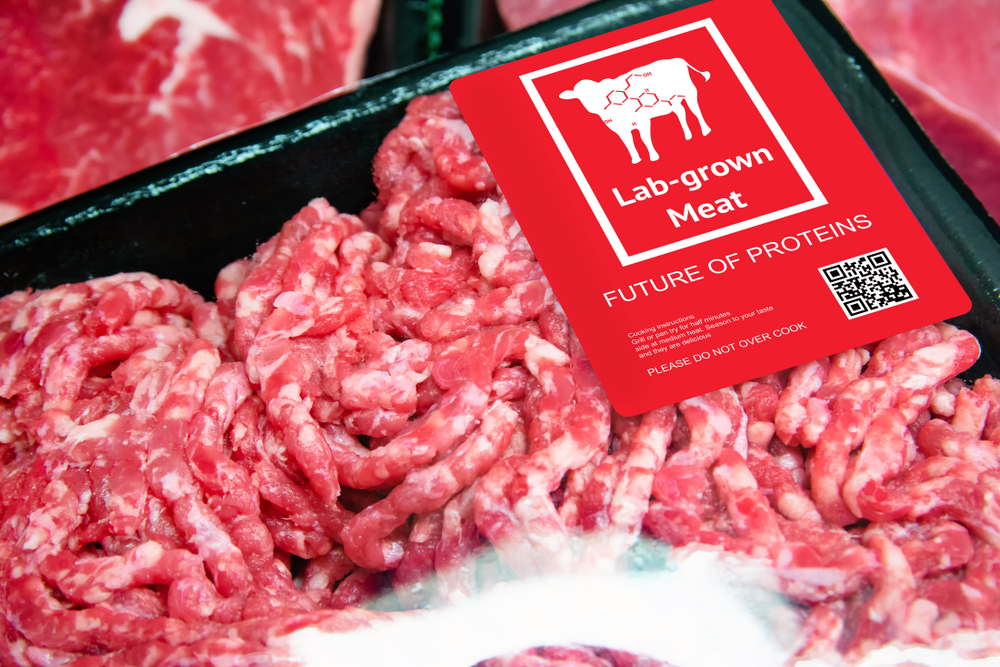
For most of human history, beef began as grass, passed through a ruminant stomach, and ended up on a plate. Today, a growing number of scientists believe that the same steak could one day begin its life in a stainless-steel bioreactor, assembled cell by cell, without ever touching a pasture.
Lab-grown beef — also known as cultivated or cell-based meat — is no longer science fiction. It represents a technological attempt to decouple one of humanity’s most resource-intensive foods from animals, land, and methane emissions, while preserving nutrition, taste, and cultural relevance.
Before asking whether society should produce beef this way, a more basic question comes first: Can the existing livestock system realistically meet global demand?
How beef production works today — and why scale is tightening
Global beef production reached approximately 76.6 million metric tons in 2023. Spread across a global population exceeding 8.2 billion, this equates to roughly 6 kilograms (12 pounds) of beef per person per year, after accounting for losses. That average conceals extreme disparities: Per capita consumption in the United States exceeds 25 kilograms (50 pounds) annually, whereas in many regions of the world, it is little or none.
This output depends on a global cattle population of roughly 1.5 billion animals. Only a fraction are slaughtered each year, which allows production to function as a continuous biological flow rather than a static inventory.
The system still works — but its margins are tightening. Beef production occupies close to 60 percent of global agricultural land while contributing less than 20 percent of the world’s calories. International agricultural outlooks consistently warn that rising demand in Asia and the Middle East will intensify pressure on land, feed availability, and emissions unless production methods evolve.
As the OECD-FAO Agricultural Outlook for 2025-2034 notes, efficiency gains are slowing the growth of emissions — but not stopping it:
“With productivity improvements and a greater share of poultry in meat production, greenhouse gas emissions are expected to rise by 6 percent, significantly less than the projected 13 percent growth in meat output over the coming decade.”
In other words, even under optimistic assumptions, emissions continue to increase. The system is becoming more efficient, but it is not escaping its underlying biological and environmental constraints.
How lab-grown beef is actually produced
Despite common assumptions, lab-grown beef is not manufactured like plastic. It is grown from animal cells.
The process begins with a small biopsy taken from a living cow. Muscle stem cells and fat precursor cells are isolated and cultured in growth media containing nutrients and signaling factors that promote cell division.
Within bioreactors, cells multiply under tightly controlled conditions of temperature, oxygen, and pH. This stage is closer to biomanufacturing than conventional livestock production.
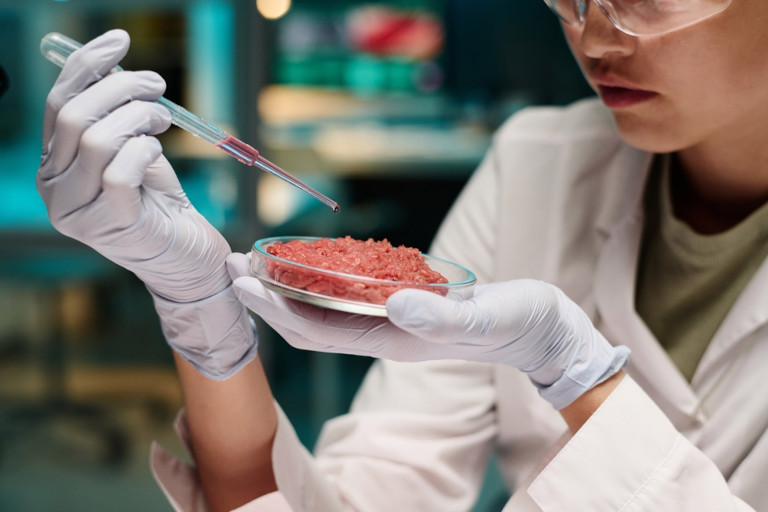
The main technical challenge is structure. Without scaffolds — or tissue-structuring methods such as 3D bioprinting — cultivated meat is closer in form to ground beef than to a whole cut. Reproducing the texture of steak remains one of the hardest hurdles.
The U.S. Food and Drug Administration defines cultivated meat as food produced from cultured animal cells rather than harvested animals.
Singapore approved the first cultivated meat product for sale in 2020. The United States followed with joint FDA–USDA approvals in 2023.
The remaining question is not whether cultivated meat works — but whether it can be produced affordably, cleanly, and at scale.
Nutrition: Equivalent by default, or by design?
At the cellular level, lab-grown muscle is still muscle. In principle, cultivated beef can match conventional beef in protein content and amino-acid profile.
In practice, nutritional equivalence depends on design choices. A 2024 review published in Frontiers in Nutrition notes that consumers frequently express concerns about health impacts, nutrition quality, food safety, and sensory properties.
Nutrients such as vitamin B12 and heme iron do not automatically appear unless deliberately incorporated. In conventional beef, these arise through complex animal metabolism and microbial ecosystems.
Cultivated meat is therefore neither inherently inferior nor automatically identical. It is a designed food, and its nutritional profile reflects production choices.
Energy use: Biological efficiency versus industrial transparency
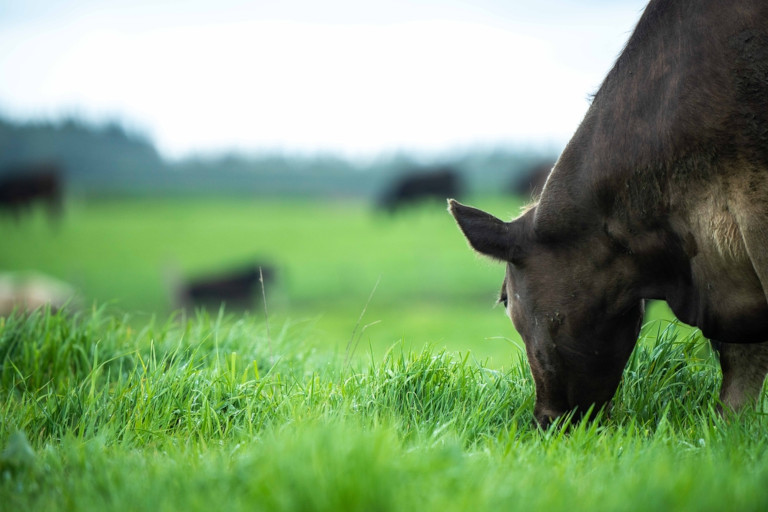
Traditional cattle production relies heavily on biological energy flows — sunlight converted into grass, grass into muscle. Its environmental costs appear as land use, methane emissions, and water consumption.
Cultivated meat shifts the burden to industrial energy systems. A 2024 life-cycle analysis in Environmental Science & Technology found that if growth media remain highly refined and energy sources are fossil-based, cultivated meat could rival or exceed the climate impact of conventional beef.
Under different assumptions — renewable energy, simplified growth media, and high-density bioreactors — the same models project substantial reductions in land use and methane emissions.
Cultivated meat is not inherently sustainable. Its footprint mirrors the energy systems that support it.
Cost realities and economic limits
Conventional beef pricing conceals significant complexity. In the United States, cattle prices averaged under US$2 per pound of live weight in 2024, whereas retail prices for ground beef commonly range from US$4 to US$8 per pound.
Cultivated meat costs have fallen dramatically since the first lab-grown burger reportedly cost hundreds of thousands of dollars in 2013. Even so, recent techno-economic analyses suggest that reaching price parity requires simultaneous breakthroughs in growth efficiency, media cost reduction, and facility scale.
As a result, early products focus on ground or blended formats rather than whole cuts.
Can livestock alone meet future demand?
Replacing even 10% of global beef production would require more than 7 million tons of alternative output annually. That scale exceeds what startups or pilot facilities can deliver.
Beef demand typically plateaus, not because cattle disappear, but because land constraints, climate impacts, and price pressures begin to intervene.
From that perspective, cultivated meat functions less as a replacement and more as a pressure-relief mechanism.
A realistic role for cultivated beef
Cultivated meat is unlikely to replace ranching in the foreseeable future. Most analyses instead frame it as a supplemental technology that could reduce land pressure, buffer climate volatility, and expand protein supply in regions where grazing systems face structural limits.
Its potential advantages lie in reducing dependence on agricultural land, improving resilience to climate disruption, and enabling protein production closer to major population centers. These benefits depend heavily on energy sourcing, production scale, and regulatory oversight.
From that perspective, cultivated beef functions less as a replacement and more as a stabilizing addition to existing food systems.
When meat becomes manufacturing
If beef can be grown without animals, meat shifts from ecology to infrastructure. Production becomes a question of energy, inputs, and governance rather than pasture and herd size.
This transition does not guarantee sustainability or affordability. It simply makes those outcomes choices rather than constraints.
For the first time, humanity can produce beef without cows. Whether that option improves food security — or reshapes existing inequalities — depends on how deliberately it is implemented.
Follow us on X, Facebook, or Pinterest
