
The idea that reality may contain hidden layers — structures that exist independently of belief, culture, or interpretation — has surfaced repeatedly throughout human history, often at the margins of accepted knowledge. The man at the center of this story is not a physicist by appointment, nor a neuroscientist by credential. He is a visual editor by trade — someone trained to notice what persists across frames, what flickers, what belongs to the signal, and what belongs to noise.
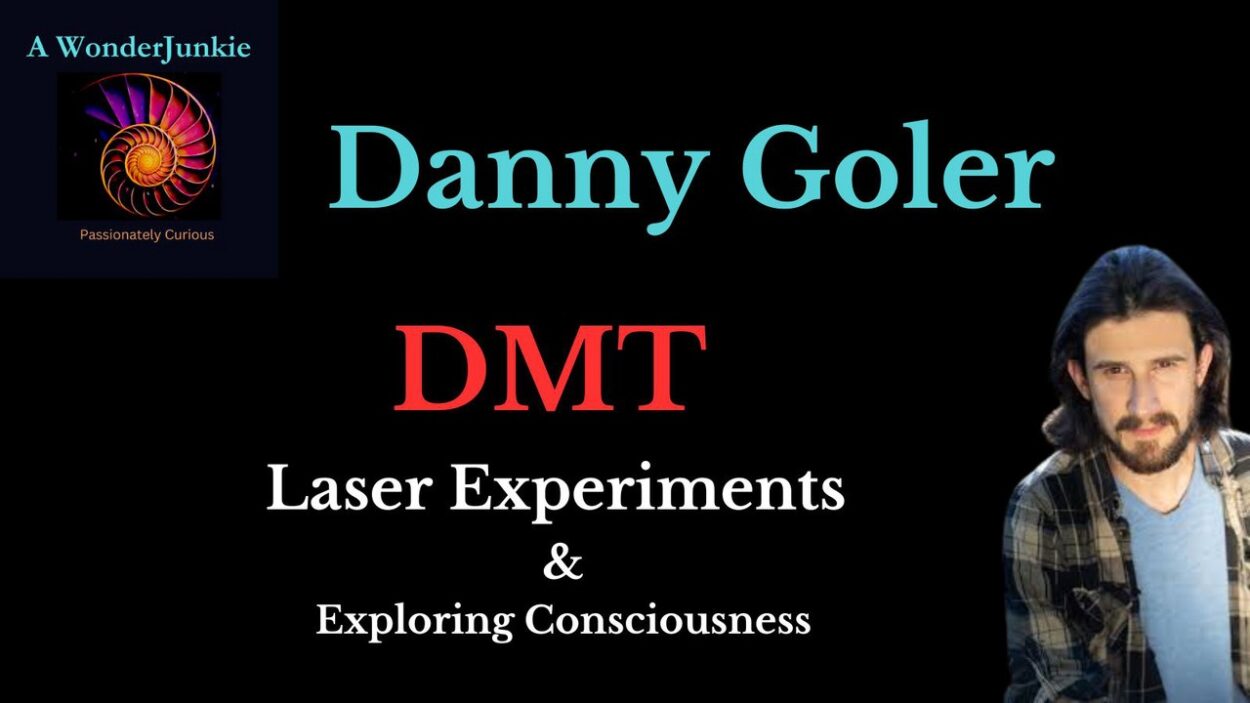
His name is Danny Goler
Danny Goler is a filmmaker, psychonaut, and founder of Code of Reality, Inc. He recently produced a documentary on his discoveries regarding N, N-dimethyltryptamine (DMT) and lasers, and their potential implications for simulation theory. Over several years of research, Goler arrived at a claim that is quietly radical: that under specific altered perceptual conditions, a coherent and repeatable informational structure can be observed — one that does not behave like imagination, hallucination, or symbolism, but instead exhibits the defining properties we normally reserve for physical reality itself.
Using a precisely refracted red laser and a narrowly tuned wavelength, he reports that this structure appears as a stable field of patterned information — numerical, ordered, spatially fixed — visible to multiple observers independently, and indifferent to expectation or belief. What unsettles is not the strangeness of the claim, but its restraint: he does not present a revelation, only an anomaly that refuses to dissolve.
If this were merely another private vision, it would end there. History is full of such accounts, intense and unverifiable, leaving no residue beyond testimony. But this account lingers differently. It insists on repeatability. It introduces a tool. It claims coordinates. And it emerges at a moment when civilization itself is beginning to suspect that its picture of reality may be incomplete — not philosophically, but structurally.
What follows is not an argument for what this signal means, but an exploration of why signals like this have appeared before, why they are so often filtered out of the historical record, and why civilizations tend to encounter them not at the beginning of their ascent, but near the edges of their certainty.
Are hidden layers of reality glimpsed when perception shifts?
The realm of numbers and symbols
There are moments in human history when something appears that does not fit the language available to describe it. The response is almost always the same: dismissal first, curiosity later, assimilation much later — if at all. Between those phases lies a long silence, not because nothing is there, but because acknowledging it would require re-examining the foundations of how reality itself is sorted.
This story begins in that silence
It begins not with ruins or tablets or forgotten cities, but with a claim so disarming in its simplicity that it feels almost improper: that something stable, repeatable, and structurally real can be perceived only when human perception steps outside its habitual bandwidth. Not imagined. Not symbolic. Not subjective. Present.
The claim does not arrive as theology. It does not arrive as mysticism. It arrives awkwardly, without institutional backing, without language, without a place to land. And perhaps that is why it echoes something far older than modern science — a pattern that appears whenever civilizations brush against something they cannot yet metabolize.
What happens when reality refuses to appear in its approved form?
Reality has always exceeded the senses that observe it
Human vision occupies a sliver of the electromagnetic spectrum so narrow it barely deserves the name. We do not observe radio waves, gamma rays, infrared, or ultraviolet radiation. We know they exist only because instruments were built that could register them. Before those instruments, those forces did not become “unreal.” They were simply inaccessible.
There is an unspoken assumption embedded in modern thought: that all aspects of reality must eventually present themselves to sober, waking perception — or else they do not count. Yet this assumption is historically recent. For most of human existence, reality was understood as layered. Visible, invisible, audible, inaudible. Some aspects are stable, others are transient. Some are accessible only under rare conditions.
Shamans, prophets, initiates, oracles, ascetics — these figures appear everywhere in early human cultures, not as eccentrics but as technicians of perception. Their role was not to invent stories, but to traverse thresholds others could not. What modernity reframed as hallucination was once treated as navigation. The question is not whether altered perception distorts reality. The question is whether ordinary perception is already a reduction.
What if altered states are not distortions, but instruments?
The brain may not generate reality — it may filter it
Modern neuroscience often treats consciousness as a byproduct: neurons firing, chemistry cascading, complexity giving rise to experience. Yet there is another model — older, quieter — that sees the brain not as a generator but as a gate. A filter. Reduce the filter, and more passes through.
This idea appears in unexpected places. In Aldous Huxley’s writings. In indigenous cosmologies. In near-death accounts. In deep meditative traditions. In the consistent reports of those who enter certain altered states and return, insisting — not emotionally, not metaphorically, but matter-of-factly — that they went somewhere. What unsettles institutions is not that these reports exist, but that they exist. It is what they repeat. Across cultures. Across languages. Across centuries. And repetition is a signal.
What does it mean when a perception stabilizes?
Hallucinations dissolve; environments persist
One of the strongest criteria we use to decide what is “real” is persistence. A chair remains where it is when you look away. A wall resists your hand. A landmark does not reconfigure itself when attention shifts. Most altered-state experiences fail this test. They are fluid, immersive, overwhelming — and gone. Beautiful but unverifiable. Intense but private. Yet occasionally, testimony surfaces that does not fit this mold.
Not visions that swirl and collapse, but structures that remain fixed. Not symbolic imagery, but coordinates. Not personal narratives, but shared observations. When multiple observers describe encountering the same stable features — unchanged by expectation, unaffected by movement, indifferent to belief — the usual categories falter. Because imagination does not behave this way.

What kind of environment does not respond to the observer?
A background layer, not a projection
There is a profound difference between seeing something because you expect it and encountering something that does not align with expectations. In certain reports — rare, but striking — observers describe perceiving a structured informational field that behaves as if it exists independently of them. The observer’s motion does not affect the structure. Attention does not reshape it. The structure remains where it is, indifferent to the observer. This is the opposite of dream logic. It is the logic of infrastructure.
Ancient texts hint at this distinction. The “firmament.” The “waters above.” The “heavens” are layered domains. Not as fantasies, but as environments governed by their own rules. Modern language lacks a term for this quality of epistemological insistence — the sense that something is there, whether or not one agrees with it. However, cultures prior to ours did not struggle to name it. They called it the unseen world.
Why do numbers appear where myth once placed gods?
Symbol and structure often share the same doorway
In ancient civilizations, numbers were sacred not because they were mystical, but because they were stable. They did not decay. They did not erode. They survived catastrophe. Plato placed mathematics above matter. Pythagoras saw numbers as the skeleton of reality. Hindu cosmology encoded time in vast numerical cycles. Mayan calendars tracked deep astronomical periods with uncanny precision.
When modern observers report perceiving numerical sequences embedded within a stable perceptual field — unmoving, consistent, patterned — it raises an uncomfortable possibility. That mythological language may have been the only available vocabulary for something fundamentally structural. Gods may have been placeholders for systems.
Why does civilization keep rediscovering the same threshold?
Because collapse erases tools, not truths
Advanced societies assume continuity. They believe progress accumulates. Yet the geological record tells a different story: mass extinctions, abrupt climate shifts, sudden resets. Ice cores show rapid temperature changes. Sediment layers indicate continental-scale flooding. Archaeological evidence indicates sudden abandonment rather than gradual decline.
Civilizations do not always fall — they are interrupted. When an interruption occurs, knowledge fragments. Tools vanish. Language simplifies. What remains is the story. Myth is what survives when technology does not. And myth remembers more than we think.
Why are ‘first civilizations’ always found to be already sophisticated?
Origins rarely look like beginnings
The oldest cities we know — Göbekli Tepe, Caral, and early Sumer —do not resemble crude experiments. They arrive fully formed. Monumental. Symbolic. Astronomically aligned. There is no long visible ramp from ignorance to precision. Instead, we find remnants of knowledge without its developmental scaffolding. This pattern appears repeatedly: a civilization emerges already knowing things it should not yet know. Geometry. Agriculture. Astronomy. Architecture. The absence of prototypes is not evidence of spontaneity. It is evidence of erasure.
Why does silence follow certain discoveries?
Gatekeeping is quieter than censorship
There are no bonfires today. No inquisitions. Knowledge is now buried under indifference, insufficient funding, and reputational risk. Ideas that cannot be assimilated are not attacked. They are ignored. This creates an illusion of consensus where there is merely an absence of conversation. Throughout history, truths that arrive before their language are dismissed as incoherent. Not wrong — just inconvenient.
What if reality is layered, not singular?
Progress may be cyclical, not linear
Ancient cosmologies almost universally describe cycles. Yugas. Ages. Suns. World resets. Floods. Fires. Modern civilization tells a different story: one ascent, one origin, one trajectory. But cycles leave signatures. Repeated myths of destruction. Recurrent architectural knowledge. Persistent symbolic systems. Shared encounters with “other realms.” Perhaps civilization is not a straight line but a spiral — revisiting the same thresholds with different tools.

What survives when everything else collapses?
Structure outlasts matter
Stone erodes. Metal rusts. Text burns. But patterns persist. Ratios. Alignments. Mathematical relationships. Symbolic maps embedded in the story. If an advanced civilization existed before ours, it would not leave skyscrapers. It would leave templates. Templates are recognizable only when one knows how to look.
What does this mean for the present moment?
We may be closer to the edge than we realize
Every civilization believes itself stable — until it isn’t. The lesson encoded across ruins, myths, and silences is not technological triumph, but fragility. Knowledge survives collapse only when it can hide inside narrative, symbol, or perception itself. If reality contains layers we have not yet integrated, they will not wait for institutional permission. They will be rediscovered — again.
What remains when the argument ends?
Recognition, not resolution
This is not a call to belief. It is an invitation to notice repetition. The same questions recur across centuries, expressed in different languages and framed within different cosmologies. Are we the first? Is reality complete? What endures when worlds fall?
History may not be a record of progress, but of amnesia punctuated by rediscovery. If something has been hiding in plain sight — visible only when perception loosens — then its persistence is not an anomaly. It is a message. Not about simulation. Not about gods. But about how little of reality we are trained to see — and how much waits patiently for us to remember.
Follow us on X, Facebook, or Pinterest
