
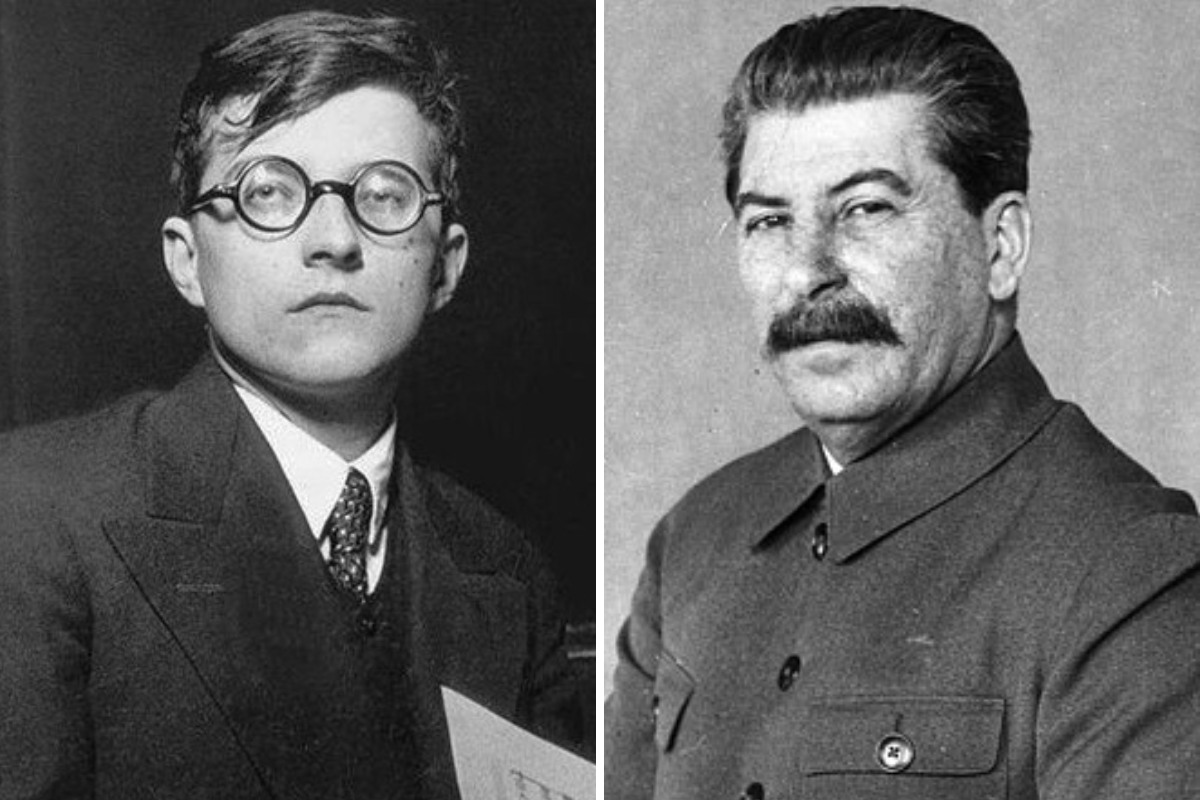
This is one of the most gripping stories of the 20th century — a secret struggle between an artist and a man of power that lasted nearly two decades, with musical scores serving as the battlefield.
Shostakovich is hailed as the second-greatest figure in Russian musical history, after Tchaikovsky. Yet, despite his extraordinary talent, this outstanding musician spent his entire life living in constant fear under the tyranny of Stalin’s Red Terror. In his later years, according to the memoir Testimony smuggled out by Solomon Volkov, Shostakovich reportedly said: “The prospect of execution was a theme that tormented me my entire life.”
The first crisis: The Thunder of ‘Pravda’
On the night of January 26, 1936, the Bolshoi Theatre in Moscow was ablaze with light. Lady Macbeth of Mtsensk was performing its 97th show — an incredible success for a modern opera.
But no one noticed that several people had quietly taken their seats in a box. Stalin had arrived. He had not informed anyone in advance, nor was there any grand welcoming ceremony. He simply sat there, in the dim shadows of the box, watching everything on stage.
Two days later, on January 28, Pravda published an unsigned editorial on its front page titled “Chaos, Not Music.” The tone of the piece was not that of a music review, but rather of a judgment: “From the very beginning of the opera, the listener is stunned by a continuous, deliberately arranged cacophony of vulgar and chaotic sounds. This music is unbearable to listen to, and it is impossible to remember.” Everyone knew who had dictated this article.
Shostakovich was 29 at the time. He was away from home when he heard about the article from a friend; his hands trembling, Shostakovich unfolded the newspaper. He read every word. Over the next few days, Pravda launched a barrage of attacks, publishing several more articles that singled out and criticized his other works.
These operas were immediately withdrawn from all theaters. His monumental Symphony No. 4, already deep in rehearsal, was quietly withdrawn to save his life. It would remain locked away, unplayed, for a quarter of a century.
Shostakovich was not arrested. This, in fact, was a more subtle form of torture — because he did not know what would happen next. In those days, once the label of “enemy of the people” was pinned on someone, the usual next stop was Lubyanka Prison, followed by Siberia, and then silence.
Every night, he would go downstairs and sit by the elevator, not to go out, but to wait there — he wouldn’t let his family answer the door, because the secret police were in the habit of knocking late at night. If he was destined to be taken away that day, he didn’t want his wife and children to witness the scene. He waited like this for over a year. Every night, he would pack a small bag by his bed, containing a few changes of clothes and basic toiletries — ready to be taken away at any moment.
‘Symphony No. 5’: Compromise or code?
In 1937, the Soviet Union was undergoing its darkest season. The Great Purge had reached its peak. Every day, people vanished from offices, apartments, and bread lines. Army marshals were executed, members of the Academy of Sciences were exiled, and writers, directors, and conductors fell into silence one after another.
Shostakovich’s close friend, Red Army Marshal Tukhachevsky — who had once supported him — was arrested and soon executed. Another friend, theater director Meyerhold, was heading toward the same fate. Every name that vanished had once been a part of his life.
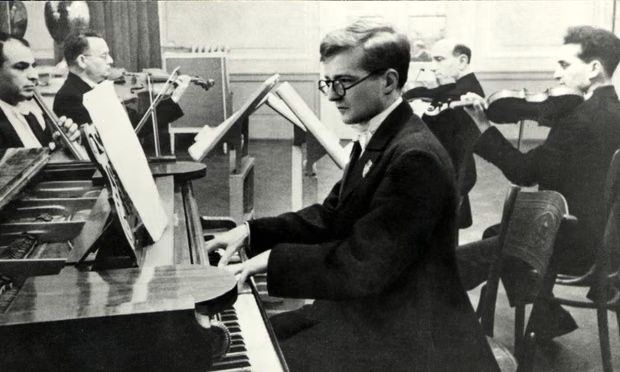
It was on a night like this that he sat down at the piano and began composing Symphony No.5. He knew exactly what this work had to do: It had to sound like a confession, like a person returning from the path of error, rediscovering light and strength. The authorities needed to see this. Otherwise, he didn’t know how much longer he could hold on. But he also knew that he could not truly write a lie.
On November 21, 1937, Symphony No. 5 premiered in Leningrad. Halfway through the third movement, Adagio, people began to weep. Not just one person, but the entire audience, in waves, almost unable to contain themselves. These were people who had just seen their neighbors taken away, who had just burned diaries that might implicate them, who had just signed their names — names they could barely bear to look at — on some denunciation letter.
What they heard in this Adagio, only they themselves knew. And the authorities heard what they wanted to hear: a work of repentance, an artist who had seen the error of his ways.
The symphony was a resounding success. According to the orchestra’s director at the time, the entire audience rose to their feet and applauded for half an hour. Shostakovich was reinstated. Many years later, when asked what the symphony was really meant to say, he was silent for a long time, then said: “I thought people would reason it out for themselves.”
The second crisis: The 1948 reprimand
The war was over. Stalin had won. This was not good news for Soviet artists. In 1945, Nazi Germany collapsed, and the Soviet Union had secured victory at a tremendous cost; Stalin’s authority had reached the zenith of his career. It was precisely in this atmosphere of euphoric victory that a more severe form of cultural control was quietly taking shape.
In 1946, Zhdanov was ordered to return to the political arena and began a new round of purges in the literary and artistic circles. Poets, writers, and directors were singled out for criticism one after another. Shostakovich knew it was only a matter of time before his turn came.
In January 1948, the moment arrived. The Union of Soviet Composers convened a general assembly — what should have been a routine meeting — but the atmosphere felt off from the very start. Zhdanov attended in person and delivered a lengthy speech, labeling the works of Shostakovich, Prokofiev, and others as “formalism” — a term Shostakovich knew all too well, like a key that unlocked the door to every form of punishment.
His sixth, eighth, and ninth symphonies were singled out for criticism, accused of being obscure, cold, and detached from the people — products of the decadent aesthetics of the West.
Shostakovich sat in the audience, motionless, listening to these words. He was already 42 years old and knew better than he had in 1936 how to turn his face to stone in such a setting. But he knew in his heart that this time was more dangerous than the last — because this time, the criticism was more systematic and far-reaching, and he discovered that those around him who had once supported him were now silent as the grave; not a single one spoke up.
After the meeting, the punishments followed in quick succession, precise and humiliating: His state stipend was revoked, his teaching position at the Conservatory was terminated, his post in the Union of Soviet Composers was rescinded, and most of his works vanished from concert programs. Overnight, he went from being a “Composer of the Soviet People” back to an ordinary man with no official status.
Meanwhile, a larger, more absurd machine began to turn without his knowledge. The bureaucrats realized that Shostakovich’s name was a resource in itself — a world-class name that carried weight on any document.
Shostakovich was indeed a world-class name: Years earlier, during the height of World War II, on July 19, 1942, millions of Americans tuned their radios to hear Arturo Toscanini conduct the Western premiere of the majestic Symphony No. 7, and Time magazine featured a photograph of the composer on its cover, dressed in a firefighter’s uniform and wearing a fire helmet. And so they began to use that name, just as one would use an official seal.
On September 30, 1950, Literary Gazette published a lengthy, effusive article titled “In Praise of Comrade Stalin’s Great Achievements,” signed by D. Shostakovich. Shostakovich never saw that article — he didn’t even know it had been published.
Stalin’s death
On March 5, 1953, Stalin died. The thaw came sooner than anyone had imagined. Banned works gradually returned to the stage, revoked teaching positions were quietly restored, and confiscated stipends were reinstated.
The things that had suddenly vanished from his life in 1948 were now being retrieved one by one, like objects left on the beach after the tide recedes, and put back in their places, as if nothing had ever happened. The official tone had also shifted; he was once again hailed as “the greatest composer of the Soviet Union,” as if those critical articles from the past had never existed.
With the dictator gone, the creative dam broke. For five full years following his second condemnation, his most significant compositions had been hidden away in a desk drawer, unperformed, while he publicly composed superficial cantatas to survive. Now, over the summer of 1953, Shostakovich poured his repressed fury into a new masterpiece. Eight months after Stalin’s death, on December 17, 1953, Symphony No. 10 premiered in Leningrad.
As he later confided to close friends, the Presto scherzo of the second movement was a portrait he had painted specifically of Stalin — not a tribute, but a caricature, a satire, a belated act of revenge he had carried out through musical notes. When the premiere ended, the audience erupted in a prolonged round of applause.
People surged backstage, vying to shake his hand, embrace him, and offer their congratulations. The backstage area descended into chaos, bustling with excitement, as if a long-suppressed celebration had finally been unleashed. Then someone noticed that, amid all the commotion, Shostakovich sat alone in a corner. He held a book and was reading. The book was A Short Biography of Stalin. This is not a contradiction; this is the truth.
Stalin was not merely his persecutor. Stalin was the backdrop to 20 whole years of his life, the gaze he had to reckon with as he wrote every single note, the presence he thought of first upon waking each morning.
A man spent 20 years fearing another man, 20 years trying to guess that man’s thoughts, avoiding his wrath, and searching for a sliver of breathing room in the shadow of that man. Shostakovich sat in the corner reading that biography, perhaps hoping to figure out what that man was really like. Or perhaps hoping to figure out what he himself was really like.
Translated by Audrey Wang and edited by Helen London
Follow us on X, Facebook, or Pinterest
