
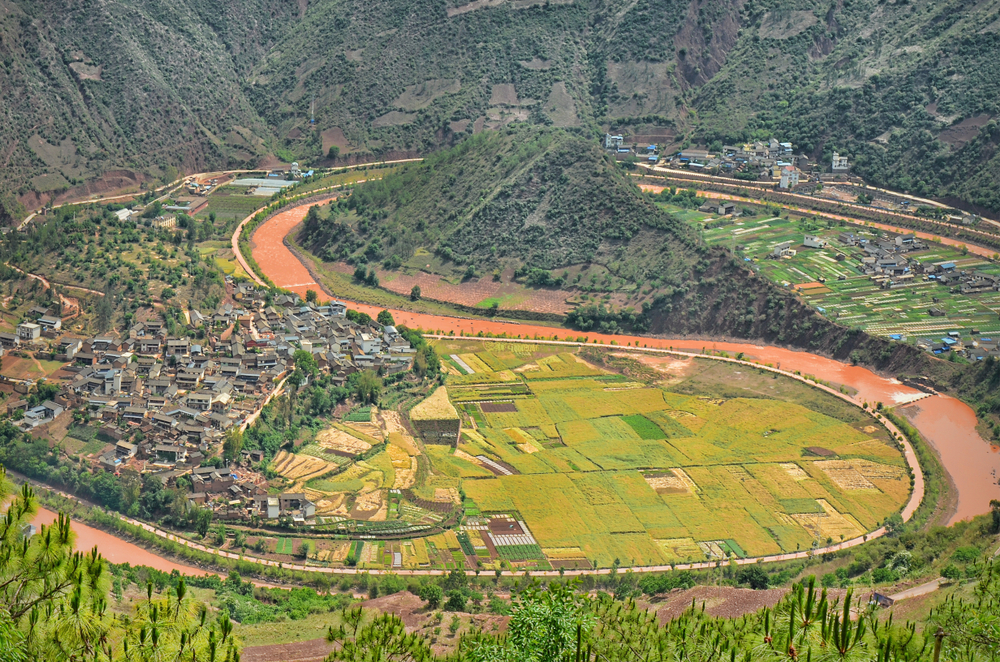
Among the many fascinating stories from Zhejiang Province, one of the most remarkable centers on an ancient village named Yuyuan, nestled in southwestern Wuyi County. Today, travel guides proudly call it the “Taiji Astrology Village.” Six centuries ago, however, it had no such elegant title. Back then, the villagers knew it by a single word: hardship.
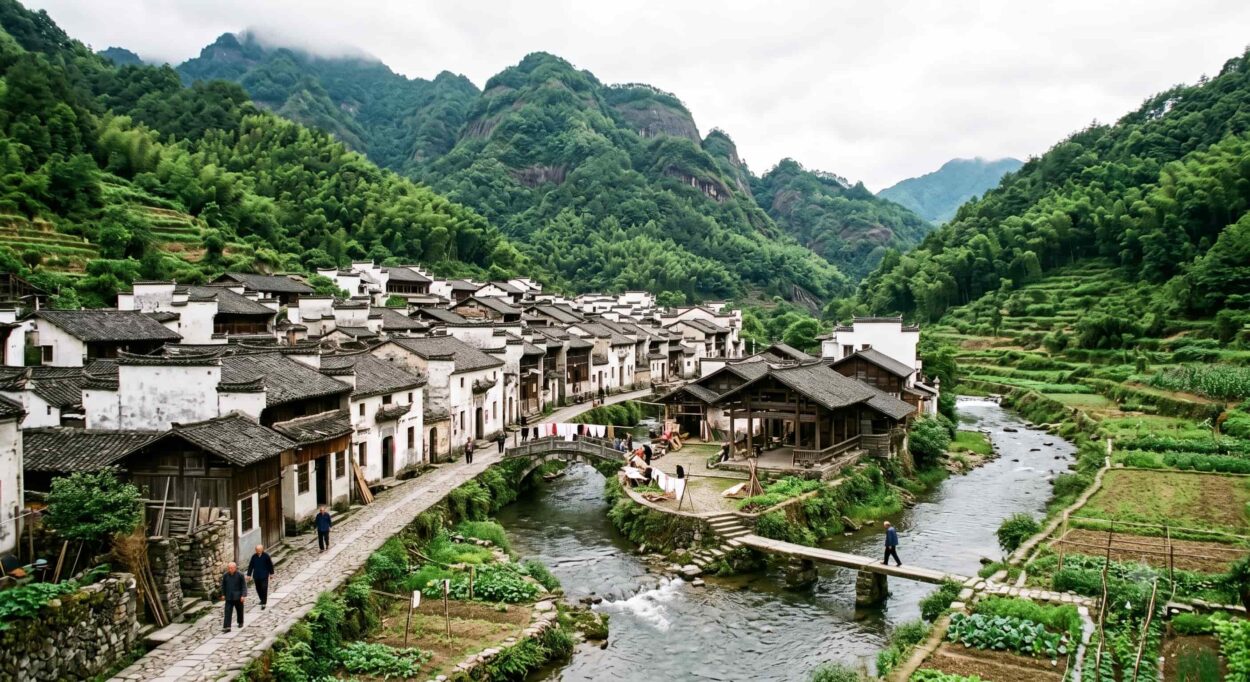
Surrounded by verdant mountains, Yuyuan seemed a peaceful refuge from the turmoil of the outside world. Yet beneath its idyllic beauty lay a hidden problem: a stream flowing straight toward the village. According to traditional feng shui, such a formation is known as “an arrow piercing the heart,” an extremely inauspicious arrangement.
During the rainy season, the stream became a raging torrent, flooding homes without mercy. Yet in times of drought, the water disappeared almost as quickly as it came, leaving the fields cracked like the weathered hands of an old farmer. To make matters worse, fires broke out frequently, and epidemics often swept through the village, claiming many lives. A family bearing the surname Yu had settled there, hoping to build a peaceful future, but, generation after generation, they found themselves struggling simply to survive.
An old friend’s visit
At the end of the Yuan Dynasty and the beginning of the Ming Dynasty, the country gradually returned to stability. Having retired from government service, the renowned statesman and strategist Liu Bowen (also known as Liu Ji) was returning to his hometown in Qingtian, Zhejiang.
While passing through Wuyi, he remembered his former classmate and close friend, Yu Lai, and decided to pay him a visit. Delighted by the unexpected reunion, Yu Lai prepared the finest seasonal dishes the surrounding mountains could offer. Yet from the moment Liu Bowen entered the village, his brow remained furrowed. Standing on a hill overlooking the settlement, he quietly studied the stream that rushed directly toward the houses. Immediately, he understood. “The village’s vital energy,” he thought, “is being carried away by this current.”
That evening, beneath the soft glow of an oil lamp, the two old friends reminisced about their youthful days of study before turning to the hardships facing the villagers. Holding his wine cup, Yu Lai sighed deeply. “Brother Bowen,” he confessed, “our ancestors chose this place seeking peace. But with these endless floods, droughts, fires, and disease, I fear my descendants may never know a secure and prosperous life.” Liu Bowen did not answer immediately.
He gently swirled the wine in his cup, his thoughts reaching far beyond the study’s earthen walls — as if tracing the surrounding mountain ranges and even the stars overhead. He knew the problem required more than simply building stronger embankments.
A dream from Heaven
That night, Liu Bowen slept in the study. While half asleep and half awake, he felt himself becoming weightless, drifting toward the sacred mountain behind the village. Looking down from above, he witnessed an extraordinary scene. The Big Dipper suddenly blazed with brilliant light. Seven golden beams descended from the Heavens, striking the earth and transforming into seven shimmering ponds. At that very moment, a magnificent green dragon raced across the land. It moved so swiftly that fierce winds swept away all the auspicious clouds hovering over the village.
Then an elderly man with snow-white hair appeared beside him and quietly said, “The dragon moves too swiftly, scattering energy instead of gathering it. If you can persuade the dragon to turn, the vital energy will remain.” Liu Bowen awoke instantly, his forehead covered in perspiration. Without bothering to dress properly, he lit the fading lamp and began sketching on a sheet of paper. Suddenly, everything became clear. The green dragon represented the straight stream flowing toward the village. To change the village’s destiny, the dragon would have to bend its course.
Transforming the landscape
The next morning, Liu Bowen showed his drawing to Yu Lai. “Follow these plans,” he said. “Redirect the stream into a winding course, and construct seven ponds within the village corresponding to the seven stars of the Big Dipper. Once this arrangement is completed, your descendants will enjoy lasting peace.” Yu Lai trusted his old friend completely. He rallied the entire village, and for months, everyone worked together. The men dug tirelessly, gradually redirecting the once-straight stream into a graceful curve. The result became a wonder admired by later generations.
Seen from above, the winding stream — together with the surrounding hillsides and terraced fields — formed an enormous Taiji (Yin-Yang) symbol. Instead of charging directly into the village, the stream now embraced it with gentle curves. What had once been a destructive force was transformed into a harmonious, life-giving presence. Liu Bowen also instructed the villagers to dig seven wells and seven ponds, each corresponding to one of the seven stars of the Big Dipper.
Practically speaking, the ponds stored water for fire prevention and improved irrigation, while also helping regulate the underground water system. In traditional understanding, they also perfected the village’s harmonious flow of energy. Sometimes wisdom serves both Heaven and earth at the same time.

A promise of prosperity across six centuries
Before departing, Liu Bowen stood at the entrance of the village and gave the villagers one solemn instruction: “Never alter the form of the Taiji, and never move the positions of the Seven Stars. Guard them well, and your village shall prosper for six hundred years.” According to local legend, his words proved remarkably true.
Since then, Yuyuan Village, once plagued by disasters, has seemed to be shielded by an invisible force. The long history of floods disappeared. Epidemics became rare, and devastating droughts and fires almost vanished. Life gradually became peaceful and prosperous.
During the Qing Dynasty, a skeptical descendant decided to fill in one of the “Star Ponds” to build a house. Curiously, on the very day construction began, a mysterious fire broke out in his home. Terrified, he immediately abandoned the project, restored the pond, and respectfully apologized to his ancestors. Whether coincidence or providence, no one afterward dared disturb the original design.
A village that flourished
From the early Ming Dynasty to the end of the Qing Dynasty — a span of exactly six hundred years — this small mountain village produced more than two hundred government officials, including ministers, physicians, magistrates, and numerous accomplished scholars.
Yuyuan eventually became renowned throughout the region as a “Village of Scholars,” where learning, virtue, and public service flourished from one generation to the next. This enduring prosperity began with Heaven’s guidance, revealed through one extraordinary dream. Liu Bowen’s gift to the people of Yuyuan was astonishingly simple: a gently winding stream and seven unassuming ponds. Yet together, they became enduring symbols of harmony between humanity, nature, and Heaven — protecting an entire village for six remarkable centuries.
Translated by Katy Liu and edited by Tatiana Denning
Follow us on X, Facebook, or Pinterest
