
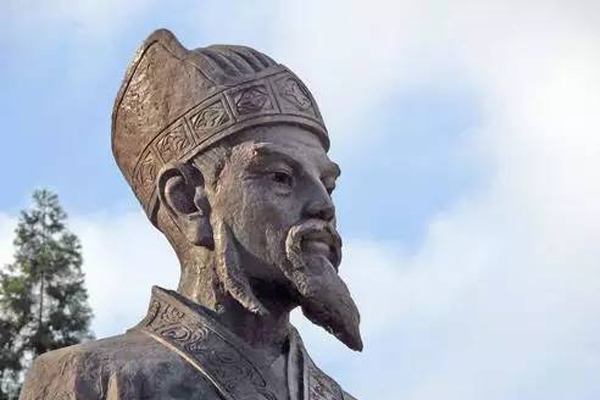
Liu Ji (1311-1375), courtesy name Liu Bowen, was a native of Qingtian, Zhejiang Province, China. A military strategist, statesman, and man of letters during the transition from the Yuan Dynasty (1271-1368) to the Ming Dynasty (1368-1644), he is regarded as one of the founding figures of the Ming Empire. Widely celebrated for his extraordinary foresight and strategic brilliance, Liu Bowen is often ranked alongside Zhuge Liang (181-234), the legendary strategist, statesman, and inventor of China’s Three Kingdoms period (220-280).
An amazing revelation
From an early age, Liu Bowen displayed exceptional intelligence. He was said to be able to grasp the essence of any text — whether on astronomy, military strategy, or Neo-Confucian philosophy — at a single glance. Although he successfully passed the imperial examinations, he later resigned from office and chose to live in seclusion, disillusioned by the corruption of officialdom. Returning to his hometown, Liu sensed a mysterious and profound atmosphere emanating from the mountains of Qingtian. Day after day, he would sit quietly facing the peaks, a book in hand, his gaze fixed in contemplation upon the distant cliffs.
After a year had passed, the cliff suddenly split open like a pair of great doors swinging wide. Liu Bowen immediately cast aside his book and rushed forward. At that moment, a voice rang out as if from the depths of the mountain, warning him: “The cave is filled with deadly poison. Do not enter!” Yet Liu, undeterred, pressed on, pushing aside the obstruction and stepping inside.
To his surprise, the interior was bathed in brilliant light. Before him lay a stone chamber roughly ten feet square, its surfaces smooth as if shaped by unseen hands. On the wall were carved seven large characters: “This stone is broken by Liu Ji.” Overjoyed and astonished, Liu stepped forward and pushed against a massive boulder. It yielded effortlessly, splitting apart to reveal a stone casket within. Inside were four volumes of an ancient, handwritten military treatise. Liu carefully tucked the precious manuscripts into his robe and turned to leave. The moment he stepped back outside, the stone walls sealed shut behind him, leaving no trace that the opening had ever existed.

Seeking instruction
Back home, Liu Bowen studied the volumes repeatedly. Yet despite memorizing the text, he found himself unable to fully comprehend its deeper essence. Realizing that mere repetition was not enough, he set out in search of a master, traveling through remote mountains and visiting renowned temples in hopes of finding guidance. At last, in a secluded mountain temple, he encountered an old Taoist seated quietly at a table, reading in silence. Recognizing him as a reclusive practitioner, Liu Bowen approached respectfully and humbly requested instruction.
He pleaded earnestly, but the Taoist did not turn to look at him. Only after a long silence did he finally place the book he had been reading into Liu’s hands and say: “Study this for ten days. If you can recite it from memory, I will teach you. If not, you must leave.” The book was two inches thick, filled with dense text, yet Liu Bowen studied without rest, managing to memorize half of it in a single night. Astonished, the Taoist finally exclaimed: “You are truly a genius.”
From that moment on, the old Taoist not only explained the treatises of military strategy to him but also imparted the knowledge he had accumulated throughout his life. Through this instruction, Liu Bowen came to master not only the arts of warfare and strategy but also the study of celestial calendars and the interpretation of astronomical omens. But Liu’s profound understanding extended far beyond mere books.
Future foretold
One day, while touring West Lake in Hangzhou with friends, a strange cloud formation rose from the northwest, casting a brilliant glow upon the water. His companions, including Lu Daoyuan (Lu Yuan, a scholar-official of the late Yuan and early Ming dynasties) and Wen Gongliang (Yuan Dynasty writer and official), took this to be an auspicious “cloud of celebration” and prepared to compose poems in the traditional rhyming style to commemorate the magnificent sight.
Liu, however, simply drank heartily, seemingly unconcerned. When pressed further by those around him, he declared with conviction: “This is an auspicious omen for the Son of Heaven. He ought to appear over Jinling. Ten years from now, the true Emperor will rise there, and I shall go to serve him.” At the time, Hangzhou was at the height of its prosperity. Upon hearing this, the senior figures and local notables were astonished, regarding Liu as a madman. One by one, they dispersed, taking his words lightly and paying him no further heed.
Not long after, Zhu Yuanzhang (Emperor Taizu of the Ming Dynasty, 1328-1398) raised an army at Heyang, crossed the Yangtze River to the south, and went on to capture Jinhua and pacify Kuocang. Observing the unfolding events and celestial signs, Liu remarked to those close to him: “This is the will of Heaven. Is such a thing truly within the power of man alone?”
At that moment, Sun Yan, a commander acting on Taizu’s orders, sent an envoy to formally invite Liu into service. Recognizing the turning of fate, Liu Bowen resolved to travel to Jinling and enter the rising realm of Zhu Yuanzhang. He presented Taizu with the Eighteen Strategies for the Times. Each of these eighteen proposals was regarded as a distillation of profound wisdom. Taizu deeply admired them and adopted their guidance, thereby laying the early strategic foundations for the establishment of the Great Ming Dynasty.
When the capital was to be established, Taizu commissioned Liu Bowen and another remarkable figure, Zhang Tieguan, to independently survey and design the site for the imperial palace. Although they did not consult one another, the plans they submitted matched precisely in orientation and dimensions, as though shaped by a single mind.
Conclusion
Liu Bowen’s life embodied the integrity of a Confucian scholar, the insight of a master strategist, and the quiet refinement of a seeker. Drawing upon the wisdom and resolve cultivated during years of solitude in the mountains, he helped Zhu Yuanzhang lay the foundations of an enduring historical narrative.
Liu is remembered not only as a key architect in the rise of the Ming Dynasty but also as a figure whose foresight seemed to move in harmony with the deeper currents of fate. His life reflects a timeless principle: that true clarity of thought is born of rigorous self-discipline and inner cultivation.
Thus, his story is not merely a record of political achievement; it is a reminder of what human understanding may attain when perception, purpose, and character are brought into alignment.
Translated by Patty Zhang and edited by Tatiana Denning
Follow us on X, Facebook, or Pinterest
