
Some bonds stay with us long after life has forced its inevitable parting. The profound love shared between husband and wife is one of those remarkably quiet, enduring ties that withstand time’s relentless march. It functions as an invisible thread that continues to weave itself through human memory, daily domestic rituals, and the small physical objects left behind in the quiet corners of a house. Even after someone has passed away, the shared life leaves indelible traces that steadfastly refuse to fade.
Historical expressions reflect universal human grief
Across diverse cultures and through endless centuries, people have found gentle, deeply personal ways to hold on to what was lost. The classical literary traditions of the East capture this profound ache with timeless clarity and emotional resonance. The great Song Dynasty poet Su Shi expressed this enduring sorrow in legendary lines that continue to resonate across centuries: ten long years have passed since life and death parted us, and though I try not to think of you, I cannot forget.
That very same devotion lives on today in the poignant life stories of ordinary people around the globe. It shows up in the cherished belongings they preserve, the quiet personal habits they maintain, and the subtle daily gestures that honor a devotion that permanently transformed their lives. These physical tokens serve as tangible bridges between the remembered past and the ongoing present.
Simple clothing can preserve precious memories
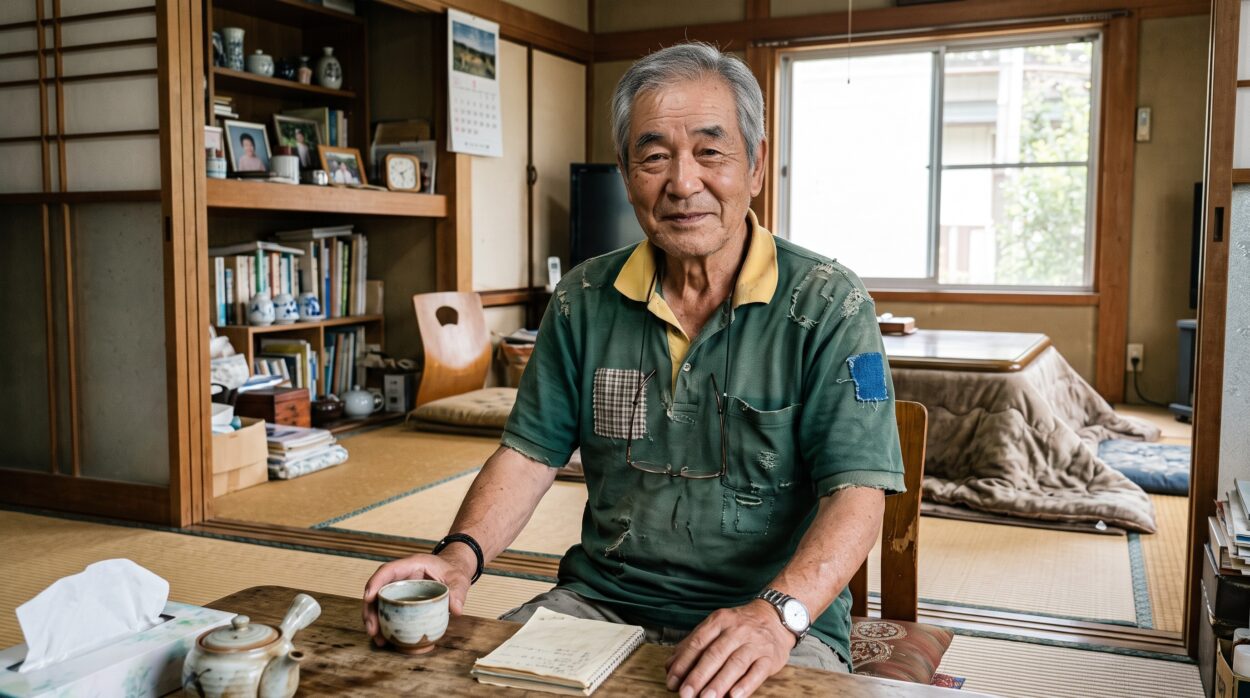
In Japan, a woman known online as R1A once shared a photograph of her aging father wearing a distinctly faded green polo shirt with a yellow collar. To any outside observer, it appeared to be nothing more than an ordinary, well-worn piece of everyday clothing softened by decades of continuous use. It was visibly patched in multiple places and clearly carried the marks of long-term wear and careful repair.
The daughter gradually realized she had watched her father wear this exact garment throughout her entire conscious life. Nearly two full decades had elapsed, yet her father remained steadfastly loyal to this single, humble shirt. Whenever the fabric inevitably tore along the seams, he mended it himself with steady, patient hands rather than discarding it for something new. For years, she struggled to understand why he guarded this simple item so fiercely.
Old photographs expose forgotten romantic origins
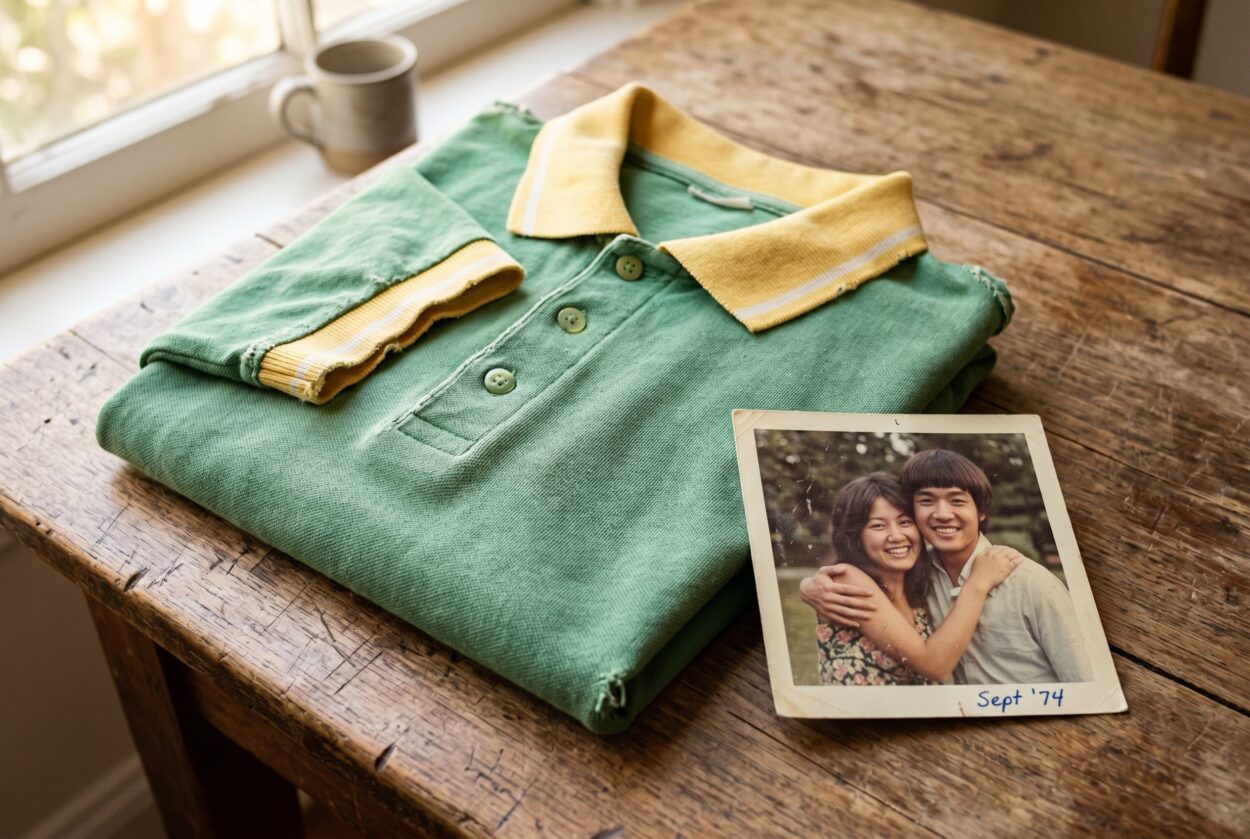
The mystery finally dissolved one day as she carefully sorted through forgotten family photo albums stored in their home. Among the dusty pages, she stumbled upon vibrant photographs from her parents’ honeymoon in Italy years earlier. In those images, her father stood smiling radiantly alongside her mother, both wearing identical green polo shirts as a charming couple’s outfit.
Tragically, her mother had passed away when the young daughter was only six years old, leaving her husband to face the daunting task of raising two small children entirely on his own. Eighteen long years had slipped by since that devastating loss, but the father’s devotion had never wavered. Only upon seeing those forgotten honeymoon snapshots did the daughter finally understand the deep emotional weight attached to that solitary green shirt.
Gentle humor hides a lifetime of grief
When gently confronted about the shirt, her father offered a modest explanation seasoned with lighthearted humor. He casually remarked that part of the practical reason was simply that he did not own many other comfortable clothes. However, he softly admitted that the deeper truth was that whenever he slipped the shirt on, vivid memories of his late wife returned to him instantly.
Behind his modest joke lay an entire lifetime of unyielding romantic fidelity and personal devotion. The faded polo shirt was never merely a woven piece of cotton; it served as a physical conduit connecting him directly to the woman he had loved with all his heart. To discard the garment would have felt like abandoning her memory and losing her all over again.
Faithful devotion endures without remarriage
Throughout the many years that followed his wife’s passing, he chose never to remarry or seek another companion. His daughter firmly believes that her mother permanently occupied a sacred space in his heart that no other human being could ever hope to fill. Although their father-daughter relationship had experienced periods of distance and emotional strain over the years, discovering the true backstory behind the mended shirt permanently softened her perspective toward him.
Reflecting on her father’s lifelong commitment, the daughter eventually declared, with immense pride and tenderness, that he was truly the most handsome man in the world. This admiration did not stem from his physical appearance or his humble attire, but rather from the boundless weight of selfless love that the worn shirt silently represented.
Far away in Henan Province, China, another remarkable story of lifelong devotion unfolded over several decades. A farmer named Song Bingyao lost his beloved wife to cancer when she was only thirty-five years old, leaving behind three young children and a heartbroken husband. Although well-meaning friends and neighbors repeatedly tried to help him find a new life partner, Song quietly declined every offer, choosing instead to focus entirely on raising his children and honoring his wife’s memory.

Shared passions inspire a massive creation
His late wife had possessed a deep, joyful love for spring peach blossoms, and early in their marriage, the young couple had planted a small peach tree together right in front of their home. Remembering how radiant her face became whenever those delicate flowers bloomed each year, Song decided to honor her memory on a grand scale by planting peach trees across a barren hillside adjacent to her final resting place.
Year after grueling year, he painstakingly carried saplings up the rocky terrain, planting them one by one and tending to them with unwavering devotion. Over more than 30 years, his persistent efforts transformed the once-empty hillside into a vast botanical sanctuary with over 10,000 flourishing peach trees.
Enduring bonds transcend physical presence
Every spring, when the hillside erupts into a sea of soft pink blossoms, the breathtaking view stands as a living, breathing testament to an unbroken marital bond. Song vowed to continue planting and tending his trees for as long as he remains alive. Ultimately, these quiet, persistent acts demonstrate that love does not cease when life ends; it simply transforms into memory, daily ritual, and enduring devotion.
Translated by Katy Liu and reviewed by Helen London
Follow us on X, Facebook, or Pinterest
