
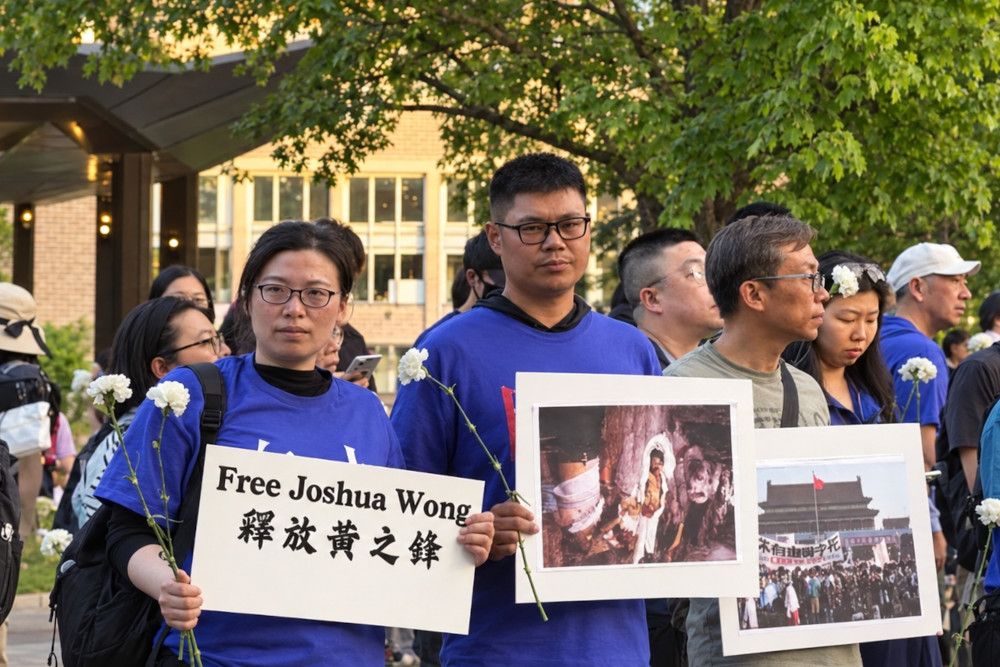
On a busy street in downtown Toronto, Chinese couple Luo Yu and Wang Jingjing walked among hundreds of people in a march, carrying a banner with determined expressions.
Both were born in the 1980s and are originally from Nanjing, Jiangsu Province. For years, they say, they accepted the official narratives they had been taught in China. Today, they actively participate in overseas democracy and human rights events. Their shift in outlook reflects a process some Chinese living abroad experience as they reexamine China’s political system and society.
From college classmates to life abroad
Luo Yu and Wang Jingjing met in college and married many years after graduation.
Luo worked as a tour guide and traveled frequently to countries around the world. As a result, he accessed information outside China’s Great Firewall earlier than many of his peers.
Wang, meanwhile, worked as a clerk at a state-owned enterprise in Nanjing. Her life was familiar to many ordinary Chinese office workers: working nine to five, giving gifts to superiors during holidays, and relying on such “shows of respect” to help secure her position.
“I didn’t earn much each month, yet the gifts I gave sometimes cost more than my salary,” Wang recalled. “Our manager would even demand that my family help renovate his home. The corruption was blatant.”
Luo said that, at first, he accepted CCP propaganda wholesale, much as he believed most people around him did. But as he traveled abroad more frequently, he encountered information blocked in mainland China, including YouTube, Facebook, and reports from overseas media.
Over time, he began to see a significant gap between what he had learned from textbooks and the history and world he was experiencing firsthand.
Beginning in 2016, Luo frequently traveled to the United States for work. There, he said, the words of the Declaration of Independence took on a new meaning for him. Its reference to the rights to “life, liberty, and the pursuit of happiness” affected him deeply.
He began deliberately seeking out videos by historians on YouTube and reexamining subjects such as the Cultural Revolution, Mao Zedong, and the founding of the United States. His reading eventually led him to Rousseau’s “The Social Contract” and Montesquieu’s “The Spirit of the Laws,” which further challenged his previous understanding of politics and society.
Luo shared what he was learning and experiencing abroad with Wang, who also gradually began reassessing ideas she had long taken for granted.
Personal experiences of injustice and censorship
Wang’s doubts about Chinese society and the rule of law were also shaped by events she had witnessed firsthand.
Years ago, she said, an aunt by marriage died in a hospital under circumstances the family did not understand. Before relatives had time to investigate what had happened, a large number of police arrived. According to Wang, family members who had come to handle the funeral arrangements were kicked and beaten.
“Another aunt of mine was beaten black and blue,” Wang recalled. “I posted the video on Weibo and tagged many media outlets, but not one responded. Instead, my account and the video were blocked and deleted by the platform.”
For Wang, the experience exposed what she saw as the denial of freedom of expression and the lack of protection for ordinary people’s rights.
When family members questioned whether the police officers at the scene understood the law, Wang recalled, one officer replied: “I am the law.”
Those words have remained with her ever since.
“There is simply no rule of law in China,” she said. “Ordinary people’s rights receive no protection at all.”
Censorship and a modern ‘literary inquisition’
For Luo, another source of pressure was the pervasive censorship he encountered on Chinese social media.
He said a Toutiao account he had operated for years was shut down about a decade ago after he posted comments on politically sensitive subjects.
According to Luo, terms involving subjects such as the “CCP,” “oppression,” or “resistance” could be automatically replaced with asterisks or simply “harmonized” — a popular Chinese euphemism for content being censored or deleted.
Experiences such as these accumulated over time, leading both Luo and Wang to reconsider the education they had received and the relationship between individual freedom and everyday life.
Learning to distinguish Party, government, and state
The couple arrived in Canada in June 2022.
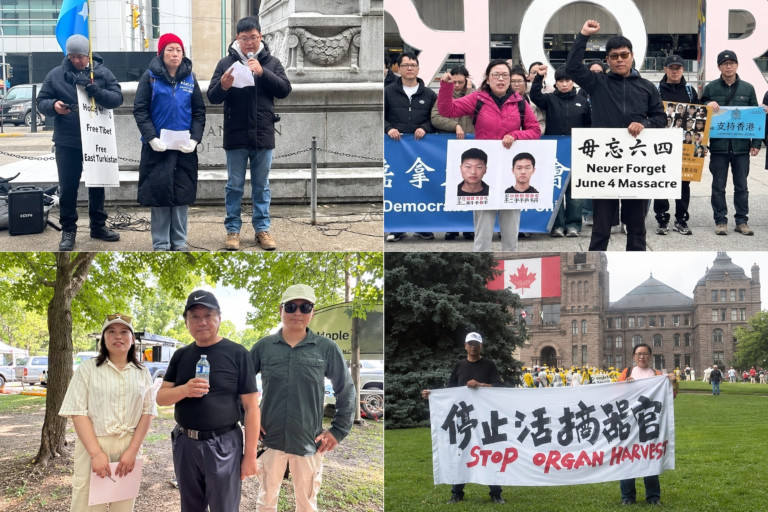
Afterward, Luo began participating in activities connected with the Canada Committee of the China Democracy Party. Through democracy classes and public events, he said, he developed a deeper understanding of China’s political system and overseas democracy movements.
Luo said that for years he had confused the concepts of the Party, the government, and the state, and that he now regards this confusion as precisely the result of the CCP’s deliberate ideological indoctrination.
From childhood, he said, people are taught that “the Party stands above the state, while the people stand above the Party.” In his view, this leaves many Chinese people unable to clearly distinguish among the three.
The collapse of a political party, Luo argued, does not necessarily determine a nation’s or its people’s survival. Yet he said the CCP places the Party above the state, so that dissatisfaction with the ruling party can be treated as the serious crime of “subversion of state power.”
As their involvement increased, Luo and Wang gradually moved from simply attending events to expressing themselves more publicly.
Luo helped organize activities for International Human Rights Day and delivered a speech. During events marking the 37th anniversary of June Fourth — the June 4, 1989, military crackdown on pro-democracy demonstrators in and around Beijing’s Tiananmen Square — Wang attended several commemorations and spoke at the June Fourth memorial at the University of Toronto.
Concerns about transnational repression
Even after moving overseas, the couple says they still feel the shadow of what they describe as the CCP’s transnational repression.
Their concerns increased after China’s “Law on Promoting Ethnic Unity and Progress” took effect on July 1, 2026. Article 63 states that organizations and individuals outside China may be held legally accountable for certain acts directed against the People’s Republic of China that undermine ethnic unity or promote ethnic separatism.
Luo described the psychological effect in these terms: “Even if your body has crossed the Great Firewall, your mind is still under the CCP’s control. It wants to control you both physically and mentally, making you afraid and preventing you from opposing it.”
Despite those concerns, the couple continues to speak publicly.
“I attended events marking the 26th and 27th anniversaries of Falun Gong’s resistance to persecution,” Luo said. “Even if I did not say a single word, simply standing there was the greatest support I could give Falun Gong. If there is one of me, there will be two, then three, then four. Only when tens of thousands, even millions, stand up can our voices be heard by the world.”
Their greatest wish
Luo told Secret China: “I hope that one day I can live freely and express myself freely on Chinese soil, without suffering persecution under an authoritarian government.”
Wang expressed a similar hope for the future.
“I hope the CCP collapses soon,” she said, “so that we can return to our hometown and build a democratic, free country governed by the rule of law.”
Translated by Chua BC
Follow us on X, Facebook, or Pinterest
