
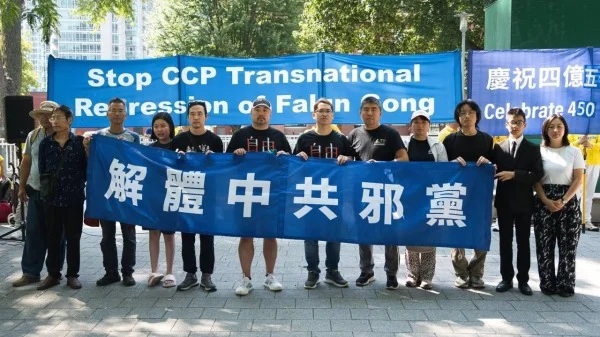
In mid-August 2025, at a “Quit the CCP” rally in downtown Toronto, Canada, Zhang Guangyuan, originally from Shandong, China, solemnly declared his withdrawal from both the Young Pioneers and the Communist Youth League, officially severing all ties with the Chinese Communist Party (CCP) regime.
Born in the 1980s, Zhang Guangyuan moved to Toronto with his family in the spring of 2023. In an interview with the Vision Times, he recounted his personal journey from a “little pink” — a term for young, nationalist Chinese citizens — to a fully awakened individual. His experience serves as a mirror, reflecting both the suffering and the resilience of ordinary Chinese people living under the CCP’s rule.
Victims of extreme control policies during the economic collapse caused by the pandemic
Zhang Guangyuan’s journey of awakening began with the COVID-19 pandemic that erupted at the end of 2019. At the time, he had been running a cosmetics wholesale business in a prefecture-level city in Shandong for nearly ten years. Since starting his venture in 2014, his company has steadily grown, with a daily turnover of 10,000 to 20,000 yuan. Zhang Guangyuan recalled that he entered the cosmetics industry in 2012 and devoted over a decade of hard work, believing that diligence would secure him a stable and prosperous life.
However, the pandemic changed everything. The strict “zero-COVID” policy implemented by the CCP plunged his life into despair. Starting in mid-2020, whenever one or two confirmed cases appeared in a city, the entire community or neighborhood would be locked down, and people were not allowed to leave their homes, let alone operate businesses.
“The rent alone was 270,000 yuan a year, and the combined costs of the warehouse and store were enormous. During the pandemic, the store had to close, but the rent still had to be paid. There was no income, only mounting expenses, and I survived only by relying on my savings,” Zhang Guangyuan recalled.
By 2021, Zhang Guangyuan’s business was already operating at a loss, and many factories owned by his peers and friends had gone bankrupt. He highlighted the absurdity of the government’s policies: “Whenever there was a single confirmed case in a neighborhood, the entire building would be sealed off, making even buying groceries nearly impossible.”
Zhang Guangyuan also recounted reports he heard from friends in Shanghai, where some elderly residents reportedly starved to death after the city was abruptly locked down, with no food stored at home. Meanwhile, people were unable to work, and the government provided no financial support. In contrast, foreign companies offered subsidies to employees who could not work during the pandemic, a stark difference that left him questioning the system.
Through circumventing Internet censorship, Zhang Guangyuan accessed overseas social media and discovered that epidemic prevention measures in countries like Canada were far more humane. This exposure prompted him to consider moving abroad for the first time.
“The supply chain is broken. Customers have no money to buy things, and we have no business. The CCP’s policies focus solely on control, with little regard for people’s livelihoods,” Zhang Guangyuan said. He came to see these measures not merely as epidemic prevention, but as a clear manifestation of the CCP’s one-party dictatorship. “They prioritize maintaining their regime; the lives of ordinary people are unimportant.”
By the end of 2021, Zhang Guangyuan decided to apply for a passport, though the process proved extremely challenging. He could not obtain approval for tourism, so he used his child’s overseas studies as justification, gathering school acceptance letters, payment receipts, and other supporting documents. After considerable effort and with the assistance of an agency, he finally succeeded.
Arrested and detained by police for complaining about the nucleic acid test
Zhang Guangyuan never imagined that his honest, law-abiding behavior could lead to his arrest. In 2022, despite the ongoing pandemic, authorities continued to mandate nucleic acid testing every 2 days. Missing a test — even by a day — would result in a red health code and travel restrictions. That summer, while waiting in line for a test, Zhang Guangyuan voiced his frustration: “Doing nucleic acid tests every day is useless; it’s a waste of time.” Immediately, he was summoned by the police and administratively detained for seven days.
The experience became a pivotal moment in his awakening. “I was locked in a small, cramped room of about seven or eight square meters, with no bed or blanket. I had to sit on the floor. They interrogated me twice each night, leaving the lights on so I couldn’t sleep. The charge was ‘picking quarrels and provoking trouble.’ They forced me to sign documents — if I didn’t, I wouldn’t be released,” Zhang Guangyuan recalled. His family, who witnessed his arrest, were distraught. “After I got out, I was determined to go abroad,” he said, marking a turning point in both his personal and political journey.
This experience led Zhang Guangyuan to reflect deeply on the brainwashing education he had received since childhood. “I’m of the post-80s generation. From elementary school, I was taught that the Communist Party is great, glorious, and correct. I used to be a ‘little pink.’ My first job was as a salesperson in a cosmetics factory, and I didn’t understand why my boss would say, ‘There isn’t a single good person among the Communist Party officials.’ At the time, I didn’t believe him, thinking the government existed to serve the people,” Zhang Guangyuan recalled.
After starting his own business in 2014, he frequently interacted with government departments, including the Industry and Commerce Bureau and the Urban Management Bureau. “They conducted inspections two or three times a year. When the Industry and Commerce Bureau officials came, they would scrutinize every detail, determined to find problems. If the nail clippers I was selling lacked a production date, they would confiscate them and impose a minimum fine of 10,000 yuan, which went directly to the station chief.
The Urban Management Bureau was even harsher. They would scrape off any advertisements pasted on the windows and take away shopping carts at the door without saying a word,” Zhang Guangyuan said, describing the constant pressure that small business owners faced.
These experiences led Zhang Guangyuan to recognize the true nature of the CCP: “It is a one-party dictatorship, a monopoly from top to bottom. China’s biggest problem is the absence of the rule of law. When something goes wrong, there is nowhere to seek justice or voice grievances. Anyone who petitions is likely to be suppressed or persecuted.”
He gave the example of e-commerce disrupting traditional businesses: “A product costs 10 yuan at the factory and 15 yuan at wholesale for us, with each link making a profit. But e-commerce sells the same item for 11 yuan, and nobody cares. There’s no way to complain because China is not a country governed by law.”
Looking forward to the democratization of China
To provide his wife and children with a normal and safe living environment, Zhang Guangyuan made the difficult decision to move his family to Canada in the spring of 2023. Although starting over required building everything from scratch, he found particular joy in seeing his daughter’s happy smile.
“The children attend public school, which is free, and they also receive a monthly child allowance of six or seven hundred dollars. The teachers are excellent, the children are happy, and they often say they don’t want to go back,” he said. In the free “Land of the Maple Leaf,” he no longer fears for his daughter’s safety or the possibility of her disappearing without a trace.
Zhang Guangyuan credits the Nine Commentaries on the Communist Party with helping him fully understand the history and nature of the CCP — from its origins to its record of violence, deceit, and oppression. While his previous knowledge of events such as the Tiananmen Square Massacre and the Cultural Revolution had been limited, he now sees clearly that “the CCP is driven by self-interest, not the people. It is not surprising that the People’s Liberation Army opened fire on its own citizens on June Fourth, 1989.”
After moving abroad, Zhang Guangyuan became aware of the CCP’s crimes against humanity, including live organ harvesting and even targeting infants and children. He was deeply outraged. “The CCP is worse than the underworld and has no bottom line. It will do anything to serve its own selfish interests,” he said.
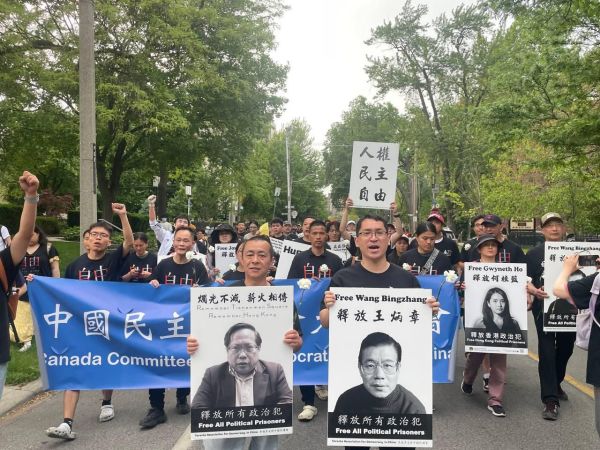
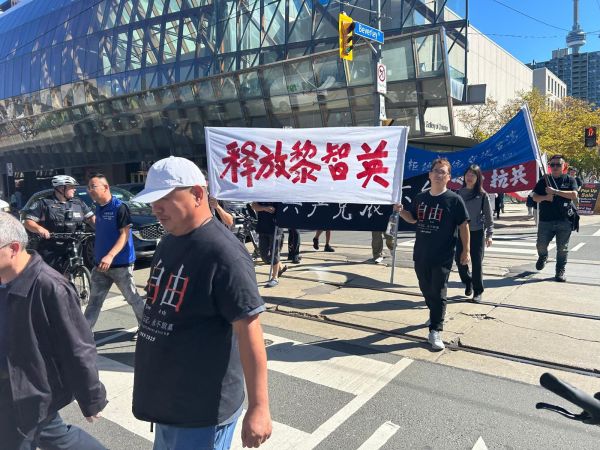
In 2024, Zhang Guangyuan joined the Canadian Committee of the Democracy Party of China. “The Democracy Party’s mission is to overthrow one-party rule and establish constitutional democracy. It’s about creating collective voices to awaken more people.” Recalling his first participation in a rally outside the Chinese Consulate, chanting “Down with the Communist Party,” he admitted feeling some fear. Still, after that initial experience, he felt increasingly confident. Living in Canada, a democratic society, gave him the freedom to finally express his thoughts without fear — a liberating experience he deeply valued.
Zhang Guangyuan was profoundly inspired by Wang Juntao, Chairman of the National Committee of the China Democracy Party. “Chairman Wang is a leader in the democracy movement, and following him feels very meaningful. He is a professional revolutionary who has dedicated decades to advancing democracy in China, risking his life to overthrow one-party rule and establish a democratic society. From him, I learned the spirit of perseverance and a genuine concern for the country and its people.”
He also noted the growing support for the China Democracy Party: “More and more people are recognizing the ideals of democracy and constitutionalism.” Zhang Guangyuan believes that China’s transformation requires both external pressure and internal awakening. “As world civilization progresses, dictatorship will eventually be abandoned by history. We overseas Chinese continue to speak out in the free world and contribute to the realization of democracy in China.”
Translated by Chua BC and edited by Tatiana Denning
Follow us on X, Facebook, or Pinterest
