

Today, most of us wouldn’t dream of taking a long trip without GPS. Whether driving or walking, modern travelers rely heavily on navigation apps to get from point A to point B. But centuries ago, when roads were unmarked and digital maps did not exist, how did Chinese travelers in ancient China manage long journeys without getting lost?
As it turns out, they had their own reliable methods — practical, time-tested strategies that drew from nature, human experience, and clever inventions.
Using nature to find your way
The sun and stars
People in ancient China often relied on the sky to determine direction. During the day, they used the sun: it rises in the east, sets in the west, and is roughly overhead at noon (in the Northern Hemisphere). At night, the North Star was a critical point of reference. Located almost directly above the North Pole, it appears fixed in the night sky.
To find it, Chinese travelers looked for the Big Dipper — seven stars that form a ladle-shaped constellation. By extending the line connecting the two stars at the edge of the “bowl” about five times its length, they could locate the North Star. In winter, the three stars in Orion’s Belt, which point south, were also used to help determine direction.
Mountains, rivers, and streams
Natural landmarks played an important role in orientation. Mountain ranges tend to follow consistent directions — like the Qinling Mountains, which run east to west. A Chinese traveler staying on the southern side of these mountains could maintain a steady southward course. Prominent peaks, such as Mount Tai, also served as major waypoints. Rivers were equally helpful; for example, the Yangtze flows from Sichuan eastward toward Jiangnan. Whether moving downstream or upstream, Chinese travelers could use the river’s flow to judge their position and heading.

Man-made landmarks and road networks
Roads and post stations
China’s most important historical roads, such as the Silk Road and the Qin Straight Road, were marked with signs, milestones, and beacon towers. These beacon towers — famous for their military use — also served as aids to Chinese travelers. During the day, they released smoke signals; at night, they were lit with flames, serving as orientation points.
Rest stops, called post stations, were built at regular intervals to provide shelter, food, and fresh horses. The attendants at these stations were often familiar with the local geography and could offer directions. Chinese travelers also estimated their journey length by counting the number of stations they passed.
Stone tablets and archways
Stone tablets were often set up at crossroads or scenic spots. These engraved markers noted place names and distances (e.g., “XX miles to the capital”), offering guidance. Another feature unique to Chinese towns was the memorial archway, or paifang — a decorative structure placed at city entrances or street intersections. These archways served both cultural and navigational purposes, such as those famously found in Huizhou.
Early maps and navigational tools
Maps
While ancient maps lacked the precision of modern ones, they were already in use by the Spring and Autumn period (771-476 BC). Works like The Maps of Guan Zi laid the foundation for cartography. Later, during the Han Dynasty, maps such as The Regional Map of Yu Gong and The Map of China and Its Neighbors helped Chinese travelers visualize the terrain.
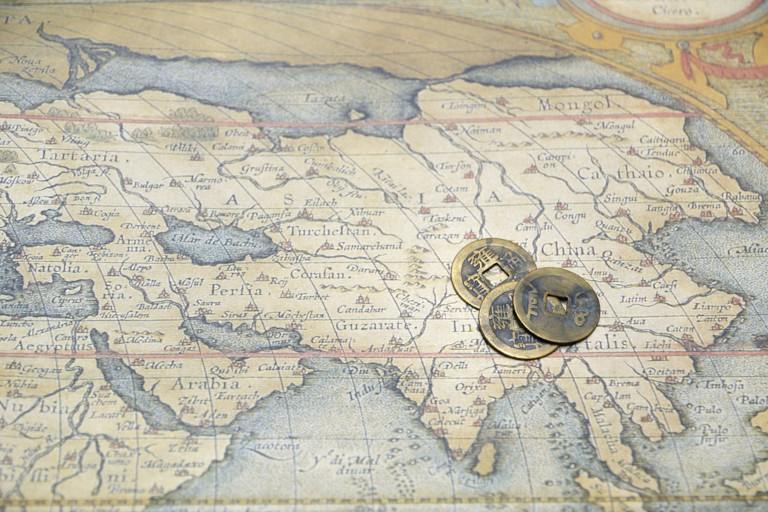
Ancient mapmaking relied on two key methods: measurement (using rulers and instruments to calculate distance and angles) and description (noting rivers, mountains, and other landmarks).
The south-pointing carriage and the compass
The south-pointing carriage was a fascinating invention, said to date back to the Yellow Emperor. It used a system of gears to keep a wooden figure always pointing south, regardless of the vehicle’s turns. Later, this tool became more ceremonial, but it was still a symbol of technological innovation.
The earliest compass, called the Sinan, appeared during the Warring States period. Shaped like a spoon made from lodestone (a naturally magnetized mineral), it always pointed south. Over time, this evolved into a portable magnetic compass, revolutionizing both land and sea navigation.
Wisdom passed down through generations
The Chinese traveler’s experience
Merchants, scholars, and pilgrims who traveled frequently developed a deep familiarity with terrain, routes, and signs. They often kept records or passed on tips about natural cues: denser vegetation growing on southern slopes, ant hills facing south, or the direction of migrating geese — all of which could help determine orientation.

Oral tradition
Information was also shared by word of mouth. Villagers and merchants exchanged local knowledge about roads, river crossings, and mountain paths. Even folklore — though often embellished — carried hints about geography, reflecting the collective understanding of direction and place.
Final thoughts
Even without digital tools, ancient Chinese travelers had a surprisingly rich set of methods to guide them. By reading the sky, observing nature, relying on community, and developing ingenious technologies, they turned long-distance travel into a skillful and thoughtful art.
Their journey may have been slower — but not without direction.
Translated by Patty Zhang
Follow us on X, Facebook, or Pinterest
