
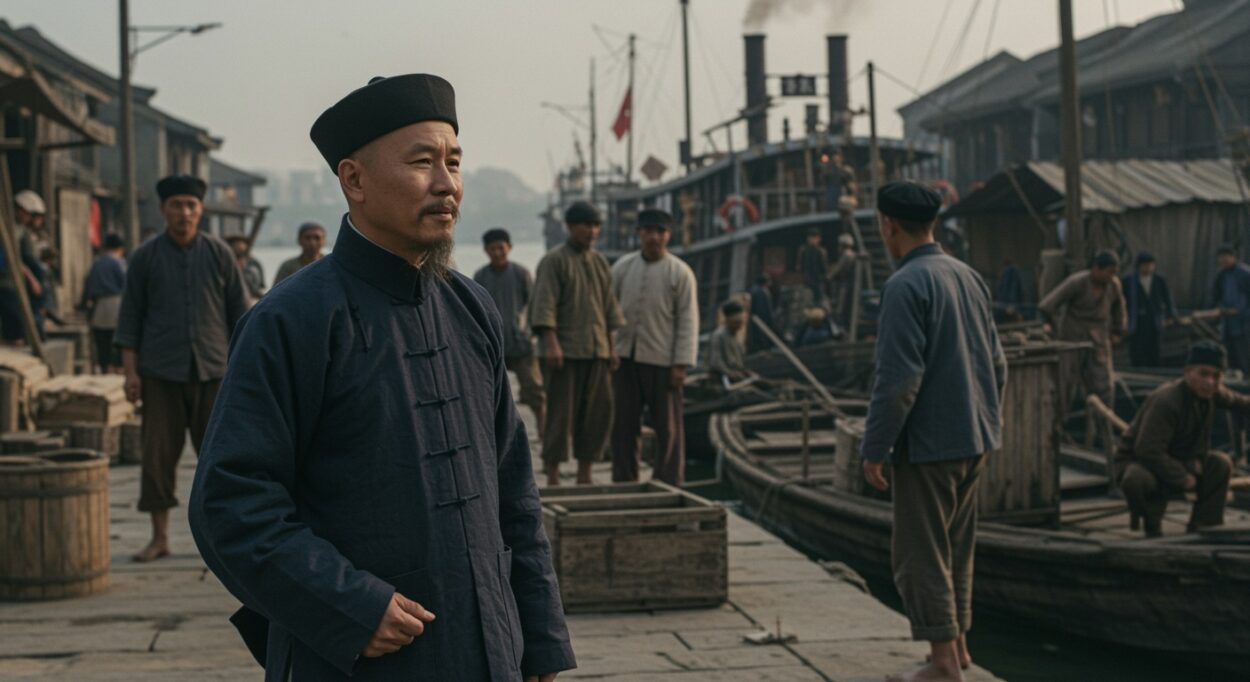
Many people lament that “good deeds go unrewarded.” Yet the principle remains true: Good is ultimately rewarded with good, and wrongdoing with misfortune. Often, it is your inability to recognize this principle in the face of unexpected setbacks that leads to doubt. The Qing Dynasty offers several illustrative examples of how kindness and generosity can shape destiny.
Escaping a maritime disaster through kindness
In the first year of the Guangxu era, Zhang Shaoqu, nearly 50 years old, was called by the county magistrate to oversee maritime affairs. At that time, travelers had to first go to Hudong (now the lower Huangpu River) to board a steamboat to their destination.
Most officials from Jiangsu had reserved passage on a ship called Fuxing, and Zhang had booked a spot as well. But another steamboat was set to depart two days earlier, and Zhang chose to take it instead. His comrades urged him to wait for Fuxing, but he did not follow their advice.
When he arrived safely, Zhang learned that Fuxing had tragically sunk at sea, with everyone aboard perishing. His survival was credited to his lifelong kindness and generosity — a reminder that goodness carries its own quiet protection and reward.

Heaven records unintentional kindness
In the year of the Wood Snake (1865), a provincial examination was to be held in Zhejiang. That summer, a man from Shengxian had a dream about a temple. In the center of the temple, a deity sat facing south, surrounded by clerks holding plaques. One by one, the clerks presented the plaques to the deity, who marked them with a pen before returning them.
Curious, the dreamer asked: “What are these plaques for?” The clerks replied: “They bear the names of those who will pass this year’s provincial examination.” Among the plaques, the dreamer noticed the name “Qiu Zhicheng” written clearly, along with several lines of smaller text. He asked what the small text said, and the clerks answered: “It is the merit he has accumulated.”
After waking, the dreamer sought out Qiu Zhicheng and recounted the dream to him. Qiu laughed and said: “I have tried for over 10 years to pass the exam and never succeeded. I am exhausted, my knowledge is limited, and I have no intention of retaking the exam. I cannot possibly fulfill what you dreamed.”
Yet the dreamer remained convinced. He informed Qiu’s relatives, who encouraged him to retake the exam. Persuaded by their support, Qiu participated — and indeed, he passed the provincial examination.
When asked what merit he had accumulated, Qiu could not think of anything at first. After much reflection, he recalled an incident two years earlier: A relative had a maid who was in danger of being beaten to death. Qiu had intervened, risking much to rescue her, and even found her a family to marry into.
Though he had acted without expectation of reward, this unintentional kindness had been recorded — and quietly shaped his destiny.
Saving a life in distress leads to success
In Kuaiji, Zhejiang, a man named Wang Jitai was renowned for his charitable nature. One day, a villager came to him, hoping to exchange an inkstone for 7,000 yuan. Wang noticed the inkstone was just an ordinary stone and politely declined the trade.
Seeing the man’s despondent expression, Wang asked why he needed the money. The man explained that his wife was about to give birth, and complications made the situation dangerous. He needed funds to hire the region’s most skilled midwife, which accounted for the high cost.
Moved by compassion, Wang immediately left the inkstone behind and gave the man the money without hesitation. Some time later, curious about the family’s well-being, he inquired how they were doing and learned that, tragically, the mother had died during childbirth. The family was in dire straits, and the grandmother, suffering from illness, wept daily, even contemplating ending her own life.
Unable to bear their suffering, Wang gathered several pieces of clothing and 10 silver coins, and personally delivered them to the family to ease their hardship.
That New Year’s Day, in the year of the Wood Rabbit (1855), Wang dreamed of a woman bowing to him. She said: “I am the woman who died from complications during childbirth,” and showed him a yellow note inscribed with the words “Minister Seventeen” in red ink. Wang awoke puzzled, unsure of its meaning.
That autumn, Wang participated in the imperial examination. In the Ming and Qing dynasties, seating was assigned according to the Thousand Character Classic, a traditional Chinese text in which each character corresponded to a specific number and position. When Wang entered the hall, he found that his seat number was exactly “Minister Seventeen,” matching the note from his dream. As he received the questions, his mind flowed effortlessly, and when the results were announced, he was declared a successful candidate.
Wang’s compassion, extended without expectation of reward, had quietly shaped his destiny — a vivid testament to the power of selfless kindness.

A mute child speaks
During the Qing Dynasty, the Lao family of Tangxi Town had a son who, at the age of seven or eight, could neither speak nor walk. Later, the family generously established a nursery for the town’s children. On the very day the nursery was completed, the boy began to speak all of a sudden.
Within two years, he learned to walk, and soon after, he began attending school and playing alongside the other children, indistinguishable from them in every way. The child’s recovery was seen as a remarkable reward for the family’s generosity — an enduring reminder that acts of kindness carry their own blessings.
Closing reflections
These tales remind us that virtue is not measured by immediate recognition or material gain. Often, it works quietly, accumulating merit, opening paths, and transforming lives in ways we cannot predict. Unintentional acts of kindness, or deeds done simply because they are right, ripple outward — shaping not only our own fortunes, but the lives of others.
These stories remind us that the rewards of goodness are not always immediate or visible. They call us to act with compassion and generosity, to cultivate virtue, and to trust that even the smallest selfless acts — done without expectation of reward — can grow into blessings far beyond what you can imagine.
Translated by Joseph Wu and edited by Tatiana Denning
Follow us on X, Facebook, or Pinterest
