
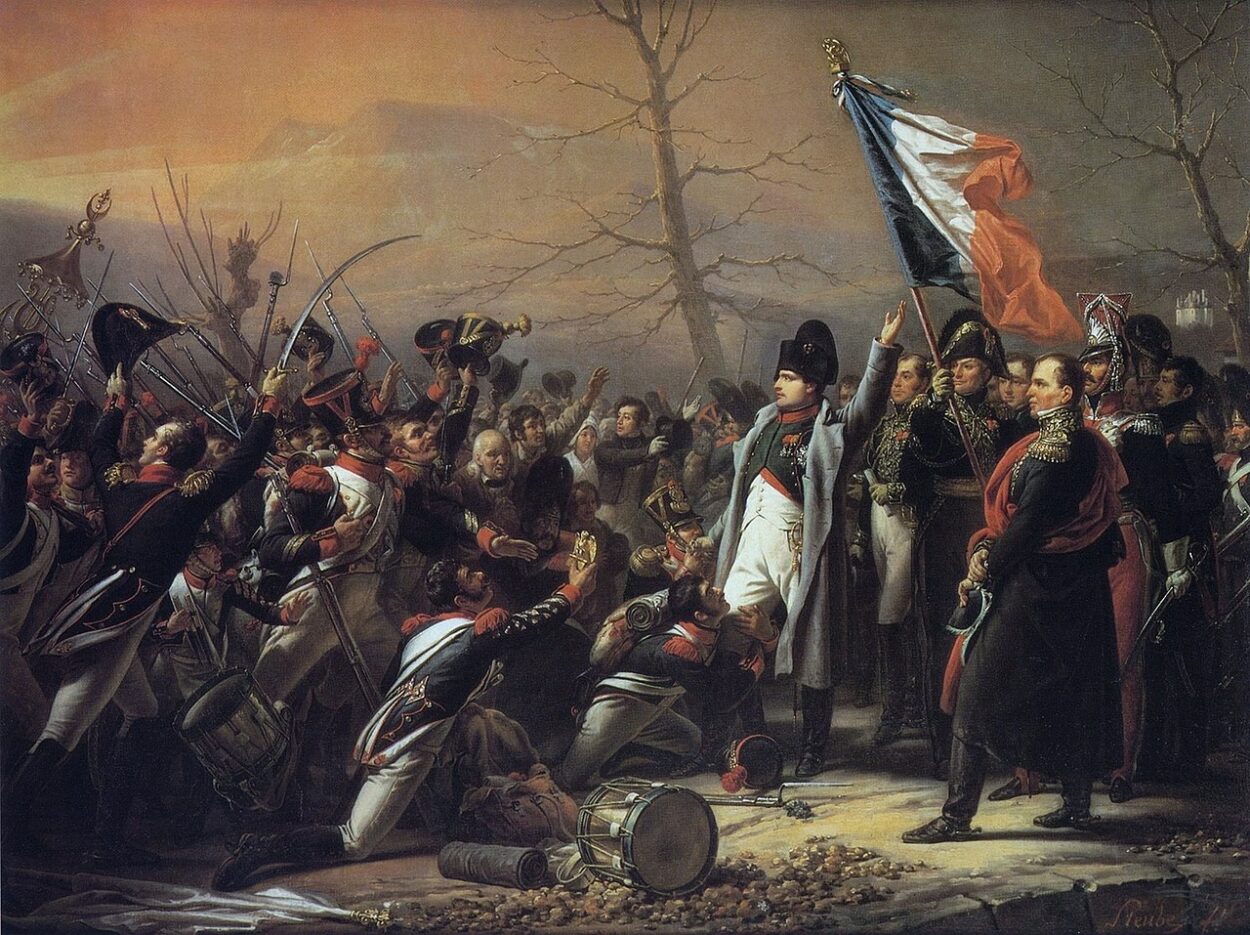
In 1815, Napoleon Bonaparte did the impossible: he slipped away from exile on a tiny island, marched straight into Paris, and reclaimed the throne of France without firing a shot. A few years later, marooned on a remote rock in the South Atlantic, he would never escape again — though rumors of rescue and poisoning still swirl today. How did one escape nearly upending Europe, while the other birthed one of history’s greatest myths?
The return and the legend
On the evening of February 26, 1815, as dusk fell over the Tyrrhenian Sea, Napoleon Bonaparte slipped away from his small island domain of Elba, bound once more for mainland France. What followed became one of the most audacious acts in European history: a march to Paris, the collapse of a restored monarchy, and a brief re-ascension to power that would end at Waterloo. And yet, for all its theatrical grandeur, that escape must be understood in the context of the age — the frailties of the Bourbon Restoration, the restlessness of French society, and the precarious balance of power in post-Napoleonic Europe.
Decades later, in exile on Saint Helena, Napoleon would live in far more constrained circumstances — watched, isolated, and subject to rumor after rumor of escape plots he scarcely believed. His failure to leave only deepened his myth, transforming him into a martyr and a legend rather than just a fallen emperor.
In what follows, I trace both episodes — the real escape and the unrealized ones — as mirror images: one a rupture, one a coffin, and both central to how we remember Napoleon.
Setting the stage: Elba, exile, and vulnerability
After the coalition armies marched on Paris and Louis XVIII was restored, Napoleon abdicated in April 1814 and was sent into exile on the island of Elba under a peculiar arrangement. The Powers spared his life — executions of deposed rulers were considered perilous precedents — but stripped him of his empire. Still, he retained a small court, a personal guard, and administrative control of Elba’s territory. As he put it in a letter: “All I have kept is my ruling over the Island of Elba and the forts of Portoferraio and Porto Longone.”
In effect, Europe treated him as a deposed potentate rather than a fugitive criminal. In practice, though, that arrangement proved unstable. The Bourbon regime in France was deeply unpopular, characterized by its reactionary, corrupt, and disconnected nature, which contrasted sharply with the revolutionary energy that had propelled Napoleon to greatness. French veterans complained about lost pensions; the middle class chafed under revived aristocratic influence; and public sentiment remained volatile.
Meanwhile, Napoleon busied himself with reforms on Elba — improving infrastructure, stimulating agriculture, instituting new regulations — but these tasks could hardly fill the ambitions of a man accustomed to commanding millions. He also kept a network of agents in France, monitoring sentiment and the fragility of the Bourbon regime.
In retrospect, his exile was as politically porous as it was symbolic: too close to the mainland, too lightly guarded, and too brimming with potential for mischief. As one historian notes, Elba was “too close to home, too lightly guarded.”

The escape: Audacity, momentum, and political theater
Napoleon’s departure from Elba was hardly subtle. By mid-February 1815, observers noted his growing agitation; officials stationed on Elba had begun to suspect preparations were underway. Yet when his British overseers inquired, he coolly reassured them:
“Nonsense, fantasies, Colonel; I am so well on Elba that I would not leave it for all the gold in the world!” Still, he made his move on the night of February 26, boarding several small vessels with about 1,000 men. The Allied powers, expecting him to remain inert, did not mount effective patrols to stop him. He disembarked on March 1 near Golfe-Juan and began an uphill march northward.
What followed was political theater of the highest order. As he advanced, regiments sent to block him repeatedly defected; crowds cheered; officers switched sides. At Laffrey, near Grenoble, a royalist general tried to issue orders to fire on his approaching troops. Napoleon walked forward, opened his gray cloak, and challenged:
“Soldiers, I am your Emperor. Know me! If there is one of you who would kill his Emperor, here I am.” The soldiers, unable to shoot a man in full view, threw down their arms, shouted “Vive l’Empereur!” and joined his cause. Within days, he reached Lyons, then Dijon, then Auxerre — his march was relentless — and by March 20, he entered Paris, where Louis XVIII had already fled. Thus began the Hundred Days, the final epoch of his power.
Speech, symbolism, and the revival of legitimacy
Napoleon’s return was not just a military event, but also a rhetorical one. He issued proclamations and speeches that sought to cast himself not as a usurper but as a restorer of national dignity. In his Proclamation to the Army of March 5, 1815, he invoked betrayal by false men and drew on the language of revolution:
“In my exile, I heard your complaints and your wishes; you accused my long slumber … I have traversed the seas through perils of every kind; I return among you to reclaim my rights, which are yours.”Addressing his troops more personally, he declared: “Among these six hundred brave men … I loved them … all were covered with honorable scars … it is you all … that I loved.”
Elsewhere on his return, he famously said: “Soldiers: in my exile I have heard your voice; I have come back despite all obstacles, and all dangers. Your general … is restored to you; come and join him.”
In short, he recast his exile not as defeat but as temporary rest, his return as the will of the people — a coup with the aura of popular legitimacy. In doing so, he exploited the deep fissures in the Bourbon restoration and the lingering reservoirs of revolutionary sentiment still alive in France.
The Hundred Days and final defeat
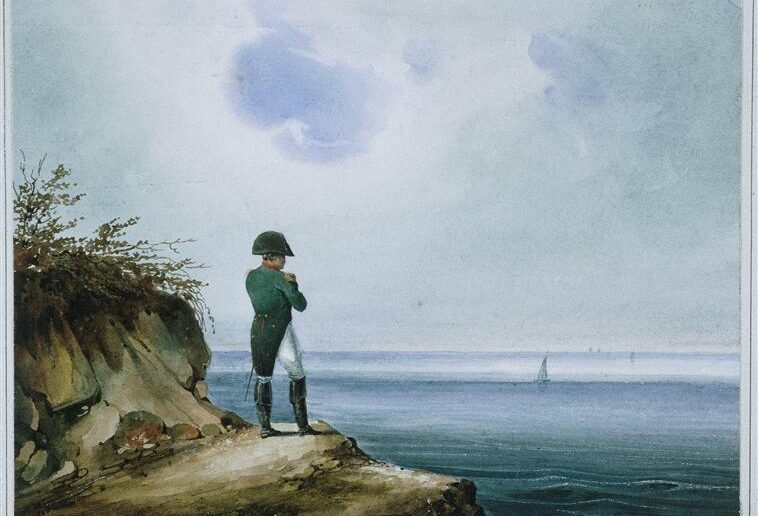
The Hundred Days (March-June 1815) proved a moment of dramatic reversal. Napoleon moved quickly to consolidate power, offering amnesty, drafting new constitutions, and gathering an army. Yet fate was unkind. At Waterloo on June 18, 1815, his forces were crushed by an unlikely coalition of British and Prussian armies. Within days, he abdicated again, this time irrevocably, and surrendered to the British. Instead of sending him again to a Mediterranean holding, the Allies decided on a more secure exile: Saint Helena, a remote and isolated island in the South Atlantic, nearly impossible to escape.
Saint Helena: Exile, myth, and the absence of escape
On October 15, 1815, Napoleon arrived at Saint Helena. He later quipped about the island: “It is not an attractive place; I should have done better to remain in Egypt.”
Where Elba had been a garden prison of sorts, Saint Helena was a desolate fortress of blinking fog and unyielding distance. The British garrison, naval blockades, and strict control of communication and visitors made every plan for escape implausible. Over the next six years, a variety of rumors and speculative rescue schemes circulated, but none came close to fruition.
In exile, Napoleon devoted himself to writing his own narrative, working with Emmanuel de Las Cases on The Memoirs of Saint Helena, a journal of daily conversations that remains a core source for understanding how he chose to frame his legacy. Among those present on the island was his physician, Barry O’Meara, who later published accounts critical of the harsh treatment he believed Napoleon faced under Governor Hudson Lowe. In conversations recorded in General Gourgaud’s private journal, we see a more human side: Napoleon teasing, probing, bitter, and reflective — far from the battlefield general, but still sharp and unbroken in will.
Although no credible attempt ever succeeded, the idea of escape haunted his exile — and haunted posterity. That he remained captive until his death bolstered the mythology: not a fallen tyrant vanquished by force, but an enduring spirit held in check by sinister powers.
He died on Saint Helena in 1821 — officially of stomach cancer, though for years various conspiracies of arsenic poisoning persisted. His final resting place would become Paris: his body was returned and interred beneath the dome of Les Invalides, where he rests amid the symbols of imperial ambition and eternal fascination.

Escape, myth, and historical afterlife
If the escape from Elba shook Europe, the captivity at Saint Helena shaped its legend. In one case, Napoleon proved that exiles can return; in the other, he proved that even the mighty may be made immovable.
The Elba escape underlined the fragility of restoration and the volatility of public sentiment — how an emperor, exiled but not forgotten, might rally support and slip through cracks of overconfidence. The Saint Helena captivity, by contrast, allowed Napoleon to become half-fiction, immortalized in memoirs and conspiracy, removed from political danger but invested with symbolic potency. Every rumor of escape, every whispered plan, contributed to a myth of defiance against fate.
As the historian Barry Edward O’Meara reported, Napoleon insisted, even in exile, that “despite all the libels, I have no fear whatever about my fame. Posterity will do me justice. The truth will be known, and the good I have.”
By the 19th century, Bonapartism became a political tradition; his memory inspired revolutionaries, dictators, and nationalist movements alike. The narrative of exile and return (or the thwarted return) fed into that energy. Even Charles de Gaulle looked back to The Memorial of Saint Helena as more than history, as part of France’s political inheritance.
Thus, the two escape episodes — one real, one unrealized — deserve to be read not as curiosities but as central to the Napoleonic legend. One shows how power can collapse and reconfigure at speed; the other shows how absence and confinement can transform memory, devotion, and myth.
Follow us on X, Facebook, or Pinterest
