
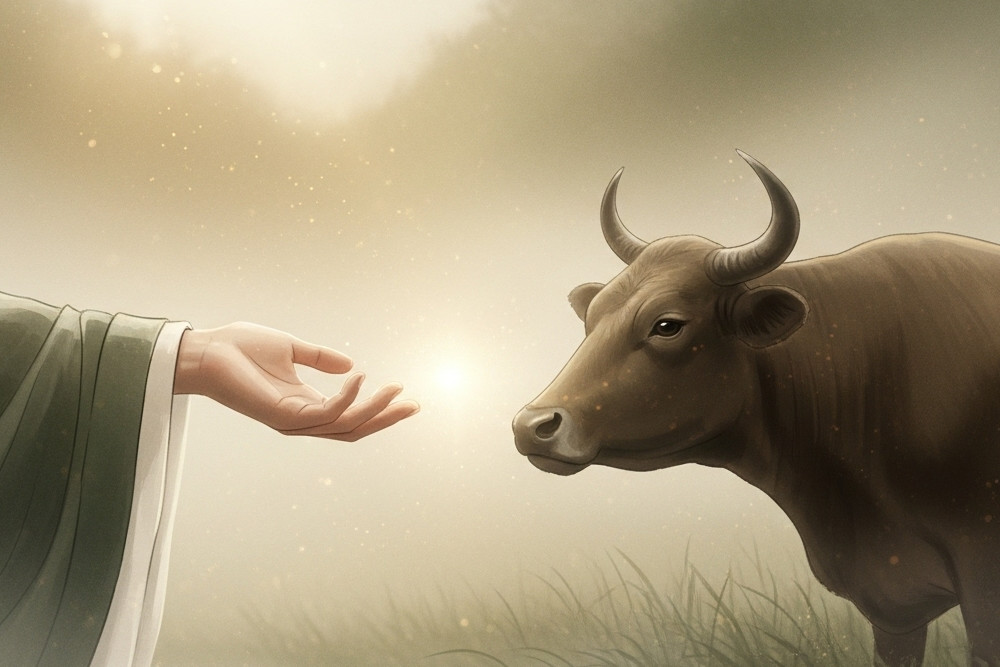
During the Qianlong era of the Qing Dynasty, a censor named Hu Muting once told Ji Yun, a scholar of the Hanlin Academy, about a strange event from his hometown.
In a small village, a family raised a pig that behaved in an unusual way. Most of the time, it was gentle, but whenever it saw the elderly man next door, it became furious. Its eyes seemed to blaze with anger as it charged at the old man, grunting and crashing about as if it wanted to bite him. Yet to everyone else, the pig remained calm and docile.
At first, the old man was outraged. “How dare this animal provoke me!” he thought. He even considered buying the pig and slaughtering it out of spite. But after a moment’s reflection, he hesitated. Perhaps, he realized, this was not random hostility at all—it might be the result of karmic enmity from a past life, as described in Buddhist teachings.
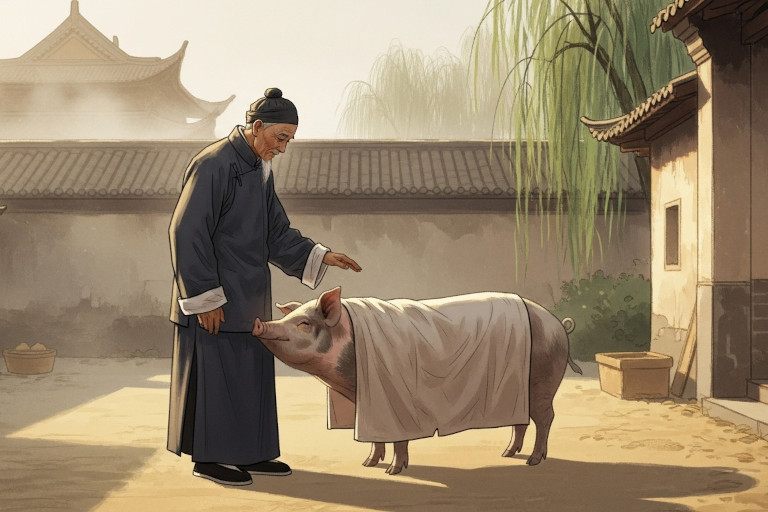
Moved by this thought, he decided to resolve the grudge rather than deepen it. He paid a high price for the pig, brought it to a temple, and released it as a “long-life pig.” Strangely enough, after this act of kindness, the pig’s behavior changed completely. When it saw the old man again, it no longer raged but approached him gently, its ears drooping as it nuzzled him affectionately.
The scholar Ji Yun compared this transformation to a poem inscribed on Portrait of the Tiger-Subduing True Man by the painter Sun Zhong, with verses by Li Yan of Western Sichuan:
“The sage rides a fierce tiger as if it were a qilin.
The beast was not born tame,
But the Way softens its wildness.
Between Heaven and Earth,
True feeling can unite all beings.”
Just as virtue can calm a tiger, sincerity and compassion can dissolve even the deepest resentment. When the heart holds no hostility, harmony naturally arises between all living things.
The faithful ox and its master
During the Yongzheng era, in the village of Lijiawa, there lived a poor tenant farmer named Little Dong. After his father died, all that remained of the family’s possessions was an old ox with a lame leg. One day, Dong decided to sell the animal for slaughter, thinking he could use the money to buy rice.
But just as he led it away, the ox suddenly bellowed, broke free of the rope, and ran toward Dong’s father’s grave. There, it knelt down and refused to move, its body trembling as it let out long, sorrowful cries. No matter how Dong pulled or whipped it, the animal would not rise.
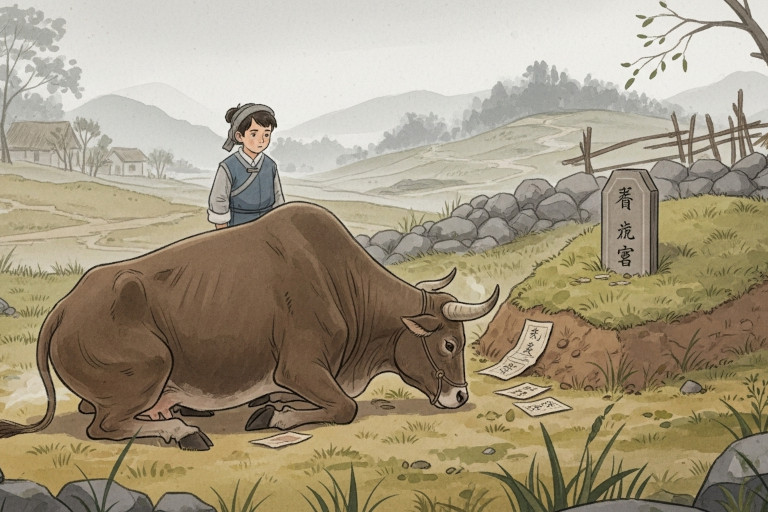
Villagers gathered to watch, whispering in astonishment. Then Dong’s neighbor, Old Liu, arrived, leaning on a bamboo stick. He struck the ox’s back and scolded it loudly:
“You beast! Do you realize what you’ve done? Years ago, your master fell into the river. Had you let him drift away, that would’ve been an act of mercy. Instead, you dragged him out and saved him—so he lived another ten years. During those years, his son had to bear the costs of medicine, the pain of old age, and finally the expense of burial. You caused all that trouble, and now you cry at his grave? What nonsense!”
Old Liu’s seemingly harsh scolding carried a hidden kindness. His words awakened Dong’s conscience and helped resolve the unseen bond between man and ox.
As the words sank in, Little Dong finally understood. This very ox had once saved his father’s life. Overcome with shame and gratitude, he slapped his own face and wept. “I’m worse than an animal,” he cried. “How could I think of selling the one who saved my father?” He led the ox home, cared for it tenderly, and when it died a few months later, he buried it himself, grieving deeply.
What these stories reveal about kindness and karma
Both stories reveal the subtle workings of karma that extend beyond human relationships. Even animals may carry memories of gratitude or resentment from previous lives. People, blinded by ignorance, often fail to recognize these connections. Yet if one can meet hostility with compassion, grudges can dissolve in an instant, and blessings soon follow.
The ancient saying reminds us: kindness is the key that links Heaven, Earth, and all living beings. Whether between people or animals, when the heart is pure and sincere, even the fiercest resentment can turn into peace.
Translated by Joseph Wu
Follow us on X, Facebook, or Pinterest
