
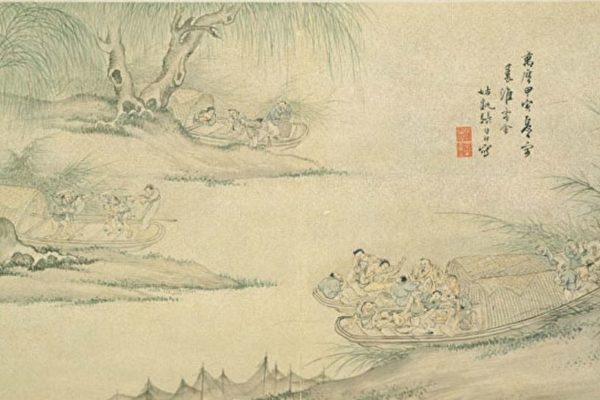
Throughout history, people have passed down a simple yet profound truth: “Good deeds bring blessings, while evil deeds invite misfortune.” Other sayings echo the same understanding — “Families that accumulate virtue will surely find good fortune,” “Good is rewarded with good, and evil meets its due,” and “Retribution may be delayed, but it never fails.” Perhaps the most striking teaching is that good and evil arise from a single thought — one thought can guide a person toward light and wisdom, while another can lead them into darkness.
In essence, these timeless maxims all affirm the same belief: Every action carries consequences. Whether those consequences appear immediately or unfold slowly over time, they will inevitably occur.

Compassion amidst chaos
The Qing Dynasty text Record of Admonitions preserves a remarkable example of this principle. It tells of a man named Zhang Rongchun, the second son of a family in Dakan Village of West Township, Wuyuan County, Jiangxi. Orphaned at a young age, Zhang was raised by his stepmother. At 14, through an acquaintance’s introduction, he traveled north to Taizhou in Jiangsu Province to learn the timber trade. Upon reaching adulthood, he shifted to other business ventures.
In the tenth year of the Xianfeng reign (1860), Zhang was transporting seven shiploads of salt across the river. One day, during a time of war and turmoil, the vessels anchored at the foot of Maoshan Mountain in Jurong (now part of Zhenjiang). Rebel troops, in their chaos and brutality, were pursuing women and children, driving many to leap into the river in desperation.
Witnessing this tragic scene, Zhang immediately commanded his crew to begin a rescue effort. Working swiftly, they pulled 27 women and children from the water.
That evening, while preparing food for the exhausted survivors, the crew discovered they had no firewood. Without hesitation, Zhang instructed the boatman to chop planks from the ship’s hull for fuel, assuring him that the wood could be replaced later. This small but costly act of generosity moved everyone present.
The next day, as Zhang’s vessel reached a nearby town, it was intercepted by a local militia leader — himself a former scholar. Suspecting Zhang of being a bandit disguised as a salt merchant, he ordered his guards to execute both Zhang and the boatman and to burn all seven ships. Zhang pleaded his innocence, but the militia leader remained unmoved.
Just as the two men were bound and about to face death, a young girl with a pigtail suddenly ran forward, sobbing as she called out to the militia leader: “Uncle! This guest, Mr. Zhang, and the boatman saved many of us who jumped into the river! Please don’t kill them!”
Kindness returned
The scholar immediately recognized the familiar voice. Looking closely, he realized that the young girl was his own niece. He asked her what had happened, and she tearfully recounted the entire incident — from the chaos at the riverside to Zhang Rongchun’s rescue of twenty-seven women and children.
Only then did the scholar understand the truth. Filled with remorse and gratitude, he invited Zhang Rongchun into his residence, offering him wine and a generous meal to express his appreciation for Zhang’s extraordinary act of compassion. Afterward, he ordered several militia members to escort Zhang safely across the river, and he provided official permits from the local defense bureau to ensure his passage.
On this journey to sell salt, Zhang Rongchun not only earned substantial profits, but also saved the boatman’s entire family — more than 30 people — from disaster. Without that single moment of kindness, how could any of them have survived? Indeed, Heaven’s reward for a good deed can come swiftly, and often in ways one never expects.

Conclusion
This account, recorded more than a century ago, illustrates a principle that generations have regarded as self-evident: the consequences of one thought are far-reaching. Zhang Rongchun acted without calculating benefit or loss. In a moment of crisis, his first thought was to choose compassion, and that decision not only saved the lives before him but also later protected his own.
History preserves many such incidents. They are not embellished tales but reminders that our conduct has weight. Whether in times of war or in ordinary daily life, a person’s decisions — especially those made when no reward is expected — shape outcomes in ways no one can foresee. Zhang’s experience underscores an enduring truth: when one conducts oneself with integrity and compassion, circumstances often align to shield and support that person at critical moments.
This is why the ancients taught that good and evil arise from a single thought. The effects of that thought may unfold gradually or appear suddenly — but they will unfold. In Zhang Rongchun’s case, one resolute act of kindness changed the fate of more than thirty lives.
Translated by Audrey Wang and edited by Tatiana Denning
Follow us on X, Facebook, or Pinterest
