
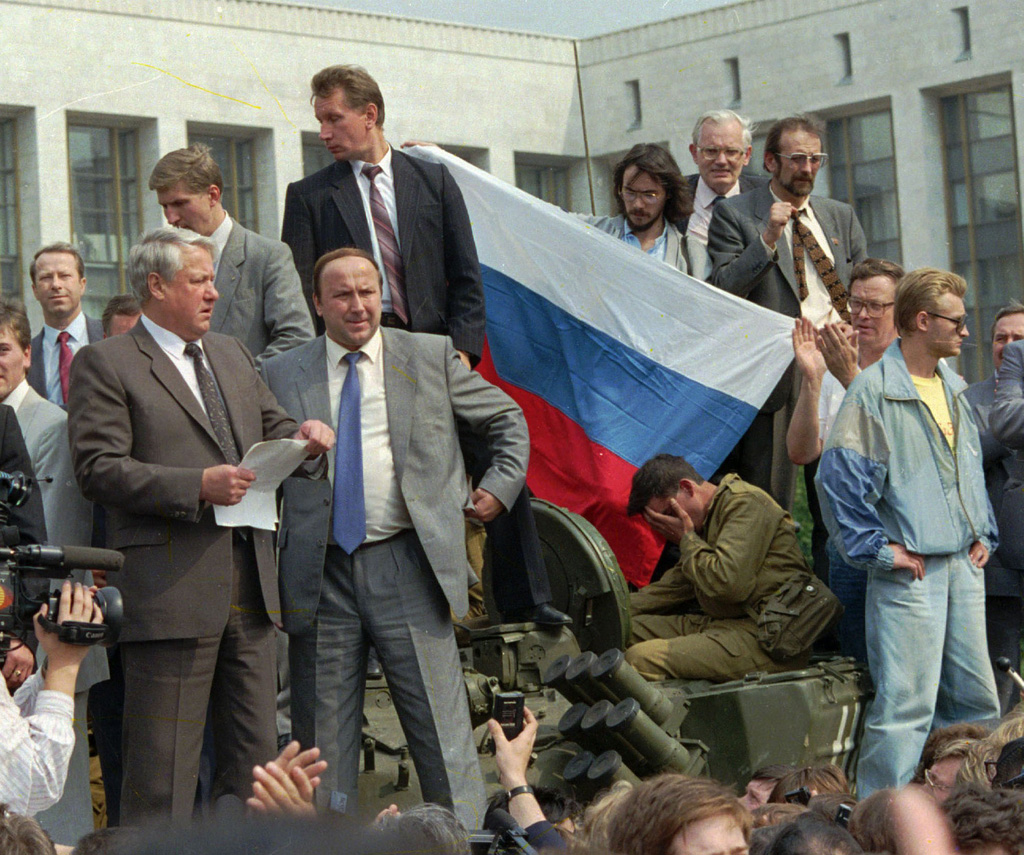
Yeltsin donned a bulletproof vest, followed by a shirt and suit, and set off with his aides toward the White House — not the American White House, but the seat of the Russian Parliament. The Alpha Group was ordered to accompany him and take up strategic positions; they now had a list of 70 men, ready to be arrested at a moment’s notice.
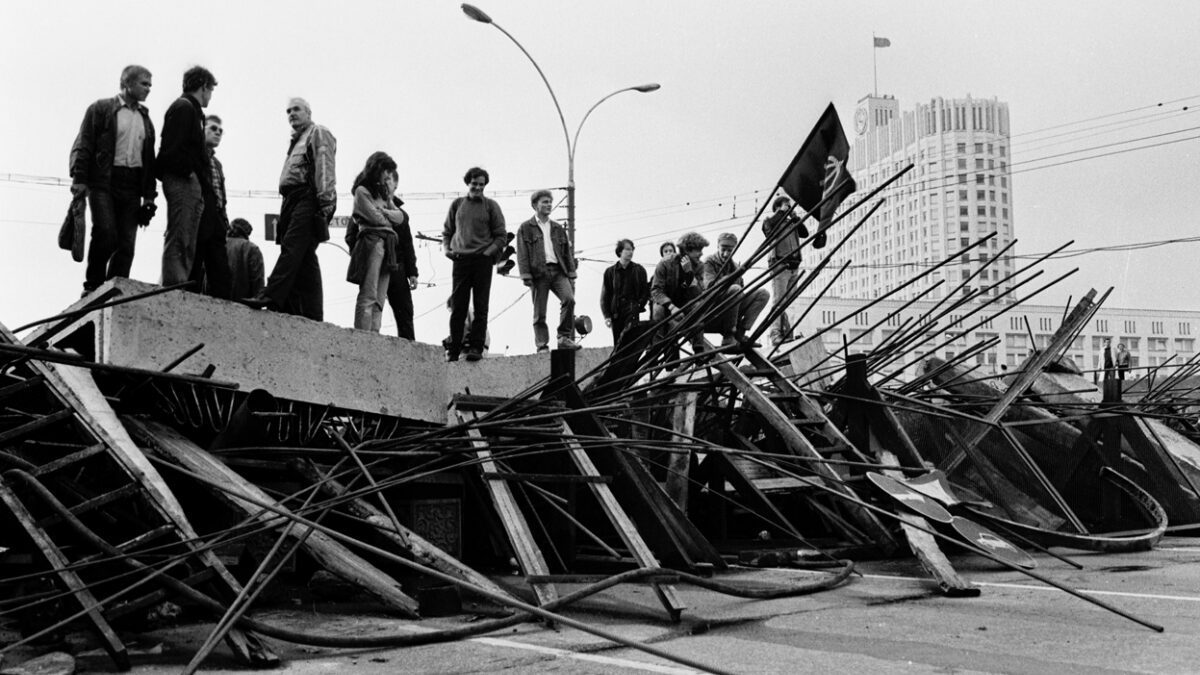
At the White House in Moscow, Yeltsin and his supporters began active campaigning, sending urgent appeals to Russian citizens nationwide. More and more Muscovites flocked to the building and began constructing barricades nearby. Yeltsin also signed an order establishing the Russian Ministry of Defense, appointing General Kobets as its minister, with the ministry’s offices housed within the Russian White House itself.
Around noon on August 19, 1991, Yeltsin walked out of the White House, boarded a tank, and delivered a speech, reading aloud the now-famous Order No. 59: “All decisions made in the name of the so-called State Committee on the State of Emergency are illegal and invalid on the territory of the Russian Federation Republic.” That afternoon, a battalion of the Ryazan Guards Airborne Division defected and assumed responsibility for the defense of the White House. Their arrival was warmly welcomed by those already defending the building.
Meanwhile, panic spread among members of the Kremlin’s State Committee on the State of Emergency. Vice President Yanayev grew increasingly hysterical, repeatedly muttering: “I’ll get shot.” Prime Minister Pavlov fell ill and was hospitalized. Defense Minister Yazov, though he had ordered troops into Moscow, remained hesitant and failed to take decisive action.
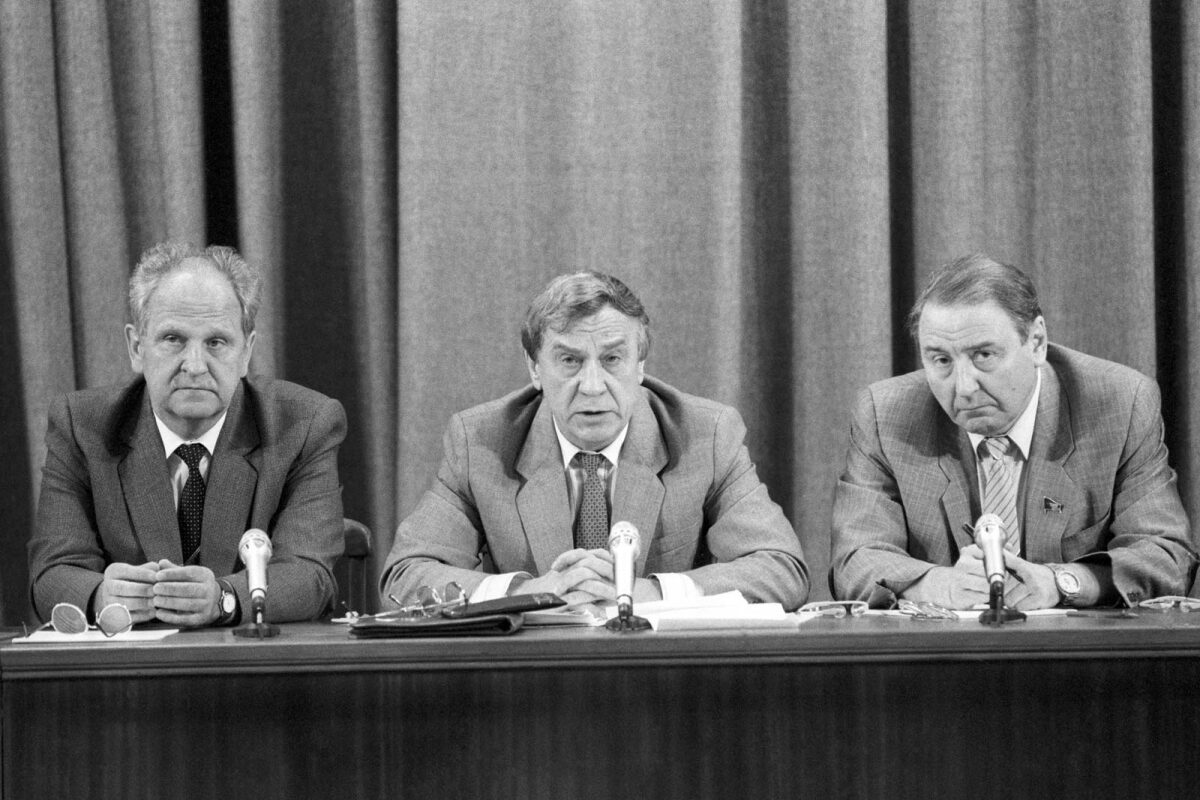
A press conference held at 5:00 PM proved painfully awkward, as reporters bluntly asked whether this was a coup d’état. During the live broadcast, viewers across the country could see Vice President Yanayev and several others visibly trembling, their faces alternately flushing and paling. When questioned about Gorbachev’s health, their answers were confused and evasive, turning the event into a public debacle.
The following day, a flood of protest telegrams and phone calls poured in. Nearly half of the local newspapers defied the authorities, publishing not only the statements of the State Committee on the State of Emergency, but also Yeltsin’s address to the people and his decrees. As word spread, ever larger crowds of civilians and Yeltsin supporters gathered in front of the White House in Moscow. Through various means, they obtained thousands of weapons, reinforced the barricades, and prepared to resist.
A middle-aged woman named Bogacheva spoke on behalf of tens of thousands gathered in front of the White House, saying: “I’m ready to die here, in this place. I will never leave. I’m 55 years old, and for years all I knew was obedience and submission. The Young Pioneers, the Communist Youth League, the trade unions, the Communist Party — they all taught us not to resist, to be cogs in a machine. But on Monday morning, a friend called me and said, ‘Turn on the radio.’ I didn’t need to. I heard a tremendous noise, stepped onto my balcony, and saw tanks rumbling down the Moscow highway. These beasts! They always thought they could do whatever they wanted to us. They ousted Gorbachev, and now they are forcing us to support a government we did not choose. I am not afraid of curfews. If necessary, I will let the tanks run over me. If necessary, I will die here.”
The military refuses to carry out orders
The troops deployed to occupy Moscow were largely unaware of their true mission and did not view the defenders of the White House as enemies. Air Force Commander Shaposhnikov publicly declared: “We will never use force against the people.” The Navy commander issued a similar statement.
That same morning, however, the State of Emergency Committee decided to storm the White House and arrest Yeltsin. The problem was that they could not locate him. Ultimately, the commander of the Alpha Group decided not to carry out the order to attack the White House. Why did this happen? Yeltsin later learned that the soldiers were unwilling to take responsibility for the consequences of their superiors’ decisions. “They were not democrats,” he observed, “but they refused to shed blood for idiots like Kryuchkov and Yazov.”
During an internal meeting within Alpha, a senior officer reportedly said: “They want to frame us with bloodshed. Each of you is free to act according to your conscience. As for me, I will not attack the White House.” Even General Calpushin, the commander-in-chief of the planned attack on the White House, abandoned the operation just two hours before it was to be launched. Although the defenders were numerous, he recognized that any assault would amount to a bloody massacre. Calpushin told reporters: “I don’t have the courage to do it. I refuse.”
The Air Force Commander Shaposhnikov, together with Airborne Forces Commander Grachev, was even more formidable. They unanimously decided that if the coup plotters attacked the White House, the Air Force would retaliate, ordering bombers to fly over the Kremlin and strike the coup organizers.
Defense Minister Yazov, one of the coup participants, turned pale as he watched events unfold. When urged to use force, he resolutely refused, saying: “I’m not going to be Pinochet!” — referring to the Chilean dictator known for brutally crushing opposition. Everything was tipping in favor of the White House defenders, yet those inside remained unaware that Yeltsin and his team were still extremely anxious.
Terrifying moments inside the White House
In his memoirs, Yeltsin wrote that around 2:30 a.m., he checked his watch and then closed his eyes for a short nap. Moments later, gunfire erupted again. When his assistants woke him, his first thought was: “That’s it, the attack has begun.” “They took me downstairs, put a bulletproof vest on me in the garage, had me sit in the back seat of the car, and then said, ‘Let’s go!’” he recalled. “When the engine of the ZIL started, I was fully awake and asked: ‘Where are we going?’”
Yeltsin’s White House stood just a short distance from the new residential buildings of the U.S. Embassy, making an evacuation possible in as little as 15 seconds. The Americans had already agreed to provide refuge if needed. However, when Yeltsin learned of the guards’ plan, he firmly refused. He could not abandon the tens of thousands of people outside who were risking their lives to protect him.
For safety, he was taken to an underground air-raid shelter. It was relatively secure, though the guards took a long time to open the two large, sealed doors. After spending several tense hours inside, Yeltsin could no longer bear the confinement. Gunfire rang out from above, but he decided to return upstairs. His men informed him that three demonstrators had already lost their lives.
Since the coup plotters could not find anyone willing to carry out their orders, at 3:00 a.m. on the third day, the head of the intelligence agency, Kryuchkov, called the White House and spoke with Yeltsin’s closest aide, Burbulis. “It’s all right now,” he said. “You can go to sleep.”
The coup had been thwarted by the people’s fierce resistance and the military’s refusal to act. By 8:00 a.m., the generals unanimously demanded that all troops withdraw from Moscow, and the order was carried out immediately. For the civilians who resisted, it all felt like a dream. They never imagined they would survive. In the face of the coup’s forces, they revealed the inherent goodness of human nature.
One woman participating in the protest said, “On the barricades, there was an incredible sense of brotherhood that you don’t feel when you’re queuing or on a tram, because men will never give you a seat on a tram. Yet, in these extreme circumstances, somehow, this week I’ve seen a profound side of humanity. I never knew there were so many kind people in my country.”
The fall of the Soviet regime
At 4:00 PM on August 21, Gorbachev’s communications were restored. His first call was to Yeltsin, who exclaimed, “Mikhail Sergeyevich, we have held out here for 48 hours!” His second call was to U.S. President George H.W. Bush. Although it was nighttime in Washington, Bush answered and told Gorbachev that he and his wife had been praying for him.
At 2:00 a.m. on August 22, Gorbachev and his entourage returned to Moscow by special plane. At the airport, reporters asked questions as Yazov, Kryuchkov, and other participants in the coup attempt were arrested under orders from the Russian Federal Prosecutor’s Office.
On August 23, Yeltsin issued an order to “cease the activities of the Communist Party of the Russian Federation.” Acting on Gorbachev’s instructions, Yeltsin and Moscow Mayor Popov sealed the Central Committee Building of the Communist Party of the Soviet Union (CPSU).
On August 24, Gorbachev resigned as General Secretary of the CPSU Central Committee and dissolved the party’s Central Committee, effectively bringing the Bolshevik era to an end. On August 24 and 25, Yeltsin signed two presidential decrees — one transferring the CPSU archives to the Russian Archives, the other nationalizing CPSU property and real estate — further restricting the party’s activities. Five days later, he ordered the Communist Party of the Soviet Union to be declared an illegal organization, formally ending its operations in Russia.
What the coup plotters of August 19 never anticipated was that their bid for power would accelerate the collapse of the Soviet Union itself. Within months, the CPSU was neutralized across the former republics, and on December 25, 1991, Gorbachev formally resigned as President of the USSR, bringing the Soviet state to a definitive close.
A warning from history and the CCP’s tenuous grip
History shows that even the most carefully orchestrated power grabs can backfire when popular resistance collides with wavering loyalties in the military or key institutions.
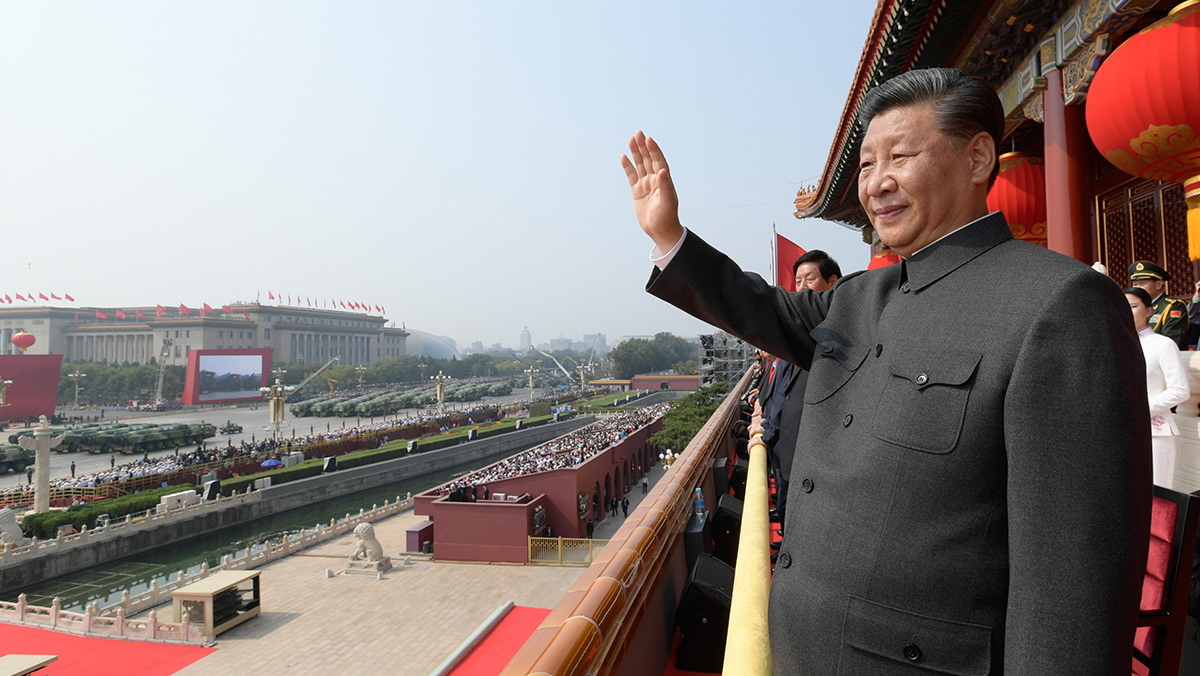
Today, Xi Jinping faces a precarious landscape in China. Rival factions persist within the military and political apparatus, while corruption, bureaucratic inefficiency, and stalled reforms continue to erode public trust. Social unrest simmers across cities and provinces, fueled by financial hardship, job losses, housing pressures, and frustration over unfulfilled promises.
Massive debt among local governments and state-owned enterprises, combined with instability in the property sector, threatens economic stability. Meanwhile, demographic decline — driven by historically low birth rates and a reluctance among young adults to marry — combined with an aging population, strains social services and long-term growth, while environmental crises and healthcare pressures further heighten public dissatisfaction.
Harsh crackdowns in Hong Kong and Tibet, coercive pressure on Taiwan, and external challenges — including trade disputes, technology restrictions, and geopolitical competition with the U.S., NATO, and neighboring countries — compound these internal strains and reinforce the regime’s precarious position.
The CCP has increasingly relied on fear and intimidation to maintain control. Its decades-long persecution of Falun Gong, which has extended to the Uyghurs, house Christians, and other prisoners of conscience — including forced organ harvesting from living individuals, leading to their deaths — has created a climate of terror. Because these crimes have gone unpunished, the regime has been emboldened to extend abuses beyond political or spiritual targets, with stories of ordinary citizens disappearing for targeted organ harvesting, spreading fear, and further eroding trust.
The COVID-19 pandemic laid bare the party’s true intentions. Its mishandling of the outbreak, aggressive global propaganda, and efforts to control the narrative at home and abroad revealed a willingness to put power above transparency, public health, and international norms. The mask is slipping — inside China and on the global stage.
Meanwhile, Xi’s consolidation of power — including sidelining or removing senior military figures such as Zhang Youxia and Liu Zhenli — has reshaped the political and military hierarchy, cementing his personal authority. Though the circumstances differ from 1991 Moscow, where Soviet coup plotters moved against their leader, the lesson remains clear: top-down control can unravel if miscalculations collide with limits of loyalty and public sentiment.
Despite the CCP’s efforts to equate itself with China, the Party does not define the nation or its people. Perhaps it is time for China’s citizens to imagine a free nation — one unshackled from Communist Party rule, able to reclaim its true and upright traditions. A China where governance, culture, and society reflect the will of the people, rather than the ambitions of a single self-serving party, restoring the dignity, creativity, and moral foundations that have long been hallmarks of China’s 5,000-year history.
See Part 1 here
Translated by Chua BC and edited by Tatiana Denning
Follow us on X, Facebook, or Pinterest
