

Standing at the tip of Fugui Cape in Taiwan, you are standing at the edge of two worlds. To the east, the Pacific Ocean stretches toward open horizons. To the west, the East China Sea shimmers under shifting skies. Beneath your feet, volcanic rock sculpted by centuries of wind tells a story older than any map or name this place has carried.
Fugui Cape is the northernmost point on the main island of Taiwan, a windswept headland in the Shimen District of New Taipei City. It is a place where geology, history, and coastal beauty converge in ways that quietly astonish. From its black-and-white lighthouse standing guard against fog to the polished ventifact stones lining the shore, every detail here has been shaped by patience and persistence.
Yet Fugui Cape remains one of the North Coast’s lesser-known treasures, overshadowed by the more famous Yehliu Geopark to the east. For those willing to take the detour, the reward is a half-day journey through one of Taiwan’s most layered landscapes, where Dutch colonial history, Japanese engineering, volcanic geology, and the daily rhythms of a working fishing harbor all share a single stretch of coastline.
This guide walks you through everything worth seeing, tasting, and photographing at Fugui Cape, along with practical details for planning your visit.

What is Fugui Cape?
Fugui Cape is a rocky headland at the northernmost tip of the main island of Taiwan, located in Shimen District, New Taipei City. It marks the dividing line between the Pacific Ocean to the east and the East China Sea to the west. The cape is home to a historic black-and-white lighthouse built in 1897, Taiwan’s largest concentration of wind-sculpted ventifact stones, and a network of scenic coastal trails. Admission to Fugui Cape Park is free, and the area is accessible by bus, car, or bicycle from Taipei.
The story behind the name: from ‘Hoek’ to ‘Fugui’
Names travel through time the way wind travels through rock, leaving traces of everyone who passed through. The headland now known as Fugui Cape has borne several names over the centuries, each a footprint left by a different era.
Local communities originally called the cape “Dabin” or “Dabian.” In the 18th century, Dutch settlers charting Taiwan’s coastline described it as a “hoek,” their word for a small peninsula jutting into the sea. Over time, local transliteration transformed the name into “Fuji,” and eventually into “Fugui.”
The final name carries its own quiet poetry. In Chinese, the characters (富貴) mean “wealth and nobility,” though the connection to the original Dutch word is purely phonetic. Still, there is something fitting about a place that has weathered storms for centuries, earning a name that suggests abundance and dignity. The cape’s layered naming tells its own story of cultural crossroads, from Indigenous communities to European traders to Japanese administrators and eventually to the modern island nation.
Fugui Cape Lighthouse: A beacon through history
The most recognizable landmark at Fugui Cape in Taiwan is its lighthouse, an octagonal tower painted in bold black-and-white horizontal bands. The design is not decorative. It was chosen so that the structure would stand out against the horizon during the heavy fog that frequently rolls across this part of the North Coast.
The original lighthouse was constructed in 1897 during the Japanese colonial period. All construction materials were shipped directly from Japan. After sustaining damage during the Second World War, the lighthouse was rebuilt by the Republic of China government in 1949, and it received its current octagonal form in 1962.
The tower stands 14.3 meters tall and sits 31.4 meters above sea level. It is one of only three lighthouses in Taiwan equipped with foghorns, a necessity in a region where visibility can drop without warning.
For decades, Fugui Cape Lighthouse remained off-limits to visitors because it sits within an active Air Force radar station compound. That changed in 2015, when the lighthouse was opened to the public on weekends. Today, visitors can walk through the compound and stand beside the tower, looking out at the point where two great bodies of water meet.
For photographers, the golden hour before sunset transforms the lighthouse into something almost painterly. The low-angle light catches the black-and-white bands and throws long shadows across the surrounding volcanic rock, while the ocean behind shifts through shades of amber and deep blue.

Windkanter stones: Nature’s sculptures
Walk along the coastal paths near the lighthouse, and you will notice something unusual underfoot. The rocks here have been polished smooth on their surfaces, with edges honed to sharp, clean angles. These are ventifacts, known locally as “windkanter” stones, and Fugui Cape holds the highest concentration of them anywhere in Taiwan.
Ventifacts form through a process that is simple in concept and extraordinary in scale. The northeast monsoon winds that sweep across this headland carry fine particles of volcanic sand. Over hundreds and thousands of years, those wind-driven particles act like natural sandpaper, slowly grinding the exposed faces of rock into flat, gleaming planes while leaving sheltered sides rough and untouched.
The stones themselves originate from the Datun Mountain volcanic range in nearby Yangmingshan National Park, part of a geological system roughly 800,000 years old. What you see scattered along the Fugui Cape shoreline is the result of volcanic eruption, coastal erosion, and relentless wind working together across geological time.
There is something meditative about standing among the ventifacts. Each stone is a record of patience. The wind did not carve these shapes in a day, a year, or even a human lifetime. It took the steady, repeated application of a force so gentle you can barely feel it on your skin to produce surfaces as smooth as polished marble.

Fengjianshu: The wind-cut trees
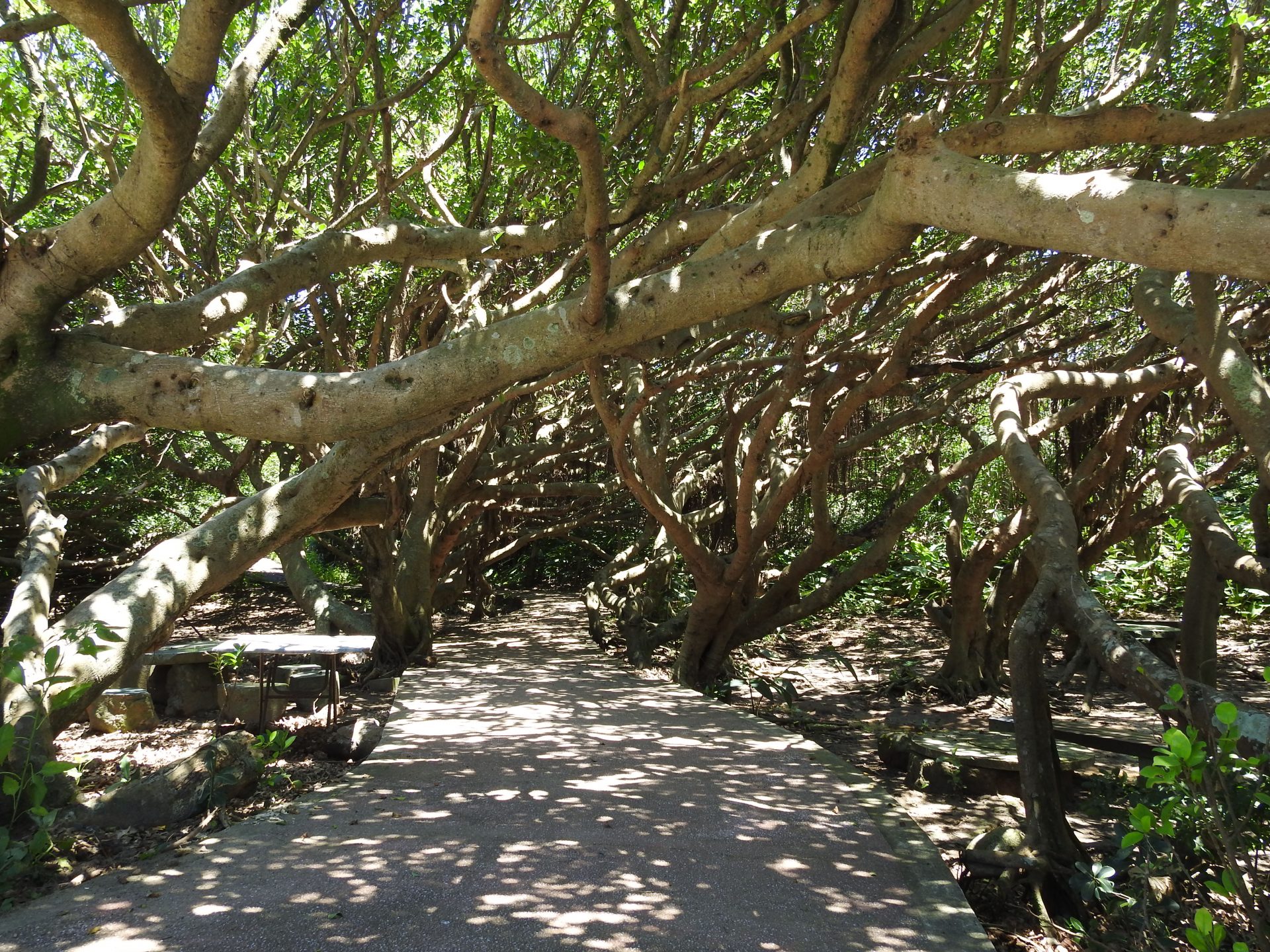
The ventifacts are not the only things the northeast monsoon has shaped at Fugui Cape. Along the walking trails that wind through the park, you will encounter trees that look as though they have been trimmed by an invisible gardener. Their branches grow thick and full on the sheltered side, while the windward face is bare, swept clean by years of salt-laden gusts.
These are “fengjianshu” in Chinese, literally “wind-cut trees,” and they are living sculptures in the same way the ventifact stones are geological ones. The trees have not been damaged by the wind so much as redirected by it. They have learned, as living things do, to grow where growth is possible.
Walking among the fengjianshu, with the ocean crashing below and the wind pressing steadily against you, it is easy to feel a sense of kinship with these resilient forms. They do not fight the conditions they were given. They adapt, and in adapting, they become something unexpectedly beautiful.
Laomei Green Reef: The seasonal wonder nearby
Just a short distance from Fugui Cape lies one of Taiwan’s most extraordinary seasonal spectacles. Every spring, a 700-meter stretch of volcanic reef along the coast near Laomei Village transforms into a vivid carpet of bright green.
The Laomei Green Reef is formed from the same Datun volcanic system that produced the ventifact stones. Over millennia, wave erosion carved deep grooves and trenches into the reef surface. Each winter, the moist northeast monsoon creates perfect conditions for green algae, primarily sea lettuce (Ulva lactuca), to colonize the rock. By March, the reef begins to glow with color. By April and May, the transformation is complete: an entire coastline draped in electric green against the dark volcanic stone and the deep blue sea.
The reef is only visible at low tide, so checking tidal schedules for Shimen before your visit is essential. The North Coast & Guanyinshan National Scenic Area provides seasonal updates and visiting conditions. Photographers prize the early morning hours, when slanted sunlight creates vivid layers of green, stone, and ocean.
One important caution: the algae-covered rocks are extremely slippery and can be dangerous. Visitors should admire and photograph the green reef from the shore rather than walking on the formations. The algae is also fragile, and foot traffic damages the seasonal growth that makes this place so remarkable.
As the weather warms into summer, the seaweed gradually disappears under the sun’s intensity, and the reef returns to its dark volcanic appearance until the following spring. If you are visiting Fugui Cape between March and May, the Laomei Green Reef alone is worth the trip.

More to explore along the coast
Shimen Stone Arch: Taiwan’s northern gateway
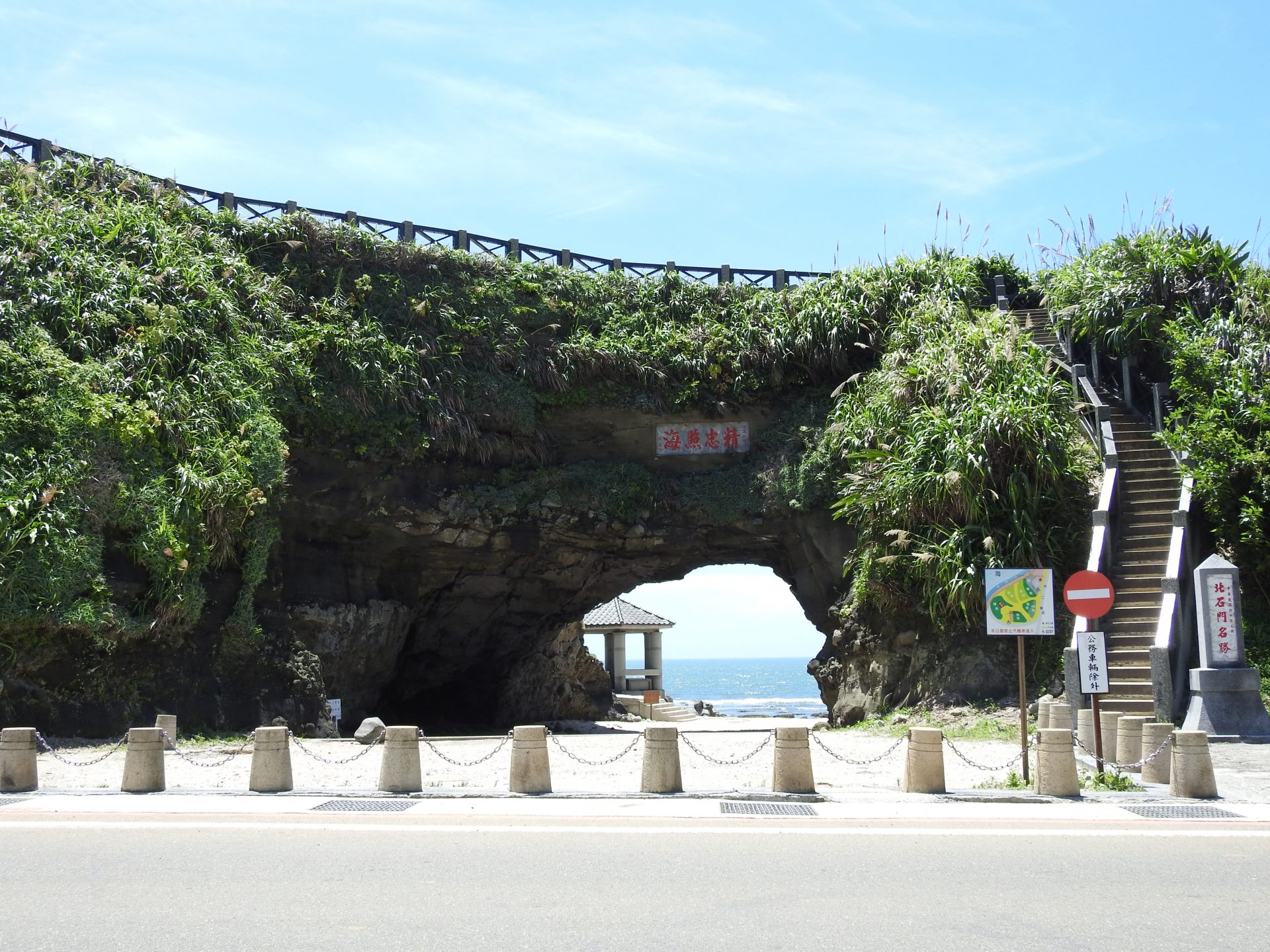
Continuing along the coast from Fugui Cape, you will reach a massive natural formation that has defined this region for centuries. The Shimen Stone Arch is a sea-carved doorway through a block of conglomerate rock, standing roughly 10 meters tall, shaped over the ages by tidal-wave erosion and coastal weathering.
The arch is so prominent that it gave the entire district its name. “Shimen” translates to “stone gate,” and for generations, local communities have regarded this formation as Taiwan’s northern gateway, a threshold between the island’s interior and the vast ocean beyond.
A short trail leads to the summit of the rock formation, where the views stretch across the coastline in both directions. On clear days, you can trace the curve of the North Coast from the white sand beaches to the west all the way to the rugged headlands to the east.
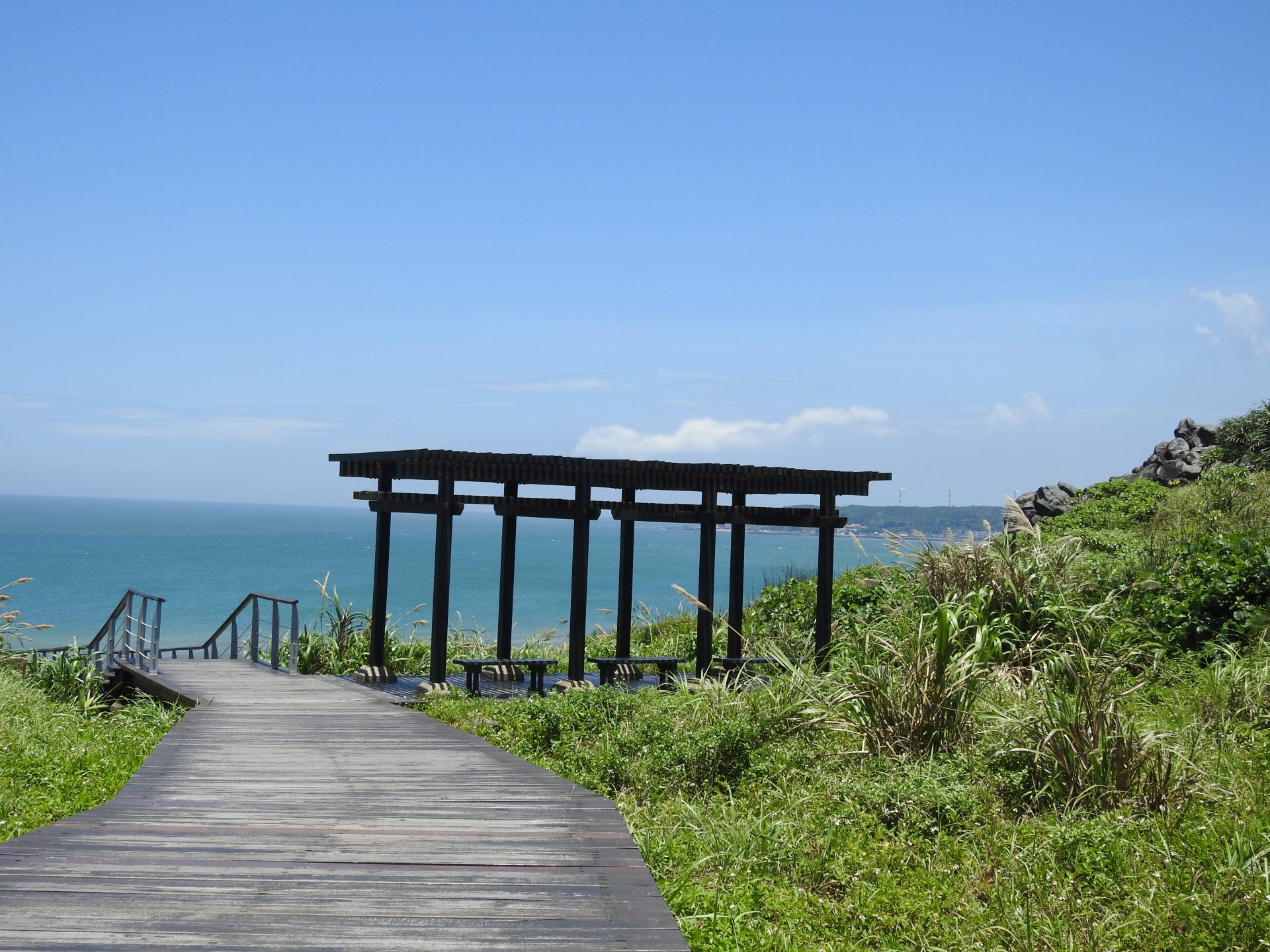
Fuji Fishing Harbor: A feast for the senses
After a morning spent among lighthouses, ventifacts, and coastal trails, Fuji Fishing Harbor offers exactly the kind of grounding experience a traveler needs. This working harbor sits on the western side of Fugui Cape and doubles as one of the North Coast’s most colorful seafood markets.
The market stalls operate beneath distinctive, brightly colored rooftops that have become a landmark in their own right. The format is simple and deeply satisfying: browse the stalls, select your seafood fresh from the morning catch, and hand it to one of the local chefs who will prepare it while you wait.
Crab, shrimp, clams, and a rotating selection of seasonal fish are the staples. The preparation style leans toward letting the quality of the ingredients speak for itself. Steamed, lightly stir-fried, or cooked in ginger-scallion broth, the seafood here tastes the way coastal food should taste, clean and immediate, with the salt air still clinging to the experience.
For visitors accustomed to more structured dining, the harbor market can feel wonderfully informal. There are no reservations, no elaborate menus. You point, you choose, you eat. It is one of those rare travel experiences where simplicity is the whole point.
Shimen Wedding Plaza: Where ocean meets romance
One of the more unexpected discoveries along the Fugui Cape coastline is the Shimen Wedding Plaza, a Mediterranean-style installation perched on the cliffs overlooking the sea. White columns, archways, and a bell tower frame ocean panoramas that have made this a popular destination for wedding photography and couples visiting the North Coast.
The plaza is open to all visitors, not just wedding parties, and the views alone make it worth a brief stop. On clear days, the contrast between the white architectural elements and the deep blue ocean creates a scene that feels transplanted from the Aegean, yet is unmistakably Taiwanese in its coastal setting and atmosphere.
How to visit Fugui Cape: A practical guide
Getting there
- By bus from Taipei: According to New Taipei City Travel, take Bus 862 (bound for Jinshan) or Bus 863 from Tamsui MRT Station. The ride takes approximately one hour. Get off at Fugui Cape stop or Laomei stop (for the green reef), followed by a five- to ten-minute walk.
- By car or scooter: Follow Provincial Highway 2 north along the coast. Fugui Cape is approximately 26 kilometers from Tamsui and is well signed along the route. Free parking is available at the Cape.
- By bicycle: The North Coast cycling route passes directly through the Fugui Cape area. The terrain is mostly flat along the coast, making it accessible for recreational cyclists.
Visiting hours and fees
- Fugui Cape Park is open daily, and admission is free.
- The lighthouse compound has restricted hours:
- Open on weekends only (the compound remains an active military radar station on weekdays)
- October through April: 9:00 a.m. to 5:00 p.m.
- May through September: 9:00 a.m. to 6:00 p.m.
What to bring
Wind protection is essential. Fugui Cape is one of the windiest spots on Taiwan’s North Coast, and even on warm days, the sustained gusts can feel surprisingly strong. Comfortable walking shoes, sun protection, and a camera round out the essentials. The coastal trail is paved and flat, covering roughly two kilometers round-trip.
Time needed
Allow one to two hours for Fugui Cape Park and the lighthouse. For a complete experience including Laomei Green Reef, Shimen Stone Arch, Fuji Fishing Harbor, and the Wedding Plaza, plan a relaxed half-day.
Planning your North Coast day trip
Fugui Cape and its surrounding attractions fit naturally into a single, unhurried day trip from Taipei. Here is a suggested itinerary:
- Morning: Start at Laomei Green Reef (if visiting March through May) during low tide, when the green algae formations are most vivid. From there, walk or drive the short distance to Fugui Cape Park.
- Midday: Explore the lighthouse, ventifact stones, and wind-cut tree trails at Fugui Cape. Allow time to walk the coastal path and take in the views from Taiwan’s northernmost point.
- Lunch: Head to Fuji Fishing Harbor for fresh seafood selected and prepared on-site.
- Afternoon: Visit Shimen Stone Arch and the Wedding Plaza, then continue along the coast to Baishawan (White Sand Bay) for a beach stop if time allows.
Best times to visit
- March through May: Peak season for Laomei Green Reef and Taiwan’s native lily blooms along the coastal trails
- May through August: Indian blanket flowers (Gaillardia) add bursts of red and yellow to the headland
- September through November: Clear autumn skies offer the best long-range visibility for photography
- Year-round: The lighthouse and ventifact formations are impressive in any season

A place shaped by patience
Standing at Fugui Cape, looking out over the meeting point of two oceans, it is hard not to reflect on the forces that made this place what it is. Wind, water, and time worked together across centuries to carve rock into sculpture, bend trees into living art, and drape an entire reef in brilliant green each spring.
Nothing here happened quickly. The ventifacts did not appear overnight. The lighthouse has stood through wars and regime changes. The fengjianshu trees did not resist the wind; they grew around it. And the fishing harbor has fed families from the same waters for generations.
Fugui Cape, Taiwan’s northernmost point, rewards the visitor who arrives with curiosity and patience. It is not the loudest destination on the island. It does not compete for attention with neon-lit night markets or towering skyscrapers. Instead, it offers something quieter and, in its own way, more lasting: the beauty of a landscape that has been shaped, slowly and persistently, into something extraordinary.
Follow us on X, Facebook, or Pinterest
