
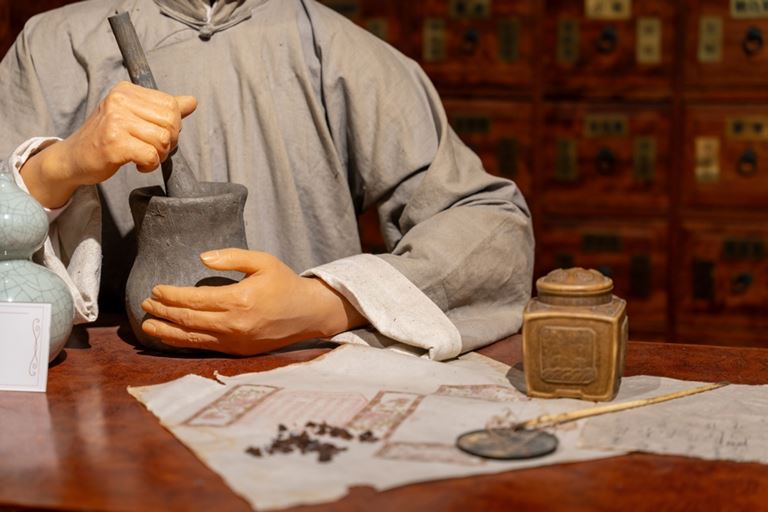
Since ancient times, traditional Chinese medicine has often been associated with philosophical and spiritual ideas, including principles such as following nature, cultivating virtue, and nurturing both body and mind. Within this framework, many ancient physicians were also regarded as practitioners of self-cultivation.
Across different dynasties, historical records and legends describe several renowned doctors who were believed to possess extraordinary abilities, including diagnosing life and death outcomes and treating unusual or difficult illnesses.
One such figure was Ma Siming, a well-known physician from the Northern Qi period (550-577) during the Northern and Southern Dynasties, who was remembered for his exceptional medical skill and reputation.
Uncanny abilities
Ma Siming was a native of Henei County (present-day Qinyang, Henan), who later rose to the official position of Imperial Attendant-in-Ordinary. From an early age, he was recognized for his exceptional medical talent and devoted himself to the extensive study and collection of medical texts and prescriptions.
He was able to recite major medical classics from memory, including the Jia Yi Jing (Systematic Classic of Acupuncture and Moxibustion), the Suwen (Basic Questions), the Ming Tang Zhenjiu (Illustrated Canon of Acupuncture and Moxibustion), and Materia Medica. However, the acupuncture points he selected in practice often differed from those recorded in the Ming Tang, which reflected his own independent and original interpretations of medical theory.
According to traditional accounts, he was also said to possess an extraordinary diagnostic ability. In certain cases, he could predict a patient’s life or death up to a year in advance when examining and treating them.
Foretelling the death of the Minister’s son
One day, Xing Dabao, the son of Minister Xing Shao, contracted typhoid fever. Ma Siming was invited to treat him. After taking his pulse, Ma Siming stepped outside and told another minister named Yang Yin: “Young Master Xing’s typhoid fever will resolve quickly even without treatment. However, his pulse reveals another underlying illness. He is unlikely to live beyond a year. At this point, there is nothing that can be done.”
Shortly afterward, Xing Dabao recovered from typhoid fever.
Xing Shao and Yang Yin were drinking with the emperor one day in the inner palace when Emperor Xianzu said, “I want Xing Shao’s son to take up a post in a county near the capital.”
Despite being in the company of Xing Shao, Yang Yin opposed the proposal, arguing that Xing Dabao was still too young, only 17 or 18 years old, and not yet suited for such responsibilities. After the banquet ended, however, Yang Yin privately informed the emperor, “Ma Siming told me that Dabao’s pulse is extremely weak and that he is unlikely to survive more than a year. If he leaves the capital, it may be even harder for him to receive proper care.” The matter was then set aside.
As predicted, Xing Dabao died of illness less than a year later.
Remedy for back pain
There was a person named Yang Ling, who suffered from swelling and pain in his back. Ma Siming treated the condition by applying “refined stone” to the affected area, after which it reportedly healed quickly.
The method for preparing the refined stone was described as follows. Take a coarse yellow stone about the size of a goose egg and heat it in a strong fire until it turns red. Place the stone in vinegar and allow a layer of fragments to naturally flake off. The stone is then removed, reheated, and soaked again. The process is repeated until it gradually breaks down completely into fragments. These fragments are dried in the sun, finely ground, and sifted into powder.
The resulting powder is mixed with vinegar and applied to the swollen and painful area. The swelling was said to subside as a result.
The ability to cure unusual diseases
Once, while accompanying the emperor to Jinyang, Ma Siming passed through the Liaoyang Mountains and noticed the same public notice posted multiple times. The notice stated that a family had a sick daughter and was willing to pay a reward of 100,000 coins to anyone who could cure her. Many famous physicians had gone to treat her, but after examining her symptoms, none dared to take on the case.
Curious about what kind of illness the patient actually had, Ma Siming went to offer a medical consultation.
Upon arrival, Ma Siming carefully inquired about the cause of the patient’s illness. She said that not long ago, while holding an ear of wheat, she suddenly saw a two-inch-long, snake-like, red insect burrow into her finger. Overcome with fear, she fainted on the spot from fright, and when she regained consciousness, she felt pain and swelling in her arm. Over time, half of her body swelled up, causing unbearable pain that made her groan incessantly day and night.
After hearing the story, Ma Siming prescribed a formula for her to take. By the time he returned from Jinyang with the Emperor, the woman had completely recovered. No one knew what was in the miraculous prescription Ma Siming had used.
A warning unheeded
Hulu Xian, the second son of the renowned Northern Qi General Hulu Jin and younger brother of Chancellor Hulu Guang, held Ma Siming in high regard. On one occasion, he visited Ma Siming and privately asked whether he foresaw any impending troubles in his fate.
Ma Siming advised him to “perform a ritual to ward off evil,” a phrase understood at the time as a warning to guard against misfortune and neutralize harmful influences. It is said that Ma Siming had already perceived the tragic fate awaiting the man, but Hulu Xian failed to grasp the deeper implication.
Later, Hulu Xian was executed together with his elder brother, Hulu Guang.
A life of virtue and extraordinary insight
In the early years of the Sui Dynasty, Ma Siming passed away. Traditionally, he was regarded by some as more than an ordinary physician, as his reported ability to perceive matters of life and death in advance seemed to surpass conventional medical knowledge. For this reason, later generations often speculated that he must have been a cultivator of the Tao, as he had an extraordinary level of insight that went beyond that of a typical practitioner of medicine.
Reference Material: Book of Northern Qi (Beiqi Shu)
Translated by Chua BC
Follow us on X, Facebook, or Pinterest
