

In one exchange preserved between Master Yinguang, the 13th Patriarch of Pure Land Buddhism, and lay practitioner Zhou Songyao, a troubling question is raised: If someone has practiced Buddhism sincerely for many years, why might they still meet a tragic death?
The question arose after Zhou learned that an elderly woman surnamed Zhang, a deeply devout Buddhist, had been struck and killed by a car while on her way to deliver vegetarian food to a fellow practitioner. The news left him shocked and unsettled. It also shook the faith of others around him who recited the Buddha’s name and tried to live according to Buddhist teachings.
Zhou wrote to Master Yinguang for an explanation, hoping to understand how such a thing could happen and whether the woman could still be reborn in the Western Pure Land despite her painful death.
A devout practitioner’s sudden death
In his letter, Zhou explained that he had practiced vegetarianism and recitation of the Buddha’s name for many years. Buddhist scriptures, he wrote, say that those who truly believe in the Buddha are protected by the Buddhas of the 10 directions and the three periods of time, and that heavenly beings and Dharma protectors watch over them. Past evil karma may gradually be dissolved, and even karmic creditors cannot easily harm such a person.
Because of this, Zhou said, he had always believed these teachings were true and not empty words.
That was why the death of Mrs. Zhang disturbed him so deeply. She had been a vegetarian for more than 20 years, often attended Buddhist lectures, encouraged others to recite the Buddha’s name and eat vegetarian food, and was known for her compassion and good deeds. Yet while walking on the road to deliver food to another lay practitioner, she was killed in a car accident.
To Zhou, and to others who heard the news, this seemed painfully difficult to reconcile with what they had been taught. If someone so sincere could die in such a tragic way, what did that say about karma, spiritual protection, and the value of practice?
Master Yinguang on karma and what people cannot see
Master Yinguang’s reply was firm, but compassionate, reflecting the clarity for which the Pure Land patriarch was known. He told Zhou that his confusion showed he did not yet fully understand the deeper principles of the Buddha Dharma.
From beginningless time, he explained, the evil karma people have created is measureless. Citing the Avatamsaka Sutra, he wrote that if the evil karma of sentient beings had shape or substance, even all of space could not contain it. For this reason, one cannot judge a practitioner’s fate by what appears on the surface in a single moment.
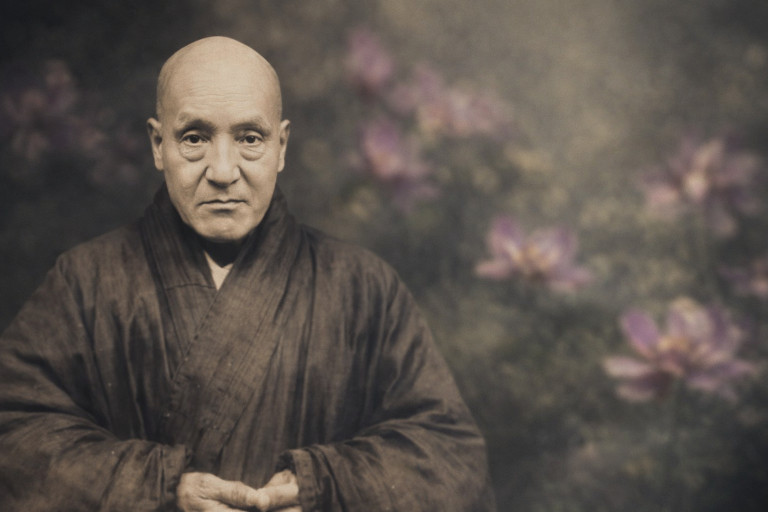
A person who practices with sincerity, he said, may be able to transform karma. Severe retribution that would otherwise be suffered in a future life may instead be reduced and experienced as lighter suffering in this life. Ordinary people, limited by what they can see with their physical eyes, notice only present fortune or misfortune. They do not see the deeper chain of causes and effects extending across past, present, and future.
In the case of the elderly woman, her painful death may have been the resolution of past karma that otherwise would have led to far graver consequences, including rebirth in the three evil realms. Because of the merit of her practice, that heavy retribution may have been lessened. And if she had truly believed and vowed during her lifetime to be reborn in the Western Pure Land, then rebirth there was still possible.
At the same time, Master Yinguang cautioned against making absolute claims. Since ordinary people do not possess supernatural insight, they should not casually declare that she definitely was, or definitely was not, reborn in the Pure Land.
What can be said with certainty, he wrote, is that good brings good results and evil brings evil results. If a person who does good suffers misfortune, that suffering comes from past evil karma ripening, not from the good they are doing in the present.
Why doubt arises
Master Yinguang then addressed the fear behind Zhou’s question. When people see a good person suffer, he said, they may begin to think that doing good has no benefit. But this is a mistaken view.
The workings of karma are not simple or linear. Causes and effects overlap endlessly. A good cause planted today may not bear fruit immediately, while karma created long ago may suddenly ripen and produce results in the present. Master Yinguang compared this to farming: The person who sows first harvests first. He also compared it to debt collection: The creditor with the greatest power may collect payment first.
Those who truly understand this, he said, do not lose faith in the face of hardship. They do not conclude that the law of cause and effect is false, nor do they assume that the Buddha’s teachings are untrustworthy. The protection of the Three Jewels and of heavenly guardians is real, but the process by which heavy karma is transformed into lighter present suffering is subtle and often beyond human understanding.
A lesson from an Indian Buddhist master
To make the point clearer, Master Yinguang gave an example from Buddhist history. He referred to the Indian master Silabhadra, known in Chinese as Jiexian, who was famous throughout India for his virtue and learning. Yet despite his spiritual attainment, he became gravely ill and suffered so intensely that he once considered ending his own life.
At that moment, according to the account, the bodhisattvas Manjushri, Samantabhadra, and Avalokiteshvara appeared to him and explained the deeper cause of his suffering. In past lives, they said, he had once been a king who harmed many beings and had thereby created karma that should have led to a long stay in the lower realms. But because he was now propagating the Dharma, that immense future suffering was being reduced and repaid through the comparatively brief suffering of severe illness in this life.
Without understanding these past causes, an outsider might have looked at Silabhadra and wrongly concluded that he was not a true master, or that Buddhist practice offered no real benefit. In the same way, seeing a virtuous person suffer can lead those without deep understanding to retreat from faith.
Master Yinguang added that karma can seem to work in the opposite direction as well. A person who does evil may appear to enjoy good fortune for a time, not because evil brings blessings, but because other past causes are bearing fruit first, while heavier consequences are delayed until later.
Holding faith when life feels unfair
Master Yinguang’s answer does not deny the pain of what happened. Nor does it pretend that such events are easy to understand. Instead, it asks believers not to judge the truth of spiritual practice solely by outward appearances.
From a Buddhist perspective, life unfolds within a vast web of causes and conditions that extends far beyond what any one person can see. Tragedy, then, is not proof that faith is false. It may instead reflect karmic debts being resolved in ways that are hidden from ordinary view.
For those who believe in the Buddha’s teachings, the proper response is not panic or doubt, but steadiness: to continue practicing, continue doing good, and trust that karmic law remains true even when immediate events seem difficult to explain.
Translated by Audrey Wang
Follow us on X, Facebook, or Pinterest
