
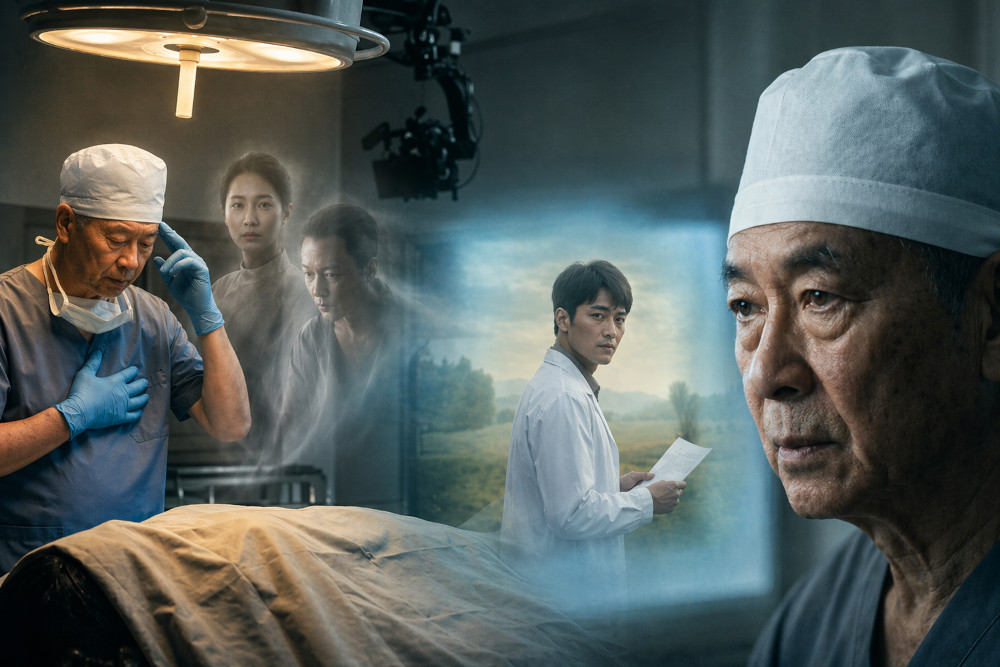
In April, just after the Qingming Festival — a traditional time in China for honoring ancestors and visiting the graves of loved ones — a video interview with Liu Liang, a professor in the Department of Forensic Medicine at Tongji Medical College of Huazhong University of Science and Technology, went viral online.
Liu has personally performed more than 4,000 autopsies and taken part in over 7,000 forensic examinations during a 43-year career, earning a reputation as one of the most seasoned figures in China’s forensic field. When the interviewer asked him directly whether human beings have souls, he answered without hesitation: “Absolutely.”
Now 65, Liu began his career as a clinical doctor before moving into forensic medicine. He was originally a thorough materialist, shaped by the Chinese Communist Party system in which he was trained. At university, he studied anatomy, pathology, and the logic of evidentiary chains with scientific rigor. His daily work was to examine the dead with scalpels and microscopes and provide answers for the courts or for grieving families.
He has seen bodies shattered in falls from high buildings, “perfect suicides” carefully staged by highly intelligent criminals, and the mutilated remains left behind in family murder cases. He has even had to dissect the bodies of people he knew. On the surface, someone who spends his life working so closely with death should be the most convinced that death is simply the end.
Yet after more than four decades of confronting death up close, Liu says his thinking gradually changed.
The gaze above the autopsy table
In the interview, Liu spoke in a restrained tone, almost as though he were testifying in court. He shared only two experiences publicly, saying that others were not suitable for open discussion. Even those two accounts were enough to leave many viewers wondering why a mainland Chinese forensic doctor with an atheist background would speak so openly about the soul.
The first experience was what he described as the gaze of the deceased.
Liu said that during autopsies, he more than once felt as though the dead were watching him. He did not describe it as a hallucination, but as a powerful and unmistakable sense of being observed, as though some awareness remained behind those closed eyes, silently looking down on every cut he made. He summed it up simply: “There are things you can’t see.”
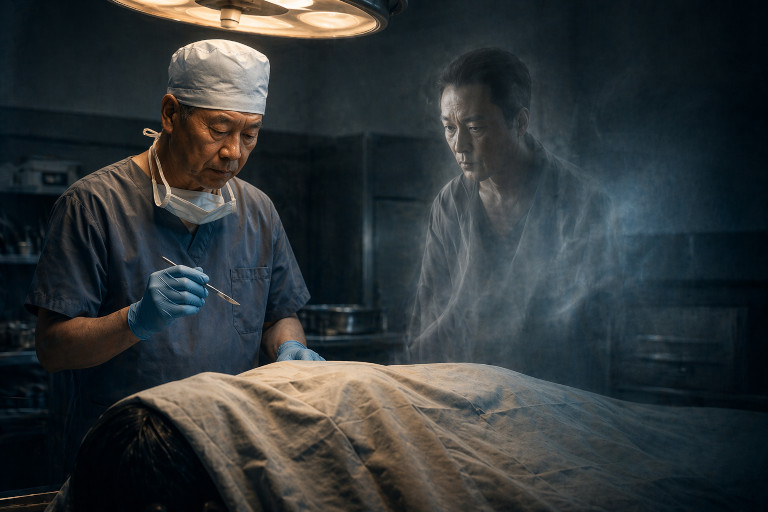
It was this unseen presence, he said, that convinced him that even when the body had gone cold, something still remained with that life. In that sense, the forensic scalpel was not an act of destruction, but a way of speaking for the dead and defending their dignity.
Dreams that pointed the way
The second experience was even more striking.
Liu said that at times he would dream that the deceased was telling him to reexamine a particular part of the body. The next day, he would do so and immediately find something important. In his telling, the dream was not vague symbolism. The deceased would indicate a specific area that might have been overlooked during the autopsy, such as a wound, a piece of tissue, or residue from a toxin. When Liu checked that area again after waking, he said he sometimes found crucial evidence that clarified the cause of death or changed the direction of the case.
For a forensic pathologist known for his exacting standards to discuss such experiences in public took considerable courage. Liu stressed that these were phenomena he had encountered repeatedly over 43 years, yet could not explain through science alone.
He is not someone known for an interest in mysticism. He led the team that conducted the first autopsy on a COVID victim in Wuhan. But perhaps because he had seen too much that could not be neatly explained by materialist assumptions, he chose at age 65 to break his silence.
At the end of the interview, however, he offered a note of caution. He said people should not become attached to such experiences, fear them, or chase after them. He repeatedly cited a line from the Diamond Sutra, often translated as “All appearances are illusory,” and urged people to remain calm and not become unsettled by unusual things.
Not an isolated case
Liu’s experience is not the only one of its kind. Forensic pathologists stand on the front line of death, trying to uncover the truth behind violence, accidents, and murder. Whether it is Liu, shaped by mainland China’s materialist education, or coroners and medical examiners trained in the West, some have come to believe that science can explain the physical cause of death, but not every experience associated with it.
American medical examiner Janis Amatuzio is one example. Since 1993, she has served as chief medical examiner in Anoka County, Minnesota, and has personally performed or supervised thousands of examinations. In her books Forever Ours and Beyond Knowing, she collected stories shared by grieving families, police officers, and clergy about what they believed were visits or messages from the dead. Over time, those experiences led her to speak openly about the possibility of the soul and the continuation of consciousness after death.
She wrote about a woman whose husband died suddenly of a heart attack and later appeared to her in a dream, calmly speaking with her before telling her that their love was eternal. She also recounted the case of a young man killed in a car accident, whose family later found comfort after what they believed were messages assuring them that he was at peace.
Amatuzio concluded that death may not be an ending so much as a transformation. In her view, the soul leaves the body, but love, awareness, and communication may continue in another form.
The same theme appears in the story of Peter Cummings, an American forensic pathologist and neuropathologist who once considered himself a committed atheist. After spending years dissecting brains and bodies, he believed consciousness was nothing more than a product of brain activity. That changed after he nearly drowned in a whitewater rafting accident and underwent what he described as a profound near-death experience.
He later said he saw his wife and son being rescued from above and felt an overwhelming sense of peace, light, and love. After surviving, his view of time and existence changed completely. He came to believe that consciousness is not confined to the body and that death is not the end, but a transition into another form of being.
Other forensic professionals have expressed similar thoughts. Australian forensic pathologist Istvan Szentmariay has said that years of working around death changed his worldview. Although he avoids discussing the soul in his professional work in order to remain objective, he has acknowledged that no one truly grasps the full mystery of death. In online forums and anonymous accounts, some other forensic workers have also described feeling watched in the autopsy room or dreaming of the dead.
Science can identify injuries, trace toxins, and explain physical mechanisms. What it cannot fully account for, these doctors suggest, are the precise dreams, strange synchronicities, and near-death experiences that some people report. The body may decay, but something else — whether one calls it the soul, consciousness, or love — may continue on in ways science cannot yet explain.
Translated by Chua BC
Follow us on X, Facebook, or Pinterest
