

Yuewei Hermitage was the elegant name of the residence of Ji Xiaolan, a famous scholar and official of the Qing Dynasty in the 18th century. It was within these walls that he compiled his celebrated work, Notes from the Yuewei Hermitage. This was a collection of strange tales, supernatural accounts, moral lessons, and tales of virtue that became well-known in Chinese literature. In Volume Four, Ji recorded a remarkable story from Xian County in Hebei Province about a man surnamed Shi.
A family in despair
One day, as Shi was returning home, he saw a husband and wife in the village holding their young child and weeping in each other’s arms. Moved by their distress, he stopped to ask what had happened.
A neighbor explained that the family had fallen into debt to a powerful local man who was pressing them for repayment. With no other way out, the husband had agreed to sell his wife to settle what they owed. Because the couple cared deeply for one another and their child had not yet been weaned, the separation was especially heartbreaking.
Shi asked how much debt they owed.
“Thirty taels of silver,” the neighbor replied.
He then asked the husband how much his wife had been sold for.
“Fifty taels,” the man said, “to become another man’s concubine.”
“Can she still be redeemed?” Shi asked.
The answer was yes. The contract had already been written, but the money had not yet been paid. There was still time to stop it.
Upon hearing this, Shi did not hesitate. He took out 70 taels of silver and gave it to the family.
“Use thirty taels to repay the debt,” he said. “Keep the remaining forty to make a living. Do not sell your wife.”
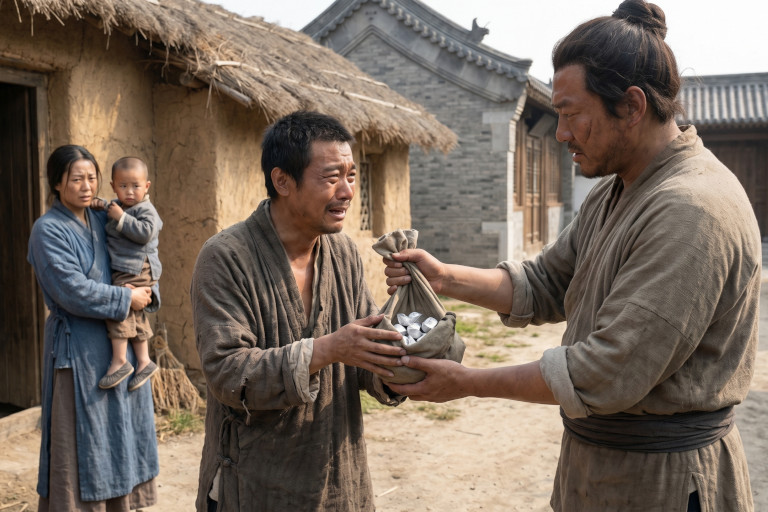
Rejecting a reward lacking virtue
The husband and wife were overcome with gratitude. They insisted on preparing a meal for Shi and even killed a chicken to honor him. As they drank together, the husband stepped outside with the child and signaled to his wife with his eyes. His meaning was clear: In return for Shi’s great kindness, he wanted her to offer herself to him.
The wife understood and conveyed the offer.
Shi immediately turned serious.
“I spent half my life as a thief and half as a constable,” he said. “I have killed without flinching. But taking advantage of someone in distress and violating an honorable woman is something I would never do.”
With that, he got up and left at once.
A fire in the night
Half a month later, a fire suddenly broke out in Shi’s village at night. It was autumn harvest season, and every household had piles of dry straw and firewood stacked around their homes. The flames spread quickly, swallowing one thatched house after another, including Shi’s own home.
The fire was so fierce that Shi and his family were trapped inside with no way out. He could do nothing but sit with his wife and child in the house, close their eyes, and wait for death.
In a daze, Shi suddenly heard a booming voice from above the roof: “A divine decree has been issued! The family of Shi is to be exempt!”
No sooner had the words sounded than the back wall of the house suddenly collapsed. Shi led his wife and carried the child out through the opening, escaping the sea of fire with astonishing speed, as if they had grown wings.
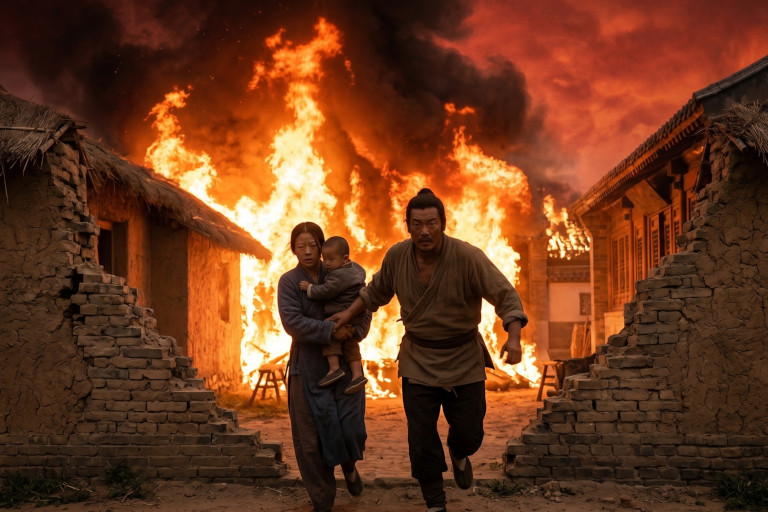
When the blaze was finally extinguished, nine people from the village had died.
The true source of protection
Afterward, the neighbors came to Shi and said: “Not long ago, we laughed at you for being foolish. Who would have thought that seventy taels of silver would save three lives?”
In one sense, they were right. But Ji Xiaolan believed the story pointed to something deeper.
In traditional Chinese moral thought, sexual misconduct was regarded as a serious wrong. If Shi had done a good deed only to lose control of himself afterward and accept the couple’s unusual form of “gratitude,” then the merit of his generosity would have been undone.
Ji concluded that the family’s survival was due to divine protection. Of that protection, he wrote, four parts came from Shi’s gift of money, while six parts came from his refusal to give in to lust.
The story suggests that kindness alone is not always the whole measure of a person’s virtue. In Shi’s case, it was not only his willingness to rescue a family in desperate need, but also his ability to restrain himself when no one would have stopped him, that changed the outcome. His charity saved the couple from one disaster, but his integrity may have saved his own family from another.
Translated by Joseph Wu
Follow us on X, Facebook, or Pinterest
