
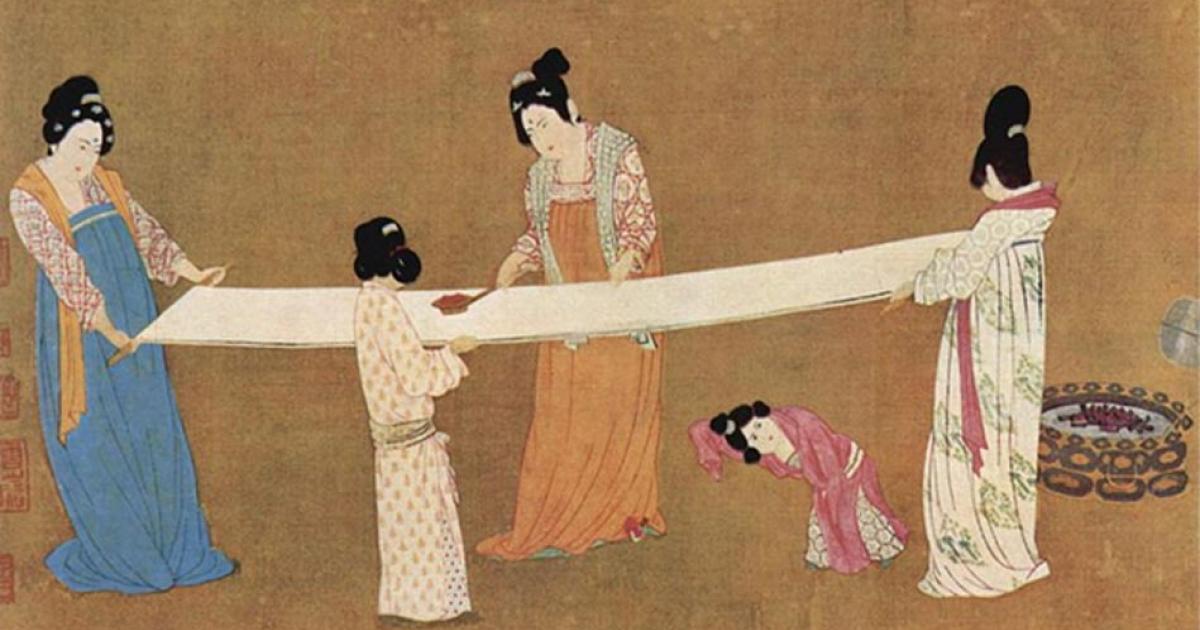
Picture a quiet afternoon in a royal garden, more than 4,000 years ago. An empress sits beneath a mulberry tree, sipping a cup of hot tea, when a small cocoon drops from a branch into her cup. As she reaches in to fish it out, something extraordinary happens. The warm water has loosened the cocoon, and a single shimmering thread begins to unwind in her fingers, longer and finer than anything she has ever seen.
That thread, according to legend, was the beginning of silk. The history of silk in China spans more than 5,000 years, weaving together legend, painstaking craft, a secret guarded with people’s lives, and a trade route that first linked East and West. The story of how it traveled from one woman’s teacup to the wardrobes of Roman senators is one of the great adventures of human history. In this story, you will meet the empress credited with its discovery, learn how the fragile thread was made, and follow it along the road that carried not just cloth, but ideas, faith, and a way of seeing the world.
The legend of Empress Leizu
According to Chinese tradition, silk was discovered by Empress Leizu (嫘祖, Léizǔ), the wife of the legendary Yellow Emperor, around the 27th century BCE. The story tells of a silkworm cocoon falling into her cup of tea, where the heat loosened a single long filament. Intrigued, she learned to unwind it and went on to teach her people how to raise silkworms and weave their thread.
For this gift, Leizu is honored as the “Goddess of Silkworms,” and the practice she is said to have founded, the raising of silkworms for their thread, became known as sericulture (蚕桑, cánsāng). The legend also credits her with inventing the silk loom. Whether or not a single woman truly began it all, the tale captures something true about silk’s place in Chinese life: it was women’s work, passed down through generations, and treated with reverence rather than mere utility.
For most of its early history, the careful tending of silkworms and the reeling of their thread remained in women’s hands, from the imperial court down to village households. Even emperors honored the craft. In a tradition that lasted for centuries, the empress herself would perform a ceremonial feeding of silkworms each spring, just as the emperor ceremonially plowed the first furrow of the season.
How old is silk?
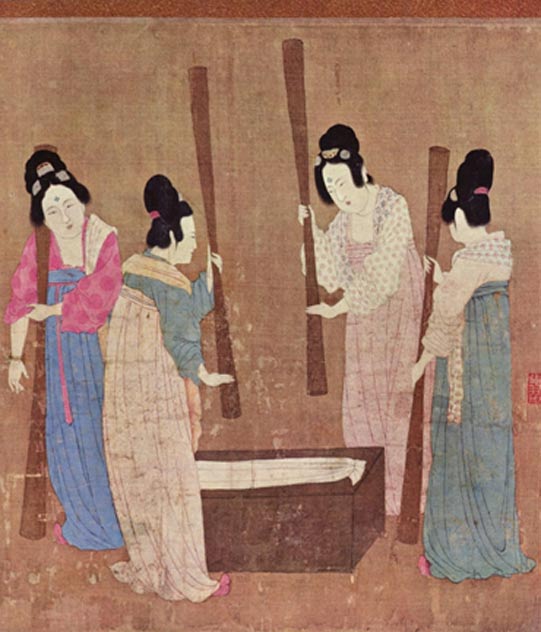
Legends give us poetry, but archaeology gives us dates, and the earth has kept silk’s secrets remarkably well. The craft of silk weaving in China is far older than written history, dating back to the Neolithic age.
The oldest known piece of woven silk fabric dates to around 3630 BCE. It was found at a Yangshao culture site in Qingtaicun, Henan Province, where it had been used to wrap the body of a child. Even older traces of silk, dating back more than 8,500 years, have been identified in the early Neolithic tombs of Jiahu. In 1927, archaeologists working near the Yellow River in Shanxi Province unearthed half of a silkworm cocoon, which was later radiocarbon-dated to somewhere between 2600 and 2300 BCE.
Taken together, these finds tell us that silk has been part of Chinese civilization for well over five thousand years. By the time the legends were first written down, silk was already ancient, already woven into the rhythm of the seasons and the cycle of life and death.
How silk was made: The patient art of sericulture
Silk is not spun by hand or sheared from an animal. It is produced by a small creature with a single purpose, and coaxing usable thread from it required patience, skill, and generations of accumulated knowledge.
The silkworm and the mulberry
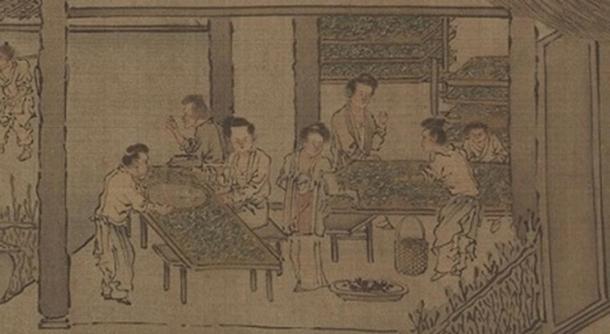
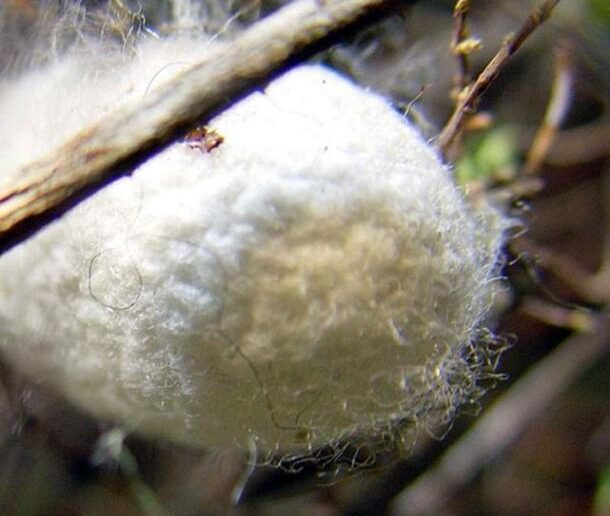
The domesticated silkworm, Bombyx mori, feeds on one thing only: fresh leaves from the mulberry tree (桑, sāng). The worms eat almost constantly, growing plump over several weeks, and then begin to spin. Each silkworm produces a single, continuous filament that it wraps around itself to form a cocoon. Unwound, that one thread can stretch for hundreds of meters, fine as a whisper yet astonishingly strong.
This is why mulberry groves, part of the botanical heritage of China, were tended so carefully across the countryside. No mulberry leaves meant no silkworms, and no silkworms meant no silk.
From cocoon to cloth
Turning cocoons into cloth followed a sequence of careful steps. How was silk made in ancient China? The process, refined over thousands of years, looked something like this:
- Rearing: Silkworms were raised on a steady supply of fresh mulberry leaves until they spun their cocoons.
- Boiling: The cocoons were placed in hot water to soften them. This also stopped the moth from hatching, which would have broken the precious thread.
- Reeling: Workers found the loose end of each cocoon and combined several fine filaments into a single, stronger thread of raw silk.
- Throwing: The threads were twisted together and cleaned of their natural gum to make them smooth and lustrous.
- Weaving: Finally, the prepared thread was woven into fabric on a loom, from plain silk and airy gauze to richly patterned damask and brocade.
Every stage demanded a delicate touch. A cocoon boiled too long or a thread pulled too hard could ruin the work of weeks. The Ming Dynasty encyclopedia Tiangong Kaiwu (天工開物), compiled by the scholar Song Yingxing in 1637, devoted careful attention to these methods, a sign of how seriously the craft was studied and recorded.
China’s thousand-year monopoly
For thousands of years, China alone knew how to make silk, and the country guarded that knowledge fiercely. Silk could be sold and exported, but the living source of it, the silkworm eggs and the secret of their care, was not to leave Chinese soil.
The penalty for breaking this rule was severe. Anyone caught trying to smuggle silkworm eggs, cocoons, or mulberry seeds out of the country could be put to death. Part of what protected the secret was the craft’s complexity, which could not be guessed from the finished cloth. But part of it was deliberate, enforced control.
Even after trade routes opened and silk began flowing westward, China held its monopoly on production for roughly another thousand years. Foreign buyers could drape themselves in Chinese silk, but they could not make it. To the rest of the ancient world, silk seemed to appear as if by magic from a distant, half-mythical land.
Silk beyond clothing: Currency, tax, and art
Silk in ancient China was far more than a luxury fabric. It functioned as money, as a measure of value, and as one of the most prized surfaces for art and writing.
During the Han Dynasty, bolts of plain silk circulated as a form of currency, as reliable as gold and far easier to carry. Soldiers were sometimes paid in silk, and government officials received it as salary. Under the Han and later the Tang Dynasty, the state even collected silk as a form of tax through the “Zuyongdiao” (租庸调) system, which combined grain, labor, and cloth. Unlike grain, which rotted, or coins, which were heavy, silk was light, durable, and valued everywhere.
Color and pattern carried meaning, too. Sumptuary laws reserved certain shades and designs for the elite, and during the Tang and Song Dynasties, the color of an official’s silk robes signaled his exact rank. To read someone’s clothing was to read their place in the world.
Silk was also one of China’s earliest fine surfaces for the written word and the painted image. Long before paper became common, scholars wrote on silk, and artists painted landscapes, poems, and portraits across it. A length of silk could hold a tax payment, a poem, or a masterpiece, depending on whose hands it passed through.

The Silk Road: A thread across the world
The story of silk is also the story of the world’s most famous trade route, the network we now call the Silk Road (丝绸之路, Sīchóu zhī Lù). And it began not with a merchant, but with an explorer sent on a desperate mission. Europeans still had no clear idea of how silk was produced.
Zhang Qian’s long journey
Around 138 BCE, Emperor Wu of Han sent an envoy named Zhang Qian westward to seek allies against the Xiongnu, the nomadic tribes who threatened China’s frontier. It was a dangerous errand, and it went wrong almost at once. Zhang Qian was captured by the Xiongnu and held for more than a decade. He married, raised a family, and bided his time, never abandoning his mission. His ordeal stands among the great survival stories in Chinese history.
When he finally escaped and returned home, he failed to bring back the military alliance the emperor wanted. But he carried something more valuable: detailed knowledge of the lands, peoples, and routes of Central Asia. His reports opened Chinese eyes to a wider world and laid the groundwork for the trade route that would define the next fifteen centuries. The emperor sent him west again around 119 BCE, and the road began to take shape.
What traveled the road
Silk was the route’s signature export, prized in distant markets precisely because it was light, valuable, and impossible to reproduce. In return, caravans carried jade, glass, precious stones, wool, fine horses, and countless other goods back toward China.
But the Silk Road moved more than merchandise. It carried ideas, art, and faith. Buddhism traveled this same road from India into China, brought by monks who journeyed alongside the merchant caravans. To trace the history of silk in China is to trace the moment when two great civilizations, Han China and Rome, first reached toward each other across thousands of miles of desert and mountain. This was a meeting of cultures as much as a meeting of markets, much like the broader story of ancient Chinese inventions that gradually reshaped the wider world.
By the time the route reached the Mediterranean, the cloth had become a sensation. Roman women prized sheer, semi-transparent silk gauze, and the appetite for it sent astonishing quantities of gold flowing eastward, to the dismay of more than one Roman moralist.
How the secret escaped China
No secret lasts forever, and silk’s was carried out of China by a handful of determined people whose stories read like quiet adventures.
One enduring legend tells of a Chinese princess, betrothed to the king of Khotan in Central Asia around the first century CE. Unwilling to live without the fabric she loved, she is said to have hidden silkworm eggs and mulberry seeds in her elaborate headdress, smuggling them past the border guards who would never dare search a princess. Knowledge of sericulture reached Korea and Japan by around 300 CE.
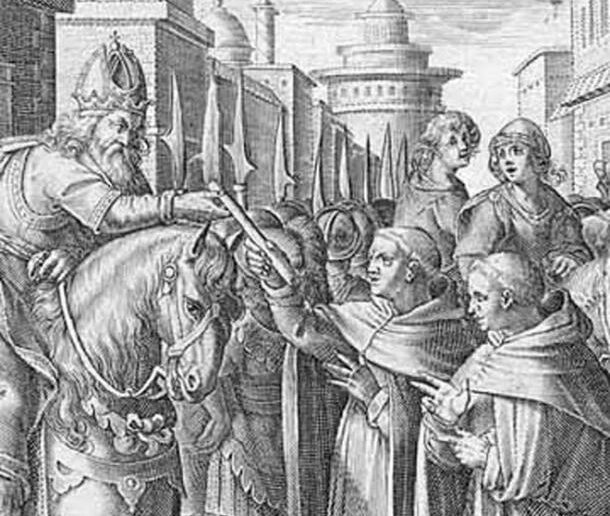
The most famous escape came later. Around 552 CE, according to the historian Procopius, two monks arrived at the court of the Byzantine emperor Justinian I with an extraordinary offer. They had lived in the East, learned the secret of silk, and were willing to retrieve it. They returned with silkworm eggs hidden inside their hollow bamboo walking staffs, smuggled across the breadth of Asia. From those tiny eggs, the Byzantine Empire built its own silk industry, and in time, silk production took root in the Arab world, and later in Italy and France.
China’s monopoly was finally broken. Yet the craft it had perfected over millennia would carry its origins in every thread.
What silk meant: A gift from heaven
To understand silk’s place in Chinese culture, it helps to see it as the ancient Chinese did, not merely as a costly fabric, but as something close to sacred. In folk belief, to wear silk was to be wrapped in protection, prosperity, and good fortune. Its softness and luminous sheen seemed to belong to a higher order of things.
The silkworm itself became a symbol of life’s deepest pattern. Its four stages, egg, larva, cocoon, and emerging moth, were seen to mirror the journey of the human soul: the genesis of life, our time in the body, the stillness of death, and the spirit’s flight onward. It is the same cyclical vision of life and renewal that runs through ancient Chinese cosmology. In this light, the humble silkworm spinning in the dark of its cocoon became a small image of transformation and rebirth.
That symbolism shaped how silk was used at life’s threshold. In some traditions, the elderly were dressed in silk garments before death to help the soul return smoothly to the universe. Words written on silk and then burned were believed to carry messages to the spirit world. Even the mulberry groves that fed the silkworms were treated with reverence, where people might pray for their ancestors or for rain.
This is the dimension of silk’s story that a list of dates can never capture. For the people who first made it, silk was not only woven on a loom. It was woven into their understanding of heaven, earth, and the soul’s passage, a thread connecting the visible world to the unseen. It belongs to the same living current of meaning that artisans embedded in ancient Chinese bronze mirrors, jade, and stone.
Silk today: Five thousand years, still unbroken
The secret that China once guarded with people’s lives now belongs to the world. Silk is woven in many countries, and the science of the silkworm is no mystery. Yet the thread that began, by legend, in an empress’s teacup has never truly been broken.
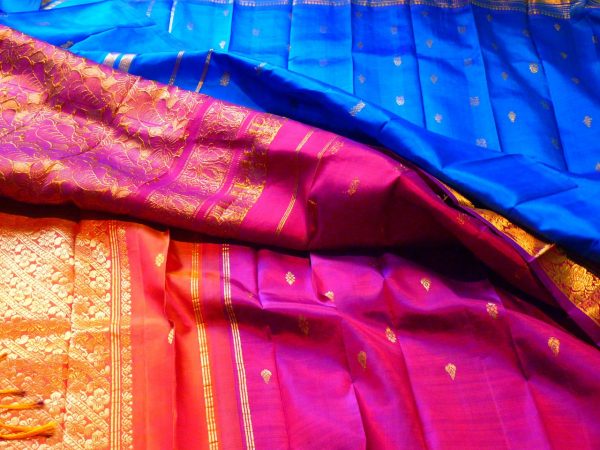
After centuries in which production scattered across the globe, China returned to its place as the world’s largest producer of silk. In the workshops of Suzhou and beyond, artisans still raise silkworms, still reel thread from cocoons softened in warm water, and still weave the lustrous brocades their ancestors would recognize. The qipao, the embroidered panel, the painted silk scroll: these are not relics, but a living craft.
Five thousand years on, the same patient art continues, hands turning cocoon into cloth, season after season, as they have since before history began.
Frequently asked questions about Silk in China
Why was silk so valuable in ancient China?
Silk was light, durable, beautiful, and, for centuries, impossible to reproduce outside China, making it as precious as gold. It served not only as luxury cloth but as currency, tax payment, and a marker of rank, so a single bolt could hold real wealth and status.
How did China keep silk a secret for so long?
China protected the secret of sericulture through both law and complexity. Smuggling silkworm eggs, cocoons, or mulberry seeds out of the country could be punished by death. The craft was also so intricate that the method could not be guessed from the finished cloth alone.
What does silk symbolize in Chinese culture?
In Chinese tradition, silk symbolizes protection, prosperity, longevity, and good fortune. The silkworm’s life cycle, from egg to moth, was also seen as an image of the soul’s journey, which is why silk appeared in burial garments and rituals meant to ease the spirit’s passage.
How did silk spread from China to the West?
Silk first traveled west as trade goods along the Silk Road from around the 2nd century BCE. The knowledge of how to make it was later revealed: a Khotan-bound princess is said to have smuggled silkworm eggs around the 1st century CE, and Byzantine monks carried eggs to Emperor Justinian around 552 CE.
A single thread
The history of silk in China is, in the end, the story of a single thread and all that it could carry. From the legend of Empress Leizu and a cocoon in a cup of tea, to the patient craft of sericulture, to a secret guarded for a thousand years, to the great road that joined the ancient world, silk wove together commerce, art, faith, and meaning.
It carried Chinese cloth to Rome and Roman gold back to China. It carried Buddhism into a new homeland and gave its name to a route that reshaped human history. And for the people who first unwound it, it carried something gentler still: a quiet picture of the soul’s own journey from birth to flight.
The ancient sage Laozi wondered whether humanity truly advances when it trades the natural for the artificial. Silk offers a hopeful answer. Here was a thing of rare beauty, drawn with great patience from one of nature’s smallest creatures and honored as a gift from heaven. Perhaps the lesson of silk is simply this: that beauty, made with care and reverence, can outlast empires, and that a single fragile thread, handled with patience, can connect a whole world.
Follow us on X, Facebook, or Pinterest
