

In the markets of Ningxia, along the great bend of the Yellow River, small crimson berries are spread out to dry in the autumn sun until they glow like tiny lanterns. For more than 2,000 years, Chinese families have folded these bright red goji berries into soups, teas, and bowls of morning congee, trusting them to brighten the eyes, steady the spirit, and lengthen life. Today the same fruit turns up in Western smoothie bowls under the label “superfood,” yet the deepest goji berry benefits are still best understood through the tradition that first treasured them. This is the story of the wolfberry: where it comes from, what traditional Chinese medicine believes it does, what modern research can and cannot confirm, and how to enjoy it wisely.
What are goji berries?
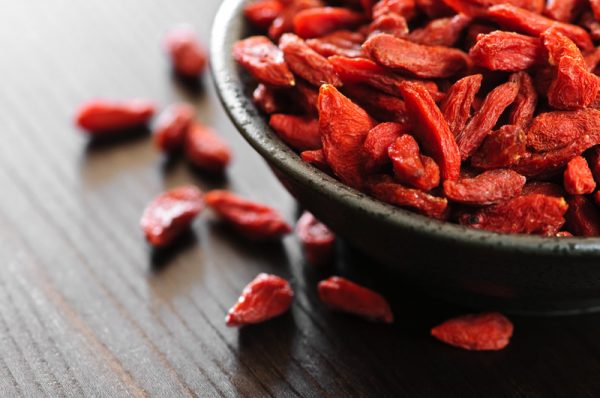
Goji berries, also called wolfberries or Gou Qi Zi (枸杞子, gǒuqǐzǐ), are the small red-orange fruit of Lycium barbarum, a shrub in the nightshade family native to northern China. Prized in traditional Chinese medicine (TCM) for over 2,000 years, they are usually eaten dried, when they taste sweet and gently tangy, with a chewy texture close to a raisin. The name comes from the Chinese gǒuqǐ (枸杞), the plant on which the berries grow. In English, they are known as wolfberries, and in the wellness aisle simply as goji. The shrub grows wild across the Himalayan valleys of China, Tibet, and Mongolia and is most famously cultivated in the Ningxia and Xinjiang regions. Not all goji berries are considered equal. In China, the finest are said to come from Ningxia, where the dry climate and mineral-rich soil along the Yellow River produce plump, deeply colored fruit. It is this regional pride, more than any marketing claim, that first earned the berry its reputation.
An ancient fruit of longevity
Goji’s story in Chinese medicine dates back to the Shen Nong Ben Cao Jing (神农本草经), the oldest surviving Chinese herbal text, compiled roughly 2,000 years ago and attributed to the mythic farmer-emperor Shen Nong. In that classic, the berry is listed among the “superior” herbs: gentle, nourishing, and safe to take over a long life rather than for a single illness. That classification matters. It tells us that goji was never seen as a quick remedy, but as a food for the long journey of aging well.
No account captures that hope more vividly than the legend of Li Ching-Yuen, a Chinese herbalist and martial artist said to have been born in the 1600s and to have lived into the 1930s, a lifespan of 256 years. He is remembered as a seller of longevity herbs, including goji berries, alongside treasures such as ginseng and the revered lingzhi mushroom. His reputed advice for a long life was disarmingly simple: “Keep a quiet heart, sit like a tortoise, walk sprightly like a pigeon, and sleep like a dog.”
It is a beautiful story, and worth holding lightly. Gerontologists regard the 256-year claim as folklore, noting that the number is a lucky multiple of eight and that historians estimate his true age at a still remarkable century or so, based on historical records of his life. The wonder of the tale lies less in the arithmetic than in what it reveals: a culture that looked to humble red berries, calm living, and daily discipline as the real ingredients of longevity.
Goji berries in traditional Chinese medicine
To understand goji berries the way Chinese medicine does, it helps to set aside the vocabulary of vitamins for a moment. In TCM, Gou Qi Zi is described as sweet in flavor and neutral in nature, and it is said to enter the Liver, Kidney, and Lung meridians, the channels through which vital energy is believed to flow. You can explore more traditional Chinese health tips across the tradition, but goji sits close to its heart.
Within this framework, goji is valued above all as a tonic that nourishes liver blood and kidney yin, and that replenishes jing (精), the deep essence that TCM associates with vitality, fertility, and graceful aging. When liver blood and kidney essence run low, the tradition teaches, the body shows this through tired, dry, or blurred eyes, dizziness, lower back weakness, ringing in the ears, and the quiet fatigue of premature aging.
This is where goji’s most famous role appears: “brightening the eyes.” In Chinese medical thought, the liver “opens into the eyes,” so a fruit that nourishes the liver naturally supports vision. Herbalists have long paired goji with chrysanthemum flowers for tired eyes and headaches, and with other calming herbs for restless sleep and vivid dreaming. Presented this way, goji is not a cure but a gentle, everyday act of replenishment, the kind of small, consistent habit that Chinese wellness has always favored over dramatic intervention.
A nutritional snapshot
Part of what makes goji berries so intriguing is that a fruit revered for 2,000 years also holds up under a modern nutrition label. For such a small berry, they are surprisingly nutrient-dense.
A typical serving of dried goji berries offers:
- Fiber to support digestion and steady energy.
- Plant protein, unusual for a dried fruit, including several amino acids.
- Vitamin A and carotenoids (beta-carotene and zeaxanthin) for eye and skin health.
- Vitamin C, iron, zinc, and other trace minerals.
- Lycium barbarum polysaccharides are the signature compounds behind much of goji’s research interest.
Ounce for ounce, goji delivers a broad array of more than 20 vitamins and minerals, along with antioxidants. It is worth remembering that dried berries are also naturally sugary and calorie-dense, so a tablespoon or two is plenty. As with most traditional foods, the goodness lies in modest, regular servings rather than large amounts.
The science-backed benefits of goji berries
Modern research has begun to examine what tradition has long claimed. The evidence is promising in places and preliminary in others, so the honest summary is this: goji berries are a nutritious food with real antioxidant credentials, not a miracle drug. Here are the goji berry benefits that current science most clearly supports, drawn from reviews such as “Seven Goji Benefits Backed by Science” and a broad review of wolfberry in ancient and modern medicine.
- Eye health: Goji berries are among the richest dietary sources of zeaxanthin, a carotenoid that accumulates in the retina and helps filter harmful light. This gives modern weight to the old idea that goji “brightens the eyes,” and researchers are studying its role in protecting against age-related macular degeneration.
- Antioxidant and anti-aging support: The berries are packed with polysaccharides, beta-carotene, and vitamin C. These antioxidants help the body neutralize free radicals, the unstable molecules linked to cellular aging and chronic disease.
- Immune support: The distinctive Lycium barbarum polysaccharides have been studied for their ability to support immune function, echoing goji’s traditional use for building resilience and vitality.
- Liver protection: In line with goji’s classic role as a liver tonic, animal studies suggest that its compounds may help protect liver cells, including by guarding against alcohol-related fatty liver damage. Human evidence is still limited.
- Metabolic and blood sugar interest: Early research has explored goji’s polysaccharides for their effects on blood sugar and cholesterol. The findings are encouraging but not yet conclusive, so goji should complement, never replace, medical care for diabetes.
- Energy, mood, and sleep: Small studies of goji juice have reported improvements in energy, calmness, and sleep quality. These results are modest and preliminary, yet they rhyme with the berry’s long-standing reputation as a gentle restorative.
- Skin health: The same carotenoids that support the eyes, beta-carotene and zeaxanthin, also help protect skin from oxidative stress. Early research suggests goji’s antioxidants may support skin resilience from within, a modern echo of its traditional role in nourishing overall vitality.
A fair reading of the science is that goji berries earn their place as a wholesome, antioxidant-rich food. Where the tradition speaks of nourishing essence and brightening the eyes, the laboratory speaks of polysaccharides and zeaxanthin. The two languages describe the same quiet gift.
How to enjoy goji berries every day
One of the loveliest things about goji berries is how easily they fold into ordinary meals. A typical serving is 1 to 2 tablespoons of dried berries, about 15 to 30 grams, or roughly 10 to 20 berries a day. You need no special preparation to begin.
Here are simple, traditional ways to enjoy them:
- Eat them straight: Dried goji berries make a sweet, chewy snack right from the bag, much like raisins.
- Steep them as tea: Pour hot water over a tablespoon of berries, let them soften for 5 to 10 minutes, then drink the infusion and eat the plumped fruit. Add chrysanthemum flowers for a classic eye-soothing brew, one of the gentlest traditional Chinese teas for calmness.
- Simmer them in congee or soup: A handful tossed into rice porridge, chicken soup, or a herbal broth is the everyday Ningxia way, adding color, sweetness, and nourishment at once.
- Scatter them over breakfast: Stir goji into oatmeal, yogurt, smoothies, or trail mix for an easy antioxidant lift.
- Pair them with red dates: Goji and jujube (red date) steeped together make a warming, blood-nourishing tonic tea long favored by Chinese grandmothers.
Enjoyed this way, goji becomes less a supplement to remember and more a small ritual to savor, one of the no-cost wellness habits that traditional Chinese living has always quietly encouraged. For restless sleepers, goji has traditionally been paired with other calming foods, in the spirit of ancient remedies for calm and balance.

How to choose and store goji berries
When buying goji berries, look for fruit that is deep red, soft, and pliable rather than hard or dull. Berries from Ningxia are the traditional gold standard, though high-quality Himalayan and certified organic options are widely available. Be a little wary of berries that look unnaturally bright or perfectly uniform, which can signal added dyes or heavy sulfur treatment; a natural goji is a rich, slightly muted red.
Store dried goji berries in an airtight container away from heat, light, and moisture, where they will keep for many months. Refrigeration extends their life further and helps preserve their color and nutrients. If your berries ever smell off or clump with moisture, it is time to replace them. With a little care, a single bag will quietly enrich your teas and meals throughout an entire season.
Who should take care?
For most people, goji berries are safe and gentle when eaten in normal food amounts. Still, honesty matters more than enthusiasm here because a few groups genuinely need care. The most important caution involves blood thinners. Documented case reports describe goji interacting with warfarin, an anticoagulant, apparently by slowing the enzyme (CYP2C9) that clears the drug from the body. The result can be elevated bleeding risk, especially at higher doses of goji, as detailed in a case report on warfarin and goji. A separate case has linked goji to toxicity from the heart medication flecainide. If you take warfarin or another anticoagulant, a heart rhythm medication, or drugs for blood pressure or diabetes, speak with your doctor before making goji a daily habit. Pregnant women are also often advised to avoid it, and anyone with a nightshade allergy should be cautious.
None of this makes goji dangerous for the healthy majority. It simply means this ancient food deserves the same respect as any potent herb: enjoy it in sensible amounts and check it against your own health and any medicines you take. When in doubt, a brief conversation with a qualified healthcare provider is the wisest first step.
Common questions about goji berries
How many goji berries should you eat a day?
A typical daily serving is 1 to 2 tablespoons of dried berries, about 15 to 30 grams, or roughly 10 to 20 berries. There is no need to eat large amounts; consistency matters more than quantity.
Are goji berries and wolfberries the same thing?
Yes. “Goji berry” and “wolfberry” are two names for the fruit of Lycium barbarum, known in Chinese as Gou Qi Zi. The word “goji” simply became the popular Western marketing name.
Can you eat goji berries raw?
Yes. Dried goji berries can be eaten straight from the bag, added to food, or softened in hot water. Fresh goji berries are more delicate and less commonly available outside growing regions.
A small red berry, a long tradition
Few foods carry their history as gracefully as the goji berry. From the pages of the Shen Nong Ben Cao Jing to the drying racks of Ningxia to the case files of modern pharmacology, this small red fruit has been asked, again and again, to help people live well and live long. Traditional Chinese medicine values it for nourishing liver blood and kidney essence, and for clear eyesight. Modern science adds its own vocabulary of zeaxanthin, polysaccharides, and antioxidants. And a healthy dose of caution reminds us to enjoy it thoughtfully.
The real lesson of goji berry benefits may be the oldest one of all: that lasting health is built not from a single wonder cure, but from small, faithful habits repeated with care. A handful of berries in your morning tea will not make you 256 years old. But it is a warm, hopeful way to honor the body you have, and to draw a little ancient wisdom into an ordinary day.
Follow us on X, Facebook, or Pinterest
