

A camel caravan crosses the moonlit Taklamakan Desert, its bells ringing softly across the dunes. Bolts of shimmering silk are bound westward; bundles of frankincense and Persian glass are bound east. For more than 1,500 years, this scene played out across some of the harshest terrain on earth, weaving together civilizations that might otherwise have remained strangers.
Most of what we think we know about the Silk Road is either oversimplified or romanticized. The name itself is misleading; it was not one road, and silk was not its most important cargo. What flowed along these routes mattered far more than gold or jade: it was wisdom, faith, and the slow, patient exchange of ideas between East and West.
What was the Silk Road?
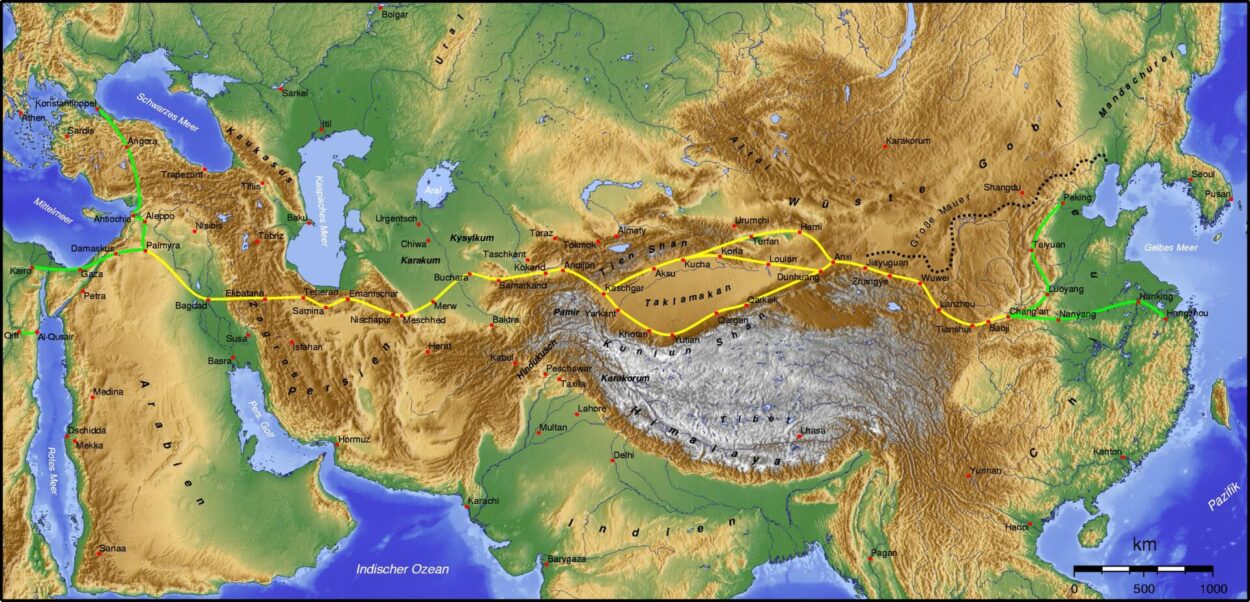
The Silk Road was a vast network of trade routes connecting China to the Mediterranean, active from roughly 130 BCE to 1453 CE. Spanning more than 6,400 kilometers (4,000 miles) overland, it linked the ancient Chinese capital of Chang’an, present-day Xi’an, to imperial Rome, Constantinople, and the great markets of Persia, India, and Central Asia.
Despite the singular name, the Silk Road was never a single highway. It was a web of caravan paths, mountain passes, and oasis stops that shifted with politics, weather, and the rise and fall of empires. Some routes hugged the southern edge of the Taklamakan Desert through Khotan and Kashgar; others traced the northern path through Turfan and the Tian Shan Mountains. Maritime routes through the South China Sea and Indian Ocean later carried much of the same trade. What unified these routes was their cargo, and the most famous of all was Chinese silk — a fabric so prized in Rome that emperors tried, and failed, to ban its import for fear of draining imperial treasuries.
How the Silk Road got its name
Here is a surprise that most history books gloss over: No one called it the Silk Road during its 1,500-year lifetime. The merchants who walked it, the monks who carried sutras across it, the princes who taxed it, none of them used that phrase. The term Silk Road was coined in 1877 by the German geographer Ferdinand von Richthofen, who used the word Seidenstraße in his geographical writings on China. By then, the routes had been silent for more than four centuries.
Modern historians often prefer the plural, Silk Routes, because it more accurately reflects the web of pathways and the diversity of what traveled them. But “Silk Road” has earned its place in the cultural imagination, and for good reason: silk, more than any other commodity, captured how a single Chinese craft transformed the economies of three continents.
Zhang Qian: The envoy who opened the road
Behind every great trade network is a human story. The Silk Road begins in 138 BCE, when a young Han Dynasty official named Zhang Qian (张骞) stepped out of Chang’an at the head of a hundred-man delegation. Emperor Wu had sent him west to find allies among the Yuezhi people against the Xiongnu, the nomadic confederation that menaced China’s northern frontier. He never found his allies in the way the emperor hoped. He found something larger.
Almost immediately, Zhang Qian’s caravan was captured by the Xiongnu. He spent ten years in captivity, taking a wife, raising children, and learning the customs of the steppe, before finally escaping westward. He pressed on across the Pamir Mountains into Bactria and Sogdiana, gathering intelligence on cultures, kingdoms, and economies that no Chinese envoy had ever seen. Thirteen years after he left, he returned home, accompanied by only one of his original companions.
What he brought back was not a military alliance. It was a map of the world beyond China, a vision of distant kingdoms that wanted Chinese silk and that produced goods, horses, fruits, and ideas China had never imagined. Within two decades, the Han court had opened the western corridor for trade. The Silk Road, in everything but name, had been born.
Zhang Qian’s story carries one of those quiet truths that shape Chinese moral memory. A man imprisoned for a decade emerged not bitter but observant. He chose to learn rather than despair, much as the ancient Chinese parables of virtue teach: character is shaped not by what happens to us, but by what we choose to carry from it. The future is not fixed by circumstance. What we see and remember in difficulty becomes the foundation others later stand on.
What was traded along the Silk Road?
Silk gave the route its name, but the cargo manifest of any caravan was extraordinarily diverse. Goods moved in both directions, each civilization eager for what the other produced.
East to West:
- Silk: China’s closely guarded specialty, was worth its weight in gold in Rome
- Porcelain and lacquerware: Refined Chinese crafts unmatched anywhere
- Tea: Though it spread west more slowly than other goods
- Spices: Cinnamon, ginger, and others
- Paper: Invented in Han China, it was transmitted along the route over centuries
- Gunpowder, the compass, and printing technology: Chinese inventions that would eventually reshape global civilization
West to East:
- Gold and silver: Minted into Chinese-style coins for trade
- Glassware: Roman and Persian glass was prized in Han courts
- Wool textiles: Products of Mediterranean and Central Asian shepherds
- Horses: Particularly the famed “heavenly horses” of Ferghana, that Han emperors went to war to acquire
- Grapes, alfalfa, and walnuts: Agricultural imports that transformed Chinese cuisine
- Frankincense and myrrh: Aromatic resins from Arabia are valued in religious and medicinal contexts
- Precious stones: Jade flowed both ways; lapis lazuli came from Afghanistan
Yet the most precious cargo never appeared on any merchant’s ledger. It was knowledge: religious teachings, medical practices, astronomical observations, agricultural techniques, languages, music, and craft skills. These passed quietly from caravan to caravan, monastery to monastery, court to court, slowly weaving the cultures of three continents into something none of them had been before.
The Silkworm Princess of Khotan
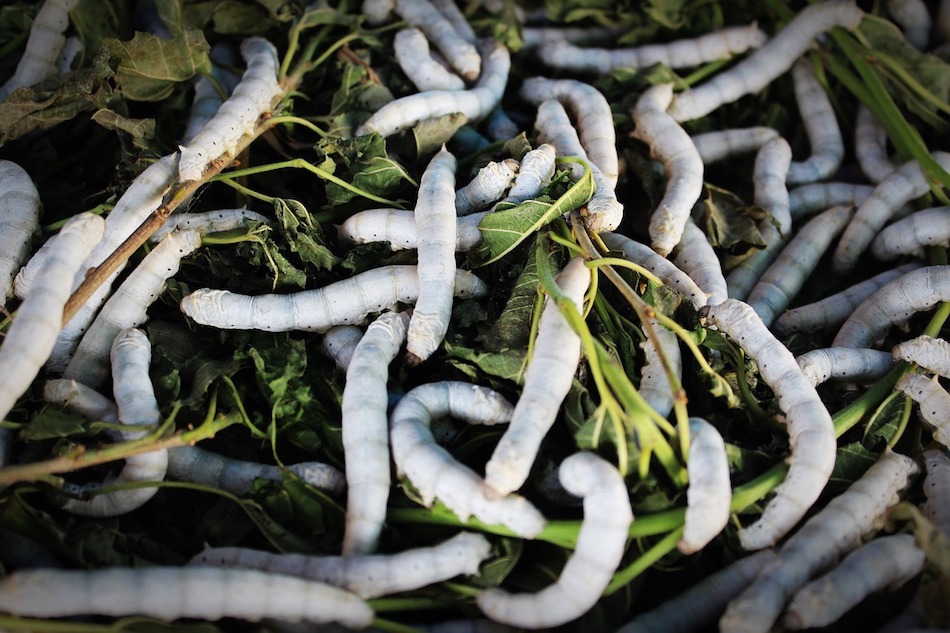
Of all the legends the Silk Road history produced, none is more revealing than the story of how silk itself escaped China. For more than a thousand years, the Chinese imperial court guarded the secret of silk-making with a death penalty. Smuggling silkworm eggs or mulberry seeds across the frontier was treason. The mystery of how thread was spun from a tiny insect’s cocoon was kept inside China’s borders by force of law.
Then, sometime in the early centuries of the first millennium, a Chinese princess was sent west to marry the King of Khotan (于阗), a kingdom in present-day Xinjiang that would endure for more than a thousand years. According to a story preserved by the 7th-century Buddhist monk Xuanzang (玄奘), the king’s envoy whispered to the princess before she set out: Bring with you the silkworm and the mulberry, for in Khotan we have neither.
The princess hid silkworm eggs and mulberry seeds in her elaborate headdress. The Chinese border guards, forbidden by custom from inspecting the headwear of an imperial bride, let her pass. When she arrived in Khotan, she founded a monastery and planted the first mulberry grove west of China. The kingdom became the silk capital of Central Asia, and within centuries the secret had spread to Persia, the Byzantine Empire, and beyond.
A painted wooden panel discovered at the ruins of Dandan-Uiliq, a Buddhist temple site in the Khotan oasis, depicts the princess herself, with an attendant pointing to her crown. The panel is now housed in the British Museum, a quiet witness to a quiet act of cultural transmission.
What makes this legend resonate, fifteen centuries on, is not the smuggling. It is the courage and quietness of the act. A young woman crossing into an unfamiliar country chose, at considerable personal risk, to bring with her something that would benefit both peoples. The Silk Road’s history is full of such hinge moments, small choices that changed the world.
The Silk Road’s most precious cargo: Ideas
If silk gave the route its name, ideas gave it its lasting importance. The single most consequential transfer along the Silk Road was the spread of Buddhism from India to China, and from China to Korea and Japan.
Beginning in the first century CE, Buddhist monks walked east along the routes carrying scriptures, statues, and teaching traditions. They translated sutras into Chinese, adapted iconography to Chinese aesthetics, and built monasteries at oasis cities along the way. The cave temples at Dunhuang, with their thousands of painted Buddhas spanning nearly a millennium, are among the most spectacular monuments to this transmission. By the Tang Dynasty, China had become a Buddhist civilization in dialogue with its older Confucian and Daoist traditions.
Buddhism was not the only faith to travel the road. Nestorian Christianity reached the Tang capital of Chang’an in the seventh century. Manichaeism, Zoroastrianism, and later Islam all spread eastward along the same routes. Each tradition met, debated, and sometimes blended with the others.
Technology moved alongside religion. Paper-making, invented in Han China around 105 CE, spread west over the following centuries, first to the Islamic world after the Battle of Talas in 751 CE, then to Europe by the twelfth century. Chinese astronomy informed Persian observatories; Persian mathematics traveled to Tang scholars. Music, dance, and visual styles crossed and recrossed borders until distinctly local traditions everywhere bore traces of distant cultures.
Even classical Chinese cosmology found its way west. The diagrams and divinatory traditions explored in ancient Chinese cosmology traveled with merchants and monks who saw the world as a system of relationships rather than separate parts, a view that would, in time, shape conversations between Eastern and Western philosophy.
This is the most enduring lesson of the Silk Road: civilizations grow when they exchange, and stagnate when they close. The wisdom of one people, when met with the wisdom of another, does not weaken. It compounds.
Marco Polo and the Mongol revival
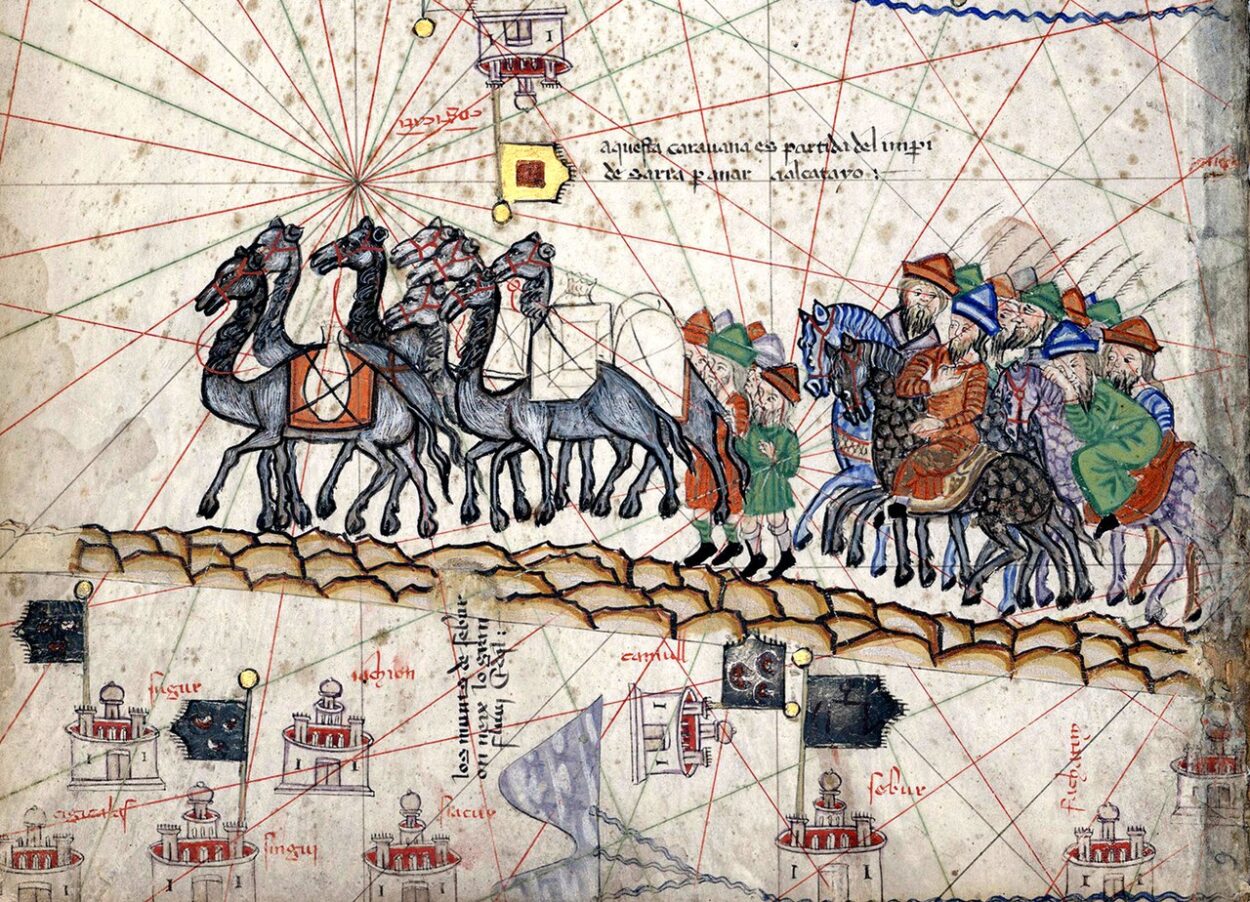
By the time Marco Polo stepped into history in the late 13th century, the Silk Road had already known a thousand years of glory and decline. What made his journey possible was a startling political fact: the Mongol Empire, founded by Genghis Khan, had unified almost the entire length of the route under a single law. Historians call this period Pax Mongolica, the Mongol Peace.
Polo set out from Venice in 1271 with his father and uncle. He was 17. Twenty-four years later, in 1295, he returned, having served at the court of Kublai Khan and traveled the provinces of China that no European had documented before. His account of those years, The Travels of Marco Polo, electrified medieval Europe. It introduced readers to coal, paper money, postal relays, and a Chinese civilization more sophisticated than anything Europe could match.
The book influenced Christopher Columbus, who carried a copy on his 1492 voyage and made notes in its margins. The Silk Road, in this sense, ended only by being absorbed into a larger story of global exploration. (For a thorough overview of Polo’s era and the broader trade network, Britannica’s Silk Road entry offers excellent context.)
Why the Silk Road declined
No single event closed the Silk Road. It frayed slowly, and then suddenly. The Black Death, which devastated Europe between 1347 and 1351, almost certainly traveled along the routes themselves. Plague-bearing fleas moved with caravans from the Central Asian steppes into the Black Sea ports, and from there into the Mediterranean. The trade that had connected the world also became a vector for catastrophe.
The political collapse of the Mongol Empire in the 14th century removed the safety the routes had enjoyed under Pax Mongolica. Local conflicts and tariffs returned. Then, in 1453 CE, the Ottoman conquest of Constantinople closed the western terminus. Although the Ottomans did not entirely seal the routes, the high taxes and political tensions that followed pushed European traders to seek alternatives.
They found them at sea. Vasco da Gama reached India by sea in 1498. Columbus had crossed the Atlantic six years earlier, seeking an ocean route to the same Asia Marco Polo had described. By the 16th century, maritime trade had largely replaced the great overland caravans. The Silk Road did not vanish. It transformed. Its routes survived as regional trade corridors and pilgrimage paths. Its languages, cuisines, and architectures survived in the cities along its length. And the cultural connections it forged between East and West, the deep ones, made of ideas rather than goods, never reversed.
What the Silk Road teaches us today
We live in a more connected world than any Silk Road merchant could have imagined. A monk in 12th-century Dunhuang would have envied the speed at which a sutra now travels from Beijing to Boston. And yet the deeper lessons of the route still wait for us.
The first lesson is that the most valuable cargo is rarely the one you set out to carry. The merchants of Chang’an packed their camels with silk; what passed back to them across the centuries was paper, gunpowder, Buddhist philosophy, and a transformed cuisine. We do not always know, in the moment of exchange, what we are giving and what we are receiving.
The second is that civilizations are made by openness. The Tang Dynasty, perhaps the most cosmopolitan period in Chinese culture and traditions, was the era of the most active Silk Road traffic. In the 8th century, Chang’an was home to merchants, monks, and scholars from a dozen nations. Many of the most enduring Tang Dynasty stories of loyalty and humility emerged from precisely this confluence of cultures.
The third lesson, perhaps the most important for our own moment, is that the work of cultural exchange is patient work. It is the work of envoys who were held captive for 10 years and are still observing. It is the work of princesses crossing borders with seeds in their headdresses. It is the work of monks copying sutras line by line in cold cave temples. The Silk Road was not built by emperors. It was built by ordinary people who chose, day by day, to carry something from one place to another and trust that it would matter.
A long, slow conversation
For 1,500 years, a network of paths through some of the most unforgiving land on earth carried the goods, ideas, faiths, and stories of the ancient world from one civilization to another. The Silk Road’s history is, in the end, the history of human curiosity and patience, a long, slow conversation between East and West that left both transformed.
The princess in her headdress, the envoy in his captivity, the monk with his scrolls, the Venetian boy in Kublai Khan’s court, each carried something more than goods. They carried the simple, durable belief that what one culture has to offer is worth the long walk to share. That belief is still ours to carry. The Silk Road did not end in 1453. It changed shape. The routes today run through fiber-optic cables and shipping lanes, but the work is the same: to keep open the channels through which wisdom travels.
Follow us on X, Facebook, or Pinterest
