

On the eve of the Lunar New Year, a quiet ritual unfolds across China. The old, faded paper comes down. Fresh red couplets go up around the doorframe. And onto the two halves of the front gate, families paste a pair of fierce, armored warriors, swords and iron batons in hand, eyes fixed on the darkness beyond the threshold. Their watch begins again, as it has for more than a thousand years.
These guardians are the Chinese door gods, known in Mandarin as menshen (门神). For centuries, ordinary households have trusted these painted soldiers to keep evil spirits out and invite peace and good fortune in. But behind the bright woodblock prints lies something richer than decoration: a tale of an emperor’s sleepless nights, a dragon’s fatal pride, and two flesh-and-blood generals so loyal that a grateful people turned them into gods.
This is the full story of the Chinese door gods, the legend that made them, the real men behind the images, and the living art that keeps them on guard today.
What are Chinese door gods?
A door god (门神, menshen) is a guardian deity whose image is pasted in pairs on the doors of homes, temples, shops, and palaces in Chinese folk tradition. Their purpose is twofold: to frighten away evil spirits, demons, and misfortune, and to welcome blessings, safety, and prosperity into the home. They stand watch at the threshold, the vulnerable boundary between the protected world inside and the unknown outside.
The threshold has always mattered in Chinese culture. A doorway is where the household meets the world, where good luck enters, and where harm might slip through. Guarding it with a powerful protector is one of the oldest human instincts, and in China, it became one of the most beloved customs of all. To explore this heritage further, Nspirement’s coverage of Chinese culture and tradition traces how everyday symbols carry deep meaning.
Meet the guardians: Qin Shubao and Yuchi Jingde
When most people picture the Chinese door gods, they are picturing two specific warriors. To the right of the gate stands Qin Shubao (秦叔宝), also known as Qin Qiong, a general with a pale, composed face who usually holds a sword. On the left stands Yuchi Jingde (尉迟敬德), also called Yuchi Gong, darker of complexion and fiercer of expression, gripping a pair of iron batons.
Why two generals, and why these two? Because the most famous door gods were not invented solely from myth. They were real commanders who served the second emperor of the Tang Dynasty (618 to 907 CE), and they earned their place at the gate through a story that ordinary families could not forget. To understand how two soldiers became the most painted guardians in China, we have to begin with a troubled emperor and the spirit that would not let him sleep.
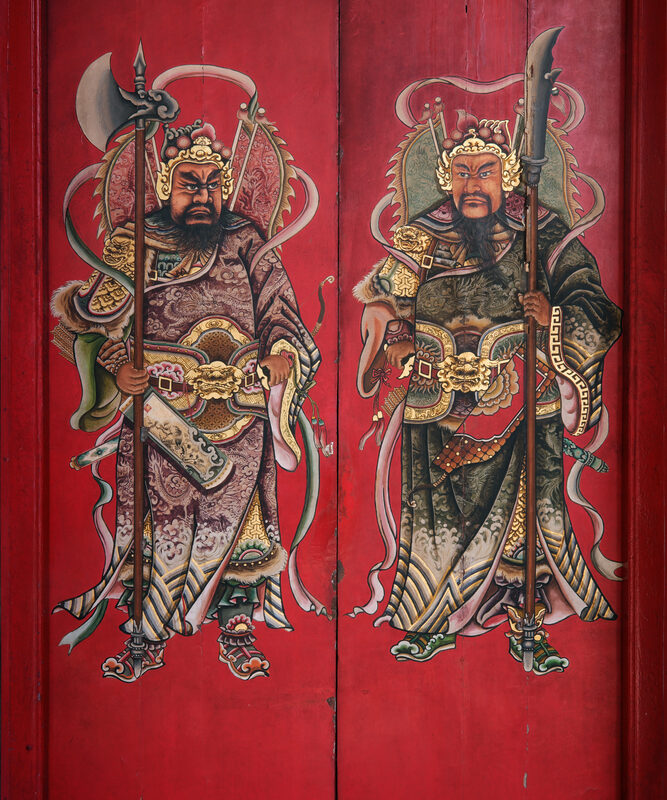
The legend: An emperor, the Dragon King, and a sleepless palace
The richest version of the door god legend comes from the great Ming Dynasty novel Journey to the West (西游记), written by Wu Cheng’en. It weaves together a broken promise, a beheading in a dream, and a haunting that no palace wall could keep out.
The Dragon King’s fatal bet
The trouble began with pride. The Dragon King of the Jing River, master of the local rains, fell into a wager with a clever fortune-teller who claimed he could predict the next day’s weather. When the Dragon King learned that the fortune-teller’s forecast matched a decree handed down by the Jade Emperor in Heaven, he grew determined to prove the prediction wrong. He changed the hour and the amount of the rainfall, just enough to win the bet.
It was a small act of vanity with an enormous price. By altering the rain, the Dragon King had defied a heavenly command, and for that crime, the courts of Heaven sentenced him to death.
A promise broken in a dream
The executioner was to be Wei Zheng (魏征), a senior minister in the court of Emperor Taizong of Tang. Desperate, the Dragon King appeared to the emperor in a dream and begged him for help. Moved to pity, Taizong agreed to keep his minister occupied so that the execution could never be carried out.
The next day, the emperor invited Wei Zheng to sit with him over a long game of weiqi (go). The plan seemed to be working. As the afternoon stretched on, the minister nodded off at the board. Yet in his sleep, Wei Zheng’s spirit rose to carry out Heaven’s sentence, and he beheaded the Dragon King in the dream. The emperor had kept his minister in the room, but he could not keep him from his duty.
The haunting and the two generals
The Dragon King’s ghost blamed Taizong for the broken promise. Night after night, the vengeful spirit came to the palace, hurling curses and filling the emperor’s chambers with dread until he could no longer rest. The court was at a loss until two of Taizong’s most trusted generals stepped forward.
Qin Shubao and Yuchi Jingde volunteered to stand guard outside the imperial bedchamber, fully armored, through the long night. The spirit did not dare approach. For the first time in many nights, the emperor slept in peace.
But Taizong could not ask his finest commanders to lose their sleep forever. So he summoned court artists to paint the two generals in full martial splendor and had the portraits pasted on the palace doors. The painted guardians proved as effective as the living men. The haunting ceased, and a custom was born. (A simpler version of the tale skips the dragon entirely and says only that the emperor was tormented by nightmares, which the two generals drove away.)

From blacksmith to god: The real Yuchi Jingde
Strip away the dragon and the dream, and a real man remains, one whose life was every bit as remarkable as the legend. Yuchi Jingde (585 to 658 CE) was born in Shuo Province, of Xianbei heritage, and in his youth, he worked as a humble blacksmith at the forge. To this day, blacksmiths across China honor him as their patron deity, a quiet reminder that the guardian on the door once hammered iron for a living.
His talent on the battlefield lifted him far from the forge. He became one of the most formidable generals serving Li Shimin, the prince who would become Emperor Taizong. Yet his loyalty nearly cost him his life. Rival princes, jealous of Li Shimin’s circle, slandered Yuchi at court and brought him close to execution. Only Li Shimin’s personal intervention saved him.
That loyalty was repaid at the Xuanwu Gate in 626 CE, during the violent palace showdown that decided the Tang succession. Yuchi played a decisive role in securing Li Shimin’s victory. Just as telling, in the aftermath, he urged mercy, counseling that defeated soldiers be spared rather than slaughtered, advice that helped calm a fractured empire. For his service, he was made Duke of Wu.
It is this blend of courage and conscience that makes Yuchi such a fitting guardian. The door gods are not merely frightening. They embody the virtues a household most wants watching over it: loyalty, steadiness, and the strength to protect without cruelty. Nspirement’s retelling of Tang Dynasty stories of loyalty explores the same values that turned soldiers into symbols.
Older than the Tang: Peach trees, Shenshu, and Yulei
The two generals were not the first to guard Chinese doors. The custom is far older than the Tang, reaching back into the earliest layers of Chinese ritual. Sacrifices to a door spirit are recorded as far back as the classic Book of Rites, and by the Han Dynasty, the doorway already had its appointed protectors.
Those first guardians were two divine brothers named Shenshu and Yulei (神荼 and 郁垒). According to ancient myth, they stood watch over a ghost gate on a sacred mountain, beneath an enormous peach tree whose branches spread across a vast distance. Through that gate passed the spirits of the world, and the two brothers inspected each one. Any demon that had done harm to human beings was bound with a rope of reeds and thrown to a waiting tiger.
To borrow the brothers’ protection, people carved or painted their names and images on small peachwood boards and hung them by their doors. Peachwood itself was believed to repel evil, and these “peach charms” (桃符) were the direct ancestors of the door gods and the red New Year couplets we know today. The peach was no random choice; in Chinese tradition it is a potent emblem of vitality and protection, a thread Nspirement follows in its look at the symbolism of plants in Chinese culture.
Over time, the dashing Tang generals captured the popular imagination and largely supplanted Shenshu and Yulei at the nation’s doors. But the older guardians were never truly forgotten, and in some regions, they still keep their watch.
Martial gods, civil gods, and the demon-queller Zhong Kui
Not all Chinese door gods are warriors. Over the centuries, the tradition branched into two broad families, each serving a different hope.
- Martial door gods (武门神) are the armored generals, Qin Shubao, Yuchi Jingde, and other deified commanders. Fierce and weapon-bearing, their task is to frighten away evil spirits and shield the home from harm.
- Civil door gods (文门神) are gentler figures, often robed scholars or officials. Rather than repelling danger, they invite blessings, longevity, and the good fortune of success and high office.
A third guardian deserves his own mention. Zhong Kui (钟馗), the famous demon-queller of Chinese folklore, is often pasted on a single door rather than in a pair. Depicted with a wild beard, a scholar-official’s hat, and a blazing glare, Zhong Kui is the great ghost-catcher, and his image alone was thought to send malevolent spirits fleeing. Where double doors call for the two generals, a single door frequently calls for him.
This variety is part of the tradition’s quiet genius. A family could choose the protector that matched its deepest wish, whether that was safety from harm, blessings for the year ahead, or both. The fierce general and the smiling scholar guarded the same threshold, each in his own way.
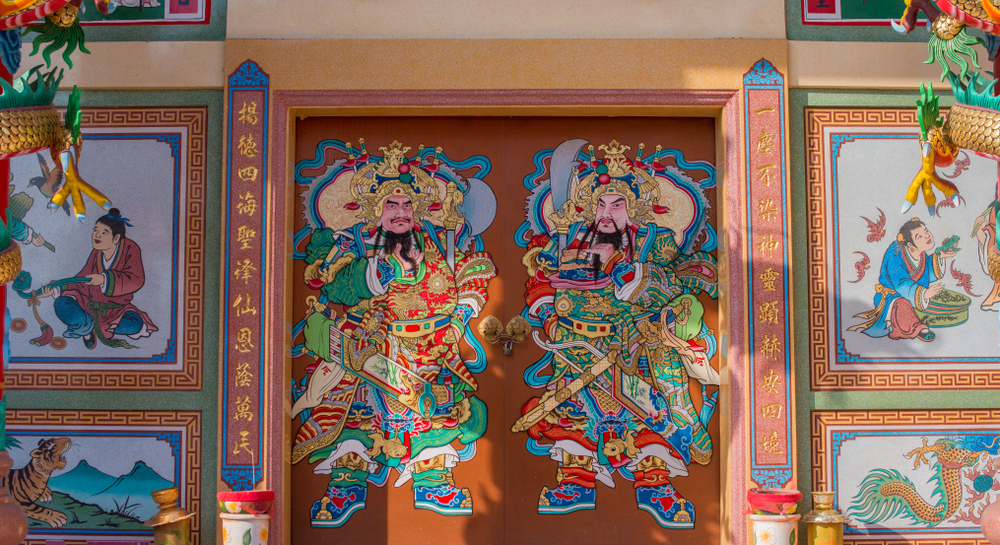
Painted protection: Door gods as new year folk art
The door gods did more than guard homes. They gave birth to one of China’s most cherished folk arts. The colorful woodblock prints known as nianhua (年画), or New Year pictures, are widely believed to date back to the printing of door gods in the Tang Dynasty. What began as protective images became a flourishing craft of color, line, and storytelling pasted up across the country each Spring Festival.
Two towns became especially renowned for the art, giving rise to the saying “willow in the north and peach in the south.” In the north, the workshops of Yangliuqing (杨柳青) near Tianjin perfected a half-printed, half-painted style, carving delicate outlines in wood and then finishing the faces by hand. In the south, Taohuawu in Jiangsu rose to equal fame. Farther inland, the workshops of Tantou in Hunan still produce door gods through a painstaking process of more than twenty steps, from bamboo papermaking and pearwood carving to round after round of printing and hand-painting. You can see fine examples of these guardian prints documented in museum collections such as the Museum of Chinese Australian History.
This is folk art with a heartbeat. Chinese New Year woodblock printing has been recognized as part of the world’s intangible cultural heritage, and, as the journalist at Sixth Tone has captured, the tradition still lives in the hands of aging masters and in the doorways of villages that renew their guardians every year. Each New Year, the old prints come down, and bright new ones go up, and the same loyal faces begin their watch once more, just as families do for other cherished Chinese New Year customs.
How to display Chinese door gods
For all their mythic weight, the door gods come with a few simple, practical rules, and getting them right is part of the custom.
- Hang them in pairs on a double door: Each general takes one leaf of the gate, one on the left and one on the right.
- Mind the placement: By tradition, Yuchi Jingde, the darker, baton-bearing general, takes the left-hand door, while Qin Shubao, the pale general with the sword, takes the right.
- Make sure they face each other: This is the rule most often broken. The two guardians should look inward, toward one another, never back to back. If they are reversed so that they face away, the gap between them is said to let evil slip through, and good fortune leak out.
- Renew them each year: As the lunar year ends, families clean the home, take down the weathered prints, and paste up fresh guardians to welcome the new year. The renewal is part of the blessing, a yearly act tied to the wider customs explored in Nspirement’s coverage of Chinese festival traditions.
These small acts of care turn a printed image into a living relationship. The guardians are not hung once and forgotten; they are greeted, retired, and welcomed back, year after year.
Conclusion: The faithful watch at the gate
The Chinese door gods carry an unusual richness. They are at once a gripping legend of a dragon and a haunted emperor, a true account of a blacksmith who rose to become a duke, an ancient memory of two brothers beneath a peach tree, and a vibrant folk art renewed every Lunar New Year. Few traditions hold so much in a single pair of images.
What stays with you, in the end, is the choice a culture made. When Chinese families looked for a guardian to watch over their most precious space, the threshold of home, they did not reach for a monster. They chose the likeness of loyal, courageous, merciful men. The door gods endure because they protect, yes, but also because they remind us of the kind of strength worth honoring: strength that stands watch through the night, asks for nothing, and chooses mercy when it could choose cruelty.
So the next time you pass a red Chinese doorway and meet the steady gaze of those two painted warriors, you will know who is looking back. They are the door gods, faithful as ever, still guarding the gate.
Follow us on X, Facebook, or Pinterest
