

Picture the imperial court at dawn. Rows of officials stand in silence, each one crowned with a remarkable hat: a flat black cap from which two stiff flaps stretch sideways, sometimes nearly a meter from tip to tip. To modern eyes, these Song Dynasty hats look almost comical, as if each minister had balanced a small set of wings on his head. Yet for more than three centuries, no respectable official would appear before the emperor without one.
Why would anyone design a hat with such improbably long wings? The most famous answer is a clever little story about a suspicious emperor and his whispering ministers. It has been told and retold for a thousand years, and it is almost certainly not true.
In this article, we will follow the legend of the winged hat and discover what historians actually believe. We will also trace how these striking Song Dynasty hats came to be, and what they quietly reveal about the elegant, deeply ordered world of the Chinese court.
The famous legend behind the Song Dynasty hats
The story begins with Zhao Kuangyin (赵匡胤), the general who founded the Song Dynasty in 960 CE and reigned as Emperor Taizu (宋太祖). He had taken the throne in a turbulent age, and like many founders, he watched his ministers closely.
According to the legend, Song Dynasty officials wore hats with long wings because the emperor wanted to stop them from gossiping. Annoyed by ministers who leaned together to murmur and scheme during morning court, he is said to have ordered long, stiff flaps added to their caps. With a meter of rigid wing on either side, no one could lean close to a neighbor without a clumsy clatter of headgear, and so the whispering stopped.
It is easy to see why the tale has endured. It is tidy, a little funny, and flattering to a famously shrewd ruler. It turns a strange fashion into a stroke of political genius, the kind of “clever solution” that begs to be repeated at a dinner table. Stories like this one, where a wise figure outwits a human weakness, belong to a long tradition of Chinese court anecdotes. They echo the lessons hidden in Tang Dynasty stories of loyalty and humility. There is just one problem. The historians who study these things are not convinced.
What is the zhanjiao futou?
The zhanjiao futou (展角幞头, zhanjiao futou) is the rigid black court hat worn by Song Dynasty officials, featuring two long, flat wings that projected from either side. Its name means roughly “straight-horn head-wrap.” Built over a frame of iron wire and thin bamboo strips, its wings could stretch from 30 centimeters to nearly a meter across. It was reserved for the most formal occasions.
These were not everyday hats. The zhanjiao futou was formal attire, worn for court audiences, state banquets, and official ceremonies, and later set aside for ordinary life. A minister walking through a doorway or climbing into a sedan chair in one of these would have found the wings hopelessly impractical. That tells us something important: this was ceremonial attire, designed for standing in dignified rows, not for getting things done.
The hat was stiff, straight, and unmistakable. It is also how we still recognize a Song official in surviving court paintings: the winged silhouette announces his office before we notice anything else about him. When such a hat appeared, everyone knew at once that they stood in the presence of officialdom at its most formal.
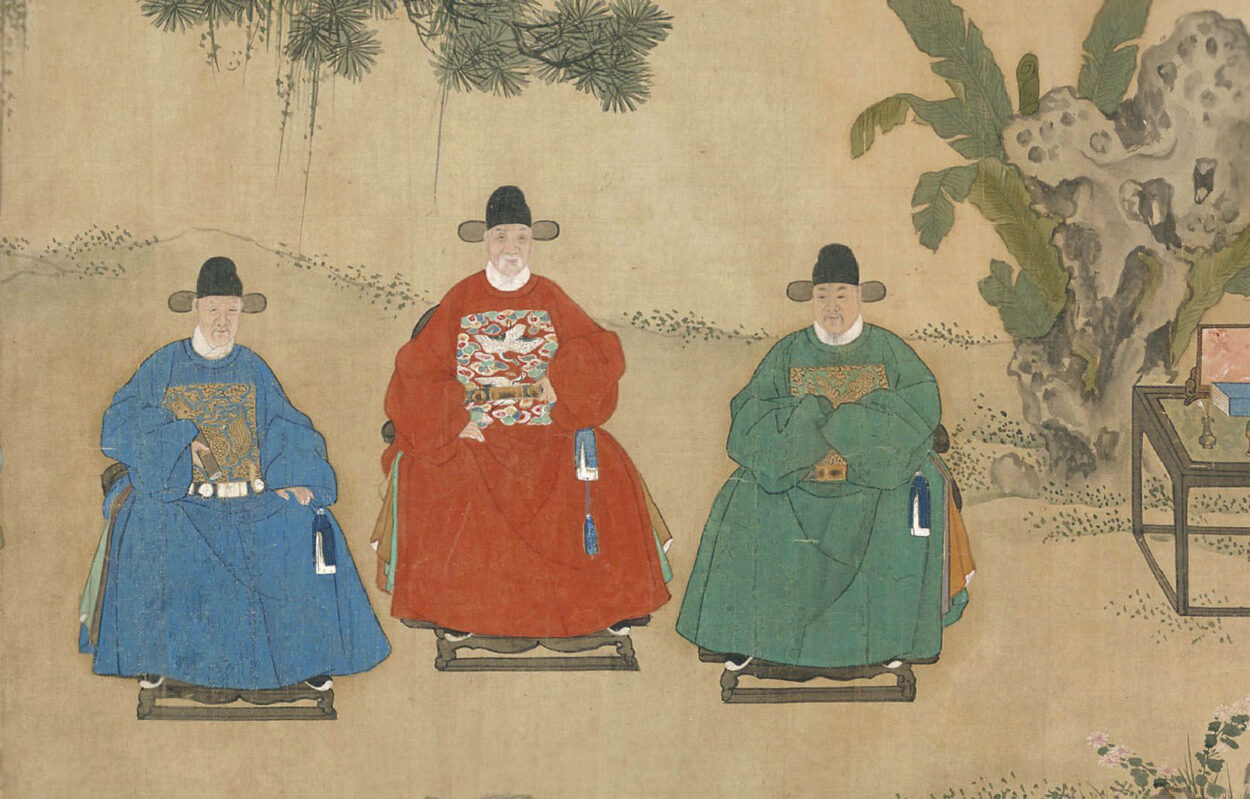
Did the wings on Song Dynasty hats really stop the whispering?
Here is where the beloved story begins to unravel. Modern scholars regard the anti-whispering explanation as folklore rather than fact, an example of a charming idea that grew more certain each time it was retold.
The art historian Jin Xu, now at Columbia University, has called the “social distancing” function of these hats an unfounded speculation. As an Atlas Obscura feature on the futou explains, the rumor can be traced to a 13th-century scholar named Yu Yan, who floated the idea in his writings. Tellingly, nothing from Emperor Taizu’s own reign records such a decree. It surfaces only generations later. Yu Yan lived centuries after the hat first appeared, and he is not remembered for careful scholarship. What he offered was a guess, not an eyewitness account, yet the guess was so satisfying that it hardened into “history.”
This is a familiar pattern. A practice whose original purpose has faded invites a tidy explanation, and the tidiest one wins, true or not. It is worth pausing here, because Nspirement’s readers know that respecting a tradition means looking at it honestly. The legend is delightful and is now part of the hat’s story. But the better question is not whether the wings silenced gossip. It is why the Song court wanted such hats in the first place.
A hat that showed your rank
So why did Chinese officials wear hats with long wings? Not to silence their gossip, modern scholars say, but to display their place in the world. The likeliest answer is far older than intrigue and far more human: the Song Dynasty hat was about status.
In the Song court, the shape and length of a futou’s wings appear to have signaled the wearer’s place in the hierarchy. The longest and most imposing were reserved for the highest officials and the emperor himself. Headwear was never merely decorative in imperial China. As part of the broader hanfu tradition of court dress, every garment signaled rank, a visible language as legible to onlookers as a uniform, placing each person within the vast machinery of the bureaucracy.
Different styles marked different roles. Senior officials wore the straight, horizontal wings we picture today. Servants, runners, scholars, and examination graduates wore their own variants, with feet that curved, crossed, or pointed in distinct directions. To read a room of futou was to read the whole social order at a glance.
This mattered enormously in the Song, an age that prized learning as the road to power. More than any dynasty before it, the Song built its government around the civil service examinations. Its offices are filled with scholar-officials who rose by study and merit rather than by birth alone. In a court of self-made men, the visible marks of rank carried real weight. A man’s hat, robe, and belt announced exactly how far his learning and his service had carried him.
Seen this way, the winged hat belongs beside the other great symbols of imperial authority, the carved dragons, the colored robes, and the Chinese imperial symbolism of the Nine-Dragon Wall. It also reflects the court’s love of ceremony and visible respect, a spirit captured by bowing in Chinese tradition. The hat did not need to stop a whisper to do its work. Its real task was to make the order of things beautiful and unmistakable.

From tang cloth to song wings: How the futou evolved
The winged cap did not appear overnight. It was the late chapter of a long, quiet evolution that began centuries earlier.
In the Tang Dynasty, the futou was not a stiff hat at all. It began as a soft black cloth, a square of fabric with four corners that a man wrapped over his topknot and tied at the back. Two of the corners hung down behind like ribbons. An early Tang minister named Ma Zhou is credited with refining the wrap, adding shape and structure so it sat more handsomely on the head. In this soft form, the futou belonged to nearly everyone, worn by emperors, scholars, and commoners alike, a near-universal head covering of the age.
Over the generations, those soft hanging ribbons slowly stiffened. By the late Tang and the Five Dynasties period, they had begun to project outward as firm “feet” rather than dangling cloth. The Song Dynasty took the final step, turning the wrapped scarf into a pre-shaped, rigid hat, complete on its frame and ready to wear. Freed from the limits of knotted fabric, the wings could now be made long, flat, and dramatic. The cap grew more refined and expressive across the dynasties, much like ancient Chinese art and symbolism in bronze mirrors.
What had once been a practical head covering became a precise instrument of formality. The same object that a Tang traveler tied in a hurry, a Song minister wore as a badge of office.
The hat that outlived the Song Dynasty: The wushamao
The story does not end in 1279 when the Song fell. The futou had one more transformation ahead of it.
Under the Ming Dynasty, the winged court cap evolved into the wushamao (乌纱帽, “black gauze hat”), the “black gauze hat” worn by officials of the new era. The Ming version traded the Song’s dramatic meter-long wings for two short, rounded flaps, a reminder that the design never stopped changing. So closely was this hat tied to government service that its name became a kind of shorthand for office itself. In Chinese, to “keep your wushamao” came to mean keeping your post, and to “lose your wushamao” meant losing it, a dismissal from duty. The hat had become the job.
This is why, when we picture a traditional Chinese official, whether in a museum portrait or a popular costume drama, the winged black cap so often appears. It is one of the most enduring images in the long history of China’s imperial era, instantly recognizable worldwide. Centuries after the last emperor laid one down, these Song Dynasty hats still crown our idea of the scholar-official. A small piece of cloth and a piece of bamboo came to stand for an entire civilization’s vision of order and learning.
What the winged hat really tells us
So why did Song Dynasty hats have long wings? Not, it seems, to muffle court gossip, however much we love the tale. The wings were almost certainly a mark of rank and a flourish of ceremony, the visible grammar of a court that prized order, dignity, and respect. The famous whispering story, born from a 13th-century scholar’s guess, tells us less about the Song than about ourselves and our hunger for a clever explanation.
And yet the legend is worth keeping, not as fact but as folklore. It survives because it captures something true about human nature: that power watches, that people murmur, and that even a hat can be enlisted in the long human effort to keep things in their proper place. The richer truth, that these hats wove rank, history, and beauty into a single silhouette, only deepens our wonder at the world that made them.
Follow us on X, Facebook, or Pinterest
