
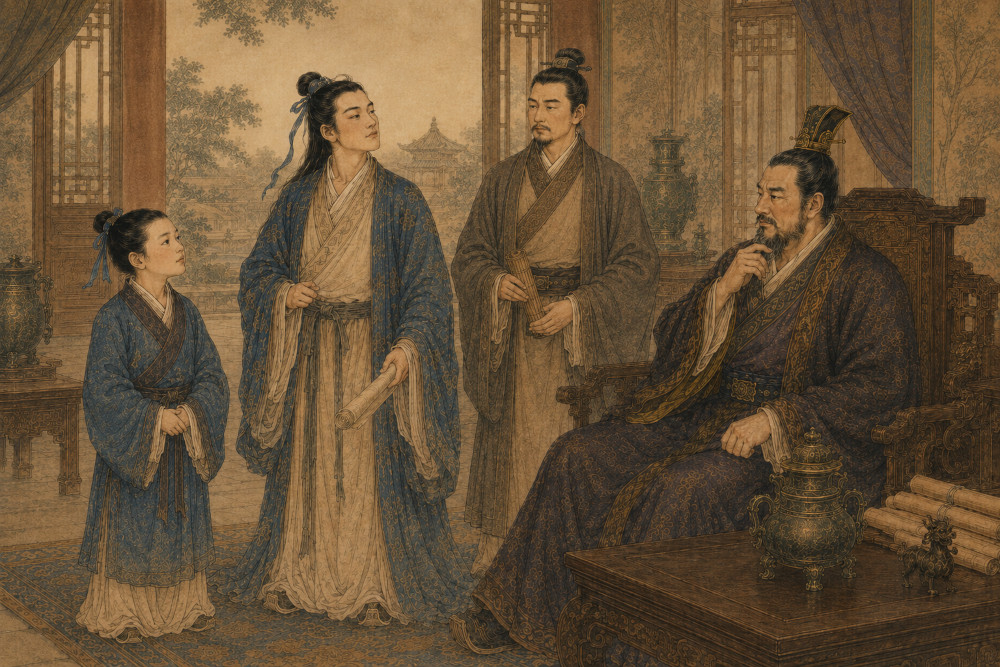
Cao Cao is remembered as one of the most formidable military strategists and statesmen of the Three Kingdoms era. Historical sources also record that he had 25 sons.
With so many children, how did he decide which ones deserved greater responsibility?
In his “Order Concerning My Sons,” Cao Cao explained his approach plainly: while his children were young, he loved them equally. As they grew older, however, he judged them by their abilities and used those who proved capable.
This was more than an ideal. Cao Cao’s treatment of several of his sons shows he was willing to look beyond affection and recognize that different talents suited different responsibilities.
Cao Chong: Wisdom guided by compassion
Among Cao Cao’s sons, Cao Chong became famous as a child prodigy.
Generations of Chinese children have heard the story of “Cao Chong Weighs an Elephant,” in which the young boy devised an ingenious method for determining the enormous animal’s weight.
Yet Cao Chong was remembered not only for his intelligence, but also for his kindness.
According to historical accounts, a low-ranking official responsible for a warehouse once discovered that rats had gnawed Cao Cao’s saddle. The man was terrified, fearing severe punishment.
When Cao Chong learned what had happened, he told the official to wait a few days before reporting the damage.
Cao Chong then used a knife to cut holes in his own clothing so that they appeared to have been chewed by rats. When he later went to see his father, he deliberately looked troubled.
Cao Cao asked what was wrong.
“People say that when rats chew someone’s clothing, something bad will happen,” Cao Chong replied. “Now my clothes have been damaged by rats, so I am worried.”
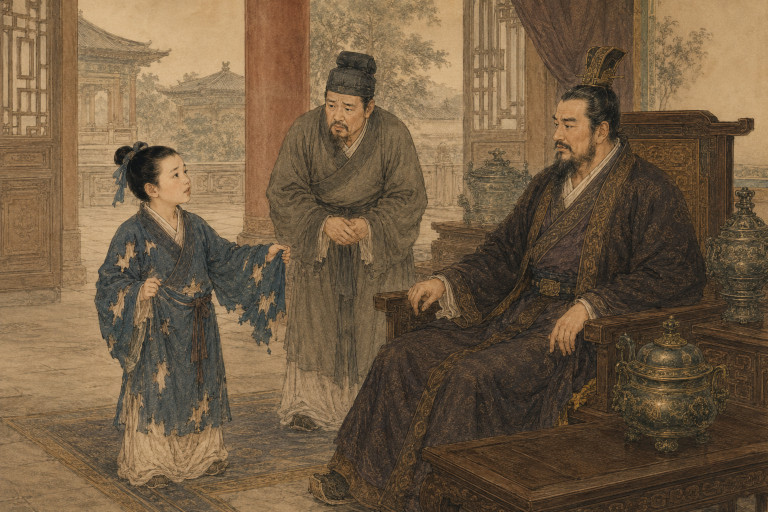
Cao Cao reassured him that such beliefs were nonsense and told him not to be concerned.
Not long afterward, the warehouse official came to report that rats had damaged Cao Cao’s saddle.
Instead of becoming angry, Cao Cao laughed.
“Even Chong’s clothing, which was kept close at hand, was bitten by rats,” he said. “How much more easily could they have damaged a saddle hanging on a post?”
The official escaped punishment.
Historical records say that Cao Chong used his intelligence in similar ways to save servants, soldiers, and attendants from punishment on many occasions. Although he was still very young, he earned not only his father’s affection but also the respect of those around him.
Cao Cao openly expressed his fondness for Cao Chong and indicated that he had considered making him his successor.
But Cao Chong fell ill and died at only thirteen years old.
Cao Zhi: Brilliant talent without enough discipline
Cao Zhi, Cao Cao’s third son, became one of the most celebrated writers of the Jian’an era.
From childhood, he showed an extraordinary love of literature. While still in his teens, he read and memorized an enormous body of poetry, essays, and classical writings, and he was said to express himself eloquently in both speech and writing.
According to a famous traditional account, his elder brother Cao Pi once ordered Cao Zhi to compose a poem before taking seven steps, with severe punishment awaiting him if he failed. Cao Zhi responded with a poem about beans boiling in a pot while the beanstalks from the same plant burned beneath them as fuel. The beans lament that they and the stalks grew from the same root, asking why one should be so eager to torment the other.
The metaphor was unmistakable: Cao Zhi was appealing to his brother not to turn against his own family. The story became known as the “Seven-Step Poem” and stands as a celebrated example of Cao Zhi’s remarkably quick literary talent.
These literary gifts set him apart from his brothers, and Cao Cao admired him greatly. More than once, he considered making Cao Zhi his successor.
But talent alone was not enough.
Historical accounts describe Cao Zhi as undisciplined and impulsive. He repeatedly violated rules, acted according to his own wishes, and drank without restraint.
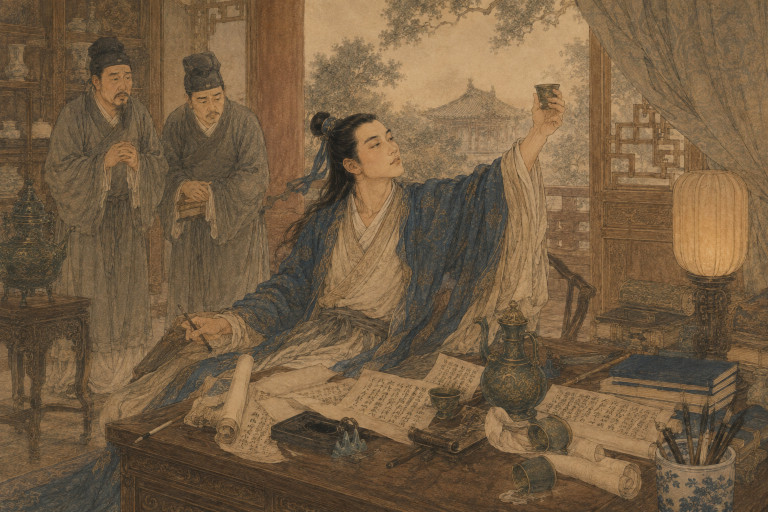
Such faults might be overlooked more easily in a poet or artist. In a ruler, however, a lack of self-discipline could have serious consequences.
Cao Cao eventually concluded that, despite his son’s remarkable gifts, Cao Zhi was not suited to inherit the responsibility of governing.
Recognizing talent requires more than admiring brilliance. It also means understanding where that brilliance can — and cannot — be put to good use.
Cao Pi: Better suited to governing
Cao Pi has often been remembered harshly.
He accepted the abdication of Emperor Xian of Han and established the state of Wei, ending the Eastern Han Dynasty. His reputation was further darkened by his role in the famous Seven-Step Poem story. Together, these events have contributed to an enduring image of Cao Pi as cold, severe, and ruthless.
Yet historical accounts present a more complicated figure.
In Records of the Three Kingdoms, historian Chen Shou praised Cao Pi’s natural literary ability, learning, memory, and wide range of talents. At the same time, Chen Shou suggested that Cao Pi might have approached the great rulers of antiquity had he possessed greater magnanimity and virtue.
Cao Pi was himself an accomplished writer and literary critic. Together with Cao Cao and Cao Zhi, he became known as one of the “Three Caos,” although Cao Zhi’s exceptional poetic reputation often overshadowed his brother’s literary achievements.
As a military commander, Cao Pi was less successful than his father. He personally led three campaigns against Eastern Wu without achieving a decisive victory.
His greater strengths appeared in administration.
After becoming emperor, Cao Pi reorganized parts of the central government and shifted important responsibilities for drafting imperial documents to officials in the Secretariat. He also sought to prevent members of the imperial household and the empress’s family from interfering in government.
He established and implemented the Nine-Rank System to evaluate and select officials, giving the central government greater control over appointments.
Together, these measures helped consolidate the rule of the newly established Wei state.
Cao Pi also made significant contributions to literature.
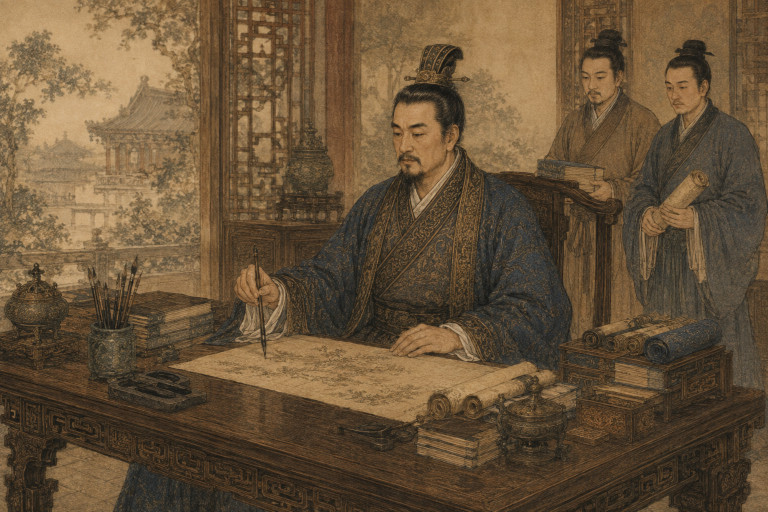
In A.D. 224, he restored the Imperial Academy and promoted the study of the classics. His own writings on literature also became influential.
In his “Discourse on Literature,” Cao Pi wrote that writing was “a great undertaking in governing a nation and an immortal achievement.”
He argued that literature had value beyond immediate political usefulness. Writers could preserve their ideas in their works and pass their names and thoughts to later generations without depending entirely on historians or powerful patrons.
By treating literature as a serious pursuit worthy of recognition in its own right, Cao Pi helped give literary writing a more prominent place in Chinese intellectual life.
The wisdom of recognizing the right person
Cao Chong possessed remarkable intelligence joined with compassion, but his life ended before he could fulfill the hopes placed upon him.
Cao Zhi possessed extraordinary literary genius, but his impulsiveness and lack of discipline made Cao Cao doubt whether he was suited to rule.
Cao Pi was neither the most beloved nor the most dazzling of Cao Cao’s sons. Yet when it came to the practical demands of governing, Cao Cao ultimately judged him to be the better choice.
Cao Pi may not have been an ideal brother, and he certainly had his shortcomings as a ruler. But Cao Cao’s decision illustrates an important principle: recognizing talent is not simply about identifying who is most gifted.
Different responsibilities require different qualities.
True wisdom lies in seeing a person’s strengths clearly — and knowing where those strengths can best be used.
Translated by Katy Liu
Follow us on X, Facebook, or Pinterest
