
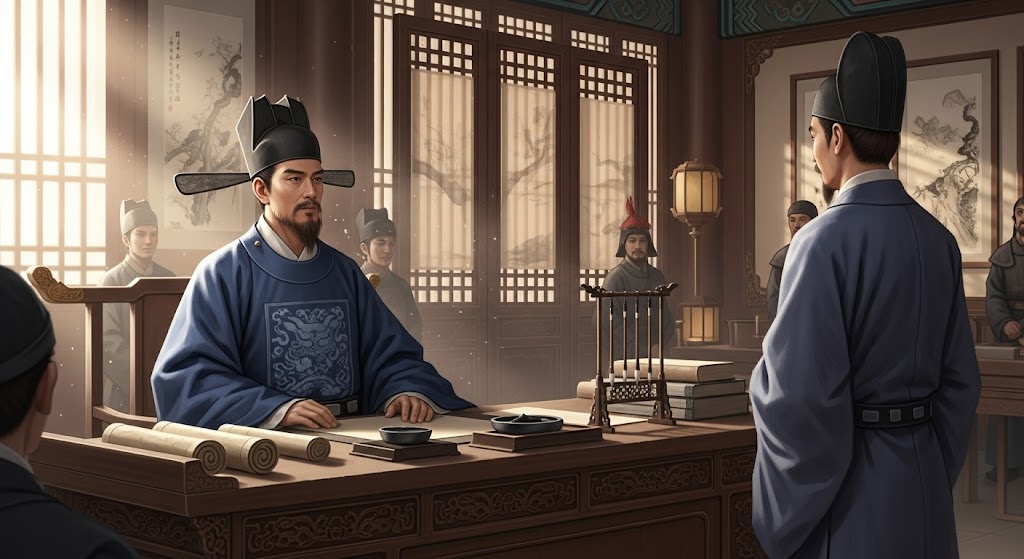
In the Song Dynasty government, Qian Ruoshui was highly regarded as an honest official and a capable minister. Ruoshui was intelligent and insightful from a young age and could write essays by the age of 10. Upon meeting Ruoshui, the hermit Chen Tuo of Mount Hua foretold: “Your mind is clear, so you could pursue studying the Tao; equally, you could achieve wealth and nobility, but be careful not to do so too quickly.” He was implying that Qian was someone endowed with a solid foundation for cultivating the Tao.
Open and covert investigations avert a family’s demise
During the Yongxi reign of Emperor Taizong of the Song dynasty, Qian Ruoshui passed the imperial examination and was appointed Tongzhou Supervisory Magistrate. The historical records from the History of the Song Dynasty describe Qian as being “clear-minded, a discerning listener and fair in his judgment.” As a result, the county government relied on him and always praised his clear and fair judgments, making him a pillar of the state and county government.
The following examines a real-life case study that illustrates how Qian solved a mystery without relying on witnesses or physical evidence. He ultimately resolved it and, in the process, saved several lives by averting the annihilation of an entire family. And after the truth was revealed, he humbly declined any credit for it.

A thorough investigation avoids a death sentence
During Qian’s service as magistrate of Tongzhou, he found the governor to be impulsive and biased, often rushing to handle cases based on his own subjective judgments, which led to unfair and inappropriate outcomes. Qian tried to dissuade him, but in most cases, after frequent arguments, he was unable to change the governor’s decisions. He often said to his colleagues, “I’m just here to atone for my sins!” As he expected, those erroneous decisions by the governor were often overturned by the court or higher authorities. Although the governor felt guilty afterwards and expressed regret, he continued to repeat his ways; a recurring pattern.
Once, a young maidservant from a wealthy family went missing, and the family was unable to locate her. The young girl’s parents went to the county government to file a complaint. The governor ordered the clerk (equivalent to a secretary) in charge of the case to investigate and adjudicate. However, this clerk had previously borrowed money from the wealthy family without success, harbouring a grudge; he falsely accused the family’s father and son of conspiring to murder the maidservant and disposing of her body in the water. Since the body could not be found, some individuals in the case were treated as masterminds, while others were considered accomplices, facing severe charges and the death penalty.
Under torture, the wealthy father and son could not withstand the beatings and confessed to the crime. A missing person’s case thus became a criminal case, with complete written records submitted to the governor. During the review, no one retracted their confession, and everyone believed the case to be valid, except for Qian, who remained sceptical. He delayed closing the case, leaving it unresolved for several days.
Upon learning of this, the clerk stormed into Qian’s office, angrily accusing him: “Did you take money from the wealthy family, hoping to let them escape the death penalty?” Qian merely smiled and said, “Now several people may be sentenced to death; isn’t it worth delaying the case for a few days to thoroughly examine the facts?”
Qian left the case unresolved for nearly ten days. The governor repeatedly urged him to conclude the case, but he remained inactive, which puzzled everyone. Suddenly, one day, Qian privately visited the governor’s residence, asked those around to leave, and quietly said, “The reason I have not concluded the case is that I secretly sent people to search for the maidservant’s whereabouts, and I have found her.”
The governor was greatly astonished and asked, “Where is she?” Qian immediately brought the maidservant to the governor’s residence. The governor had her hide behind a curtain and called for her parents. From behind the curtain, the governor asked, “Do you recognize your daughter now that you hear her?” The couple replied, “How could we not recognize her? She is our daughter!” The governor then brought the maidservant out from behind the curtain for them to identify, and upon seeing her, the parents burst into tears, exclaiming, “It’s her!”

Refuting any claims to fame and gain
The maidservant was found, and the governor ordered the release of the falsely accused wealthy father and son. After their release, they refused to leave, crying out, “If it weren’t for your grace, we would have been annihilated!” The governor said, “You should thank the magistrate Qian Ruoshui, not me.” The wealthy family immediately rushed to find Qian to thank him in person, but he closed the door and did not let them in, saying, “The governor discovered this!” Unable to enter, the wealthy father and son circled the wall, crying, grateful for Qian’s kindness, and even dispersed their wealth to invite monks to pray for blessings.
The governor greatly admired Qian for clearing the names of the innocent and saving several lives, intending to report to the court to commend him. However, Qian firmly declined, saying, “I only seek to ensure justice in the legal system and uphold the hearts of the people, not to let the innocent die unjustly; seeking credit is not my intention. Moreover, if the court truly commends me, then what will happen to the clerk?” The governor sighed, saying, “Your honesty, sincerity, and sense of justice are truly rare in this world!”
Later, the clerk personally visited Qian, expressing his remorse and bowing to apologize. Qian Ruoshui replied, “The truth of the case is difficult to know. You only made a mistake. Why apologize?” From then on, he was respected far and wide, and everyone praised Qian.
Not long after, Emperor Taizong of Song heard of this matter and immediately promoted Qian. Within two years, he was elevated from a staff position to the post of Chief Draftsman (in charge of drafting edicts). In the following five years, he was promoted to Deputy Minister of the Privy Council (a position with significant military and political power). Qian was tasked with compiling the Veritable Records of Taizong. He enlisted the assistance of four colleagues to complete the records, which comprised a total of 80 volumes. This achievement moved Emperor Zhenzong to tears as he read the completed volumes. Later, he was also ordered to revise the Veritable Records of Taizu, where his integrity, combined with his historical writing, produced outstanding results.
Epilogue
Qian Ruoshui’s uprightness, keen insight, and charitable heart are lauded by the world. What is even more commendable is that he did not claim credit or accept rewards, thus embodying the true spirit of a scholar and official. All admire his legacy.
Translated by Joseph Wu and edited by Maria
Follow us on X, Facebook, or Pinterest
