

Japan’s defeat to Belgium at the World Cup — a 2-3 loss — was accompanied by an unexpected victory: global admiration. As Japanese fans tearfully cleaned the stands and players left their locker room impeccably clean with a thank-you note, the world asked: Why?
To answer this, “Boya Primary School” invited “Hua Ma,” a mother who has lived in Japan for years, to share her observations on the roots of this profound culture.
Hua Ma, whose two daughters attend a local public elementary school, believes these actions are not extraordinary efforts, but the natural overflow of ingrained habits. They are rooted in the small, consistent details of daily education. For the Japanese team and fans, this behavior came naturally, regardless of whether they won, lost, or drew.
This led to the central question: Why does this come so naturally to the Japanese? How does Japan teach children consideration, care, and gratitude toward others?
These questions aren’t easy to answer. Hua Ma attempted to shed light on them by sharing a few minor incidents that illustrate the subtle, pervasive influence of Japanese elementary education as experienced by a mother.

Consideration in practice
Once during an autumn outing, my eldest daughter forgot her water bottle. I rushed to school to bring it to her. Though the official arrival time had passed, the principal, in his crisp suit, was still standing at the entrance, greeting everyone.
As I was leaving, a late child approached. The principal greeted him warmly with: “Good morning! Keep up the good work!”
For a child arriving late for whatever reason, hearing encouragement is far more considerate than being scolded with: “Hurry up! You’re late!” Children who are treated with consideration will, in turn, treat others with respect.
Nurturing care
My daughter’s elementary school publishes a monthly newsletter. One issue featured an “Extra Edition” on its front page: “The swallows have returned this year!”
The letter described how swallows had built a nest and were raising their young at the central gate. The parent swallows circled the school grounds, catching insects and taking turns to bring food back to the nest. The school noted that even when the parents flew into a classroom, the children smiled, witnessing the nurturing and growth of animal parenthood.
The school actively guided the children in protecting themselves and in teaching mutual care among themselves. My daughter reported that they now have three swallow nests at school this year.
The practice of gratitude
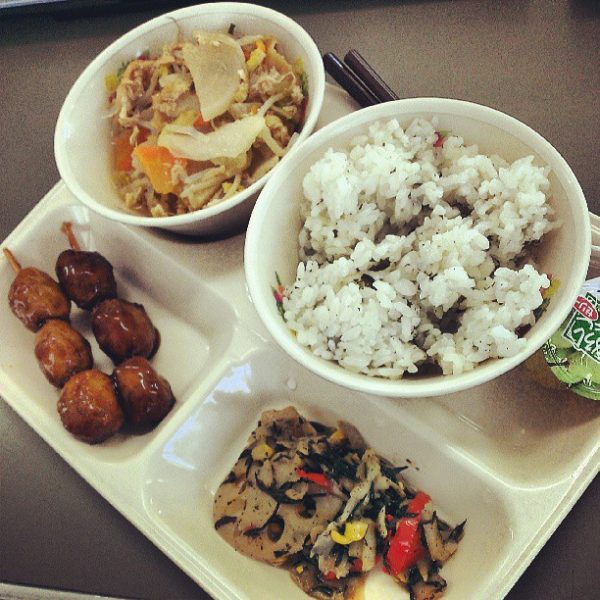
Every year, the school hosts a parent-child meal for first-graders. Students and parents gather to learn table manners and knowledge about nutrition before enjoying the school lunch together.
The tableware used — a pair of wooden chopsticks, a porcelain rice bowl, a porcelain soup bowl, and a porcelain plate — was surprisingly expensive. The nutritionist teacher explained: “We once used unbreakable plastic bowls, but later switched to quality porcelain. Precisely because it can break, we teach children to learn gratitude and cherish valuable items.”
At lunchtime, all the children waited until everyone was seated. Only after everyone said together “Itadakimasu” did they begin. This customary phrase expresses gratitude for the food itself and for those who provided and prepared it. Human life is built upon the foundation of other lives, and each meal contains the life of ingredients and the dedication of growers and cooks — all deserving of gratitude.
Appreciation for what we have
I regularly receive letters from the school counselor to parents. One contained a powerful passage based on an analogy:
“When we open the refrigerator, do we focus on what’s inside, or on what’s missing? If we approach it with curiosity about what we might find and use it to cook, we’ll feel grateful: ‘Ah, I still have this ingredient to work with!’ But if we only see what’s absent, gratitude won’t arise.”
The same applies to children. The school recommends: “First, look at what they possess within themselves. Encourage what they have, motivate them to utilize their own resources, and only then consider what else is needed.”
This perspective is a powerful lesson for parenting. If we first look at what our child has — their existing strengths and qualities — instead of immediately rushing to fill perceived “lacks” or “inadequacies,” contentment and happiness for both parent and child become easier to attain.
Valuing effort over scores
At the end of each semester, children bring home a formal, comprehensive evaluation form. The most extensive section, covering “academic subjects,” is rated at three levels: “Excellent,” “Achieved,” and “Almost There.”
My child explained the teacher’s criteria:
- “Achieved” means made the effort to reach the expected level of effort.
- “Excellent” means going beyond the required effort to achieve excellence.
- “Almost There” signifies that with a little more effort, it would be even better.
Although there are many exams, scores are not recorded on the comprehensive evaluation form. The children are taught that the most important thing is the effort they put in. A heart that strives for excellence, for both self and others, is truly worth protecting.
The simple acts witnessed on the global stage — the clean locker room and tidied stands — are not isolated moments of exceptional virtue. They are the natural overflow of this quiet, daily education. From a principal’s encouraging greeting and a swallow’s nest to a breakable porcelain bowl, these details weave a deep, reciprocal culture of consideration, care, and respect that, ultimately, defines a national character.
Translated by Eva and edited by Helen London
Follow us on X, Facebook, or Pinterest
