
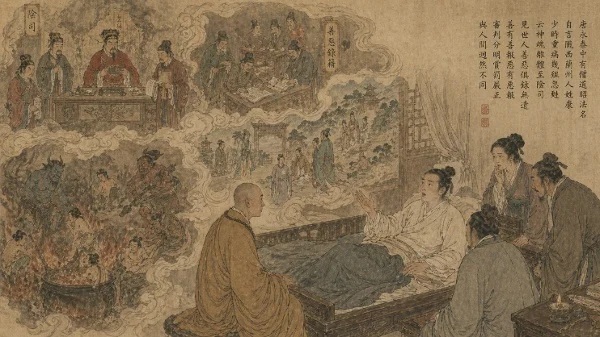
During the Yongtai era of the Tang Dynasty (765-766), there was a monk named Daozhao. He claimed to be from Lanzhou in Longxi, and his lay surname was Kang.
When he was young, Daozhao once fell gravely ill. His condition was nearly beyond remedy; he was on the verge of death, and his family believed he was certain to die. Just as he hung between life and death, he suddenly regained consciousness. His expression changed dramatically as he recounted that, while unconscious, his spirit had left his body and been taken to the underworld.
A life-altering experience
Daozhao recounted that in the underworld, he had witnessed firsthand the good and evil deeds committed by people in the mortal world. Whether great or small, every single act was recorded without the slightest error. Those who do good will surely receive blessings in the future; those who do evil will surely face retribution — not a single one can escape. Judgment in the underworld is clear and just, with rewards and punishments administered strictly — a stark contrast to the ambiguity of the mortal world.
Daozhao also said that in the underworld, he saw many deceased people; some were suffering, while others were at peace, all as a result of their actions in life. Precisely because of this, he was deeply shaken and felt profound remorse. Upon waking, he resolved to renounce worldly life, enter the monastic order, and practice the Way, seeking to avoid falling into the evil realms in his next life.
Thus, Daozhao shaved his head to become a monk, withdrew from the world, and lived in seclusion in the Taihang Mountains, leading an extremely austere life. He observed the precepts with the utmost strictness, shunned material wealth, and avoided women. He recited sutras and practiced meditation every day, without ceasing through heat and cold, remaining there for forty years.
During his long years of practice, Daozhao gradually began to display abilities beyond those of ordinary people. He could often foretell the future of certain individuals — whether auspicious or inauspicious — and later, these predictions came true one by one, without the slightest error. As a result, the people in the vicinity viewed him with awe and respect, and some even came from afar, drawn by his reputation, to seek his counsel regarding their fortunes and misfortunes.
Foretelling the destiny of two men
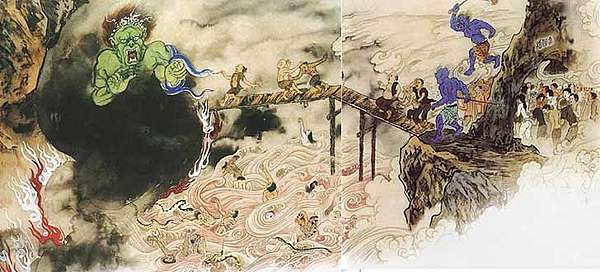
One day, two guests came to visit together. One was named Yao Miao, a man who had passed the “Mingjing” examination; the other was surnamed Zhang, an official who had entered the civil service through his family’s hereditary privilege (though his first name is no longer remembered).
Daozhao said to Mr. Zhang: “You will hold official posts in the future and serve in several regions, but you must remember this: under no circumstances should you accept a salary from Fan Yang. On the eighth day of the fourth month, you will fall ill, and there will be no cure.”
Daozhao then said to Yao Miao: “You are not suited for a career in the civil service. If you switch to a military career, you will enjoy thirty years of financial security. Furthermore, if you fall ill, under no circumstances should you allow a foreigner to treat you.”
That year, Zhang was assigned to serve as an official in the Xiang and Deng regions. Afterward, he participated in official selection processes multiple times, each time deliberately requesting a posting in the south, and his wishes were granted every time. It seemed he had truly avoided “Fan Yang.”
However, when he was selected again later, he was sent to serve as magistrate of Lu County in Guo Prefecture. He had been in office for only two days when he suddenly passed away. That day happened to be the eighth day of the fourth month. It was only then that those around him realized: “Fan Yang” was, in fact, the ancestral seat of the Lu and Zhang clans — he had not escaped it after all.
As for Yao Miao, after failing the imperial examinations, he sought refuge with an acquaintance in Rongzhou, where he held a nominal military post. He remained there for 30 years, gradually rising through the ranks, and indeed lived a life free from want.
Later, when he remarried and needed help organizing the wedding, he fell ill. He asked an elderly woman surnamed Yan to prescribe medicine for him, but after taking it, his condition worsened, and he eventually passed away. Afterward, someone investigated the background of a woman named Yan and discovered that she was actually a maidservant released by the former master — in fact, she was of non-Han ethnicity.
Daozhao continued to live in the mountains, detached from worldly affairs. As the years passed, though his reputation spread far and wide, he maintained a simple life and never allowed his fame to alter his spiritual practice. For him, cultivation and observing the precepts were the most important things.
Good and evil are rewarded in kind
Daozhao’s deeds were recorded and passed down through the ages. When people read these accounts, they are often jolted into the realization that there is no inherent justice in the world; retribution may come early or late, but it never fails to arrive.
Though the consequences of good and evil may not manifest immediately, they follow one like a shadow and will eventually come to pass. Rather than clinging to false hope, it is better to be cautious in speech and conduct in daily life and to do more good deeds; this is the true path to accumulating blessings for oneself.
Translated by Audrey Wang and edited by Tatiana Denning
Follow us on X, Facebook, or Pinterest
