
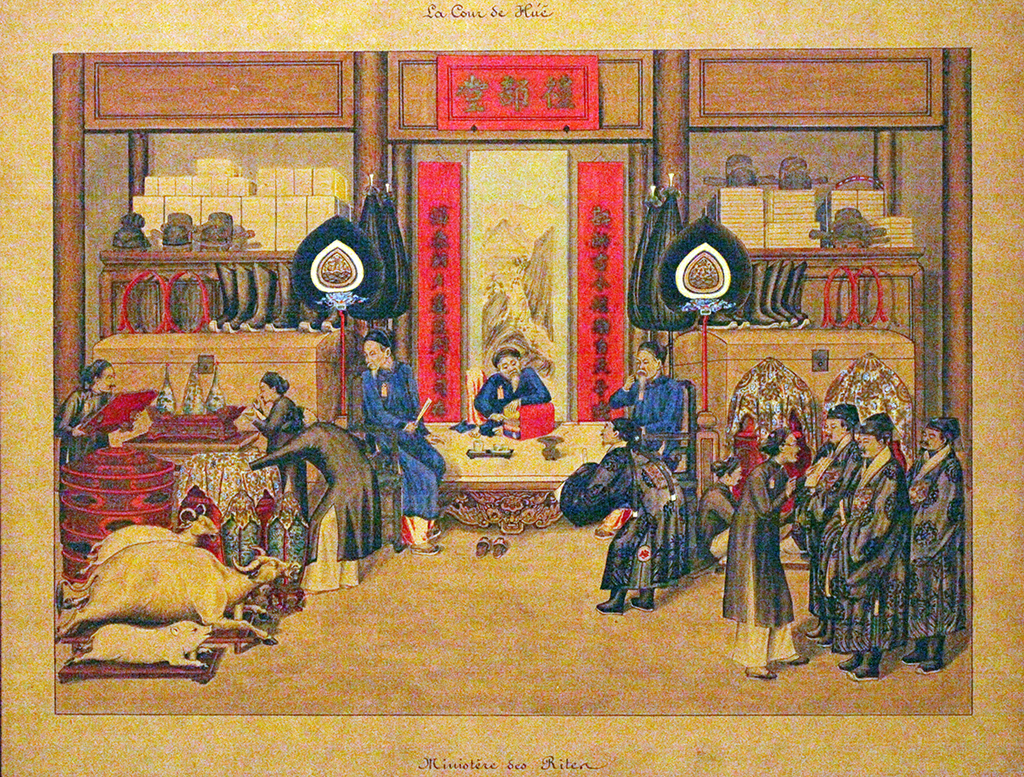
In the 23rd year of the Daoguang reign (A.D. 1844), Yang Mai arrived at the Ministry of Rites in the capital to assume his new post. He had once been the governor of Zhejiang, and now served as a deputy director — a significant demotion. Having navigated the bureaucratic landscape for two decades, Yang Mai was skilled in divining fate through physiognomy. He had studied under a reclusive master for several years, gaining insight into reading faces that earned him a reputation across the Jiangnan region.
Upon his arrival, colleagues pressed him: “Mr. Yang, you are so skilled — might you read our fortunes?” Yang Mai replied: “I am too old for that now. I stopped long ago.” At that moment, Grand Master Liang approached and said: “Brother Yang, did you not read your own fortune before the incident in Zhejiang?”
Yang Mai sighed: “At the time, I truly saw no sign of impending doom. My complexion was rosy, and my forehead showed no dark lines. How could I have imagined demotion?” MasterLiang laughed heartily: “Brother Yang, your physiognomy is remarkably accurate!”
Yang Mai looked perplexed. Liang spoke slowly. “Consider the burden of the jade seal, Brother Yang. In Zhejiang, your brow was a map of droughts, tax levies, and coastal defenses. You were worn like a spinning top because you were carrying the misfortunes of many lives upon your own shoulders. Your ‘dark lines’ were not your own — they belonged to the office.
Today, your face is clear and your complexion rosy, not because you have fallen, but because you have finally laid down the world to find yourself. This ‘demotion’ is Heaven’s way of returning your years to you. Your physiognomy is accurate; it shows a man who has finally found peace.”
Yang Mai stared in astonishment, eventually bowing his hands: “Brother Liang, your words strike the heart! I see now — face reading isn’t fixed. When a person’s state of mind changes, their appearance changes; when their actions change, their fate follows.”
Kong Zhaoqian, listening nearby, interjected: “I’ve heard of appearance changing with the heart, but what does ‘fate is shaped by one’s actions’ mean?” Yang Mai then recounted the story of Li Wei.
Li Wei’s encounter with immortals
Before his rise to power, Li Wei crossed a river with a Taoist priest of ethereal appearance. When a passenger argued fiercely with the boatman over a few coins, the Taoist sighed: “Life hangs by a thread — why quibble over trifles?” Moments later, a sudden gust of wind struck the yardarm, which swung, hitting the passenger, who vanished into the river.
As a violent storm threatened to capsize the boat, the Taoist stepped to the bow, performed the Yu Step, and chanted incantations until the waves subsided. Li Wei knelt in gratitude, but the Taoist waved him off. “That man’s fate was sealed; I could not save him. You, however, are destined for greatness. I merely lent a hand.”
Overwhelmed with emotion, Li Wei declared that he would dedicate his life to following the teachings of the Taoists. The Taoist shook his head. “Accepting fate depends on what fate you face. One must indeed accept personal fortune and misfortune — otherwise, striving against it only harms oneself. Take corrupt officials like Li Linfu and Qin Hui, for example, their destinies promised wealth and power, yet they chose evil, leaving a stench that will last for ages.”
The profound truth of the Great Way lies in simplicity
Then the Taoist master added a phrase that would guide Li Wei for the rest of his life: “When it comes to the welfare of the nation and its people, fate must never be invoked! Heaven and Earth produce talents, and the court establishes officials precisely to compensate for Heaven and Earth’s shortcomings and alleviate the suffering of the masses. If you hold a position of power yet stand idly by, blaming everything on fate, why did Heaven grant you talent? Why did the court bestow you with office? Remember this truth well!” The room fell silent as every official pondered the profound meaning of these words.
Yang Mai continued: “Another story illustrates this point even more clearly. In Shandong, a governor named Guo Tai once summoned a spirit to write down his lifespan. The spirit wrote only two words: “I know not.”
Guo Tai was confused: “Are spirits not all-knowing?” The spirit replied: “I know the lifespan of others, but yours I do not. Mortals have a fixed lifespan because they concern themselves only with their own affairs. But high officials are different. When a righteous decree benefits many, your lifespan increases; when an evil policy causes suffering, it diminishes. Even the gods cannot predetermine your end — your destiny lies within your own conscience!”
Yang Mai declared, “For us officials, fate is never fixed. Good deeds make destiny brighter; injustice makes it darker. What need is there for physiognomy?” Lord Liang agreed: “When the heart is upright, fate naturally flows smoothly!”
Yang Mai finally understood his own demotion. In Zhejiang, while he had committed no crimes, he had accomplished nothing significant for the people. Heaven had moved him to a minor post to grant him an opportunity for reflection. He channeled his energy into becoming a diligent official. Years later, when promoted to Vice Minister, his countenance had grown more benevolent and dignified than ever before.

Afterword
Adapted from Liang Gongyu’s Records from the North-East Garden, written in the Qing Dynasty, this tale teaches us that Heaven’s secrets are not hard to decipher — a righteous heart brings a good appearance, and profound virtue ensures a prosperous destiny.
Those who exhaust themselves in fortune-telling and divination would do better to focus on accumulating virtue through good deeds. Though Yang Mai experienced the vicissitudes of officialdom, he ultimately gained enlightenment — perhaps embodying the ancient wisdom: “When an old man loses his horse, who can say it is not a blessing?”
Translated by Audrey Wang and edited by Helen London
Follow us on X, Facebook, or Pinterest
